
Structured Cabling Installation Brisbane: The 2026 Network Engineering Guide
Your high-speed WiFi is only as reliable as the physical backbone hidden inside your walls. While wireless technology grabs the headlines, the reality of 2026 connectivity is that airwaves are crowded, and physical copper remains king for stability. If you've ever dealt with a frozen Zoom screen or a lagging gaming session, you know that even the fastest NBN plan fails without the right infrastructure. A professional structured cabling installation Brisbane property owners can rely on isn't just about pulling wires; it's about engineering a robust system that treats data as a critical utility.
We understand the frustration of messy "cowboy" setups and the confusion surrounding Cat6 versus Cat6A or fibre. You want a network that works every time you plug in, without cables draped across your skirting boards. This guide promises to demystify your options and show you how a meticulously calibrated system future-proofs your home or office for the next decade. We will explore the technical requirements of AS/CA S009:2020 wiring rules, the transition to Cat6A as the new baseline for Wi-Fi 7, and why a "set and forget" approach adds genuine value to your property. By focusing on precision and concealment, we ensure your connectivity is seamless, compliant, and ready for whatever the digital world throws at it next.
Key Takeaways
- Understand why modern Brisbane builds and classic Queenslanders need a physical backbone if you don't want signal interference.
- Learn why Cat6A is the essential baseline for a 2026 structured cabling installation Brisbane project to support 10Gbps speeds and Wi-Fi 7 hardware.
- Discover how hardwiring your critical devices slashes latency for gaming and trading while providing a level of physical security wireless cannot match.
- Navigate the legal requirements of ACMA-accredited cabling so you don't risk fines or voided insurance policies.
- See how a meticulous engineering approach ensures all hardware is concealed and cables are organised for a clean, professional property finish.
Why Your Brisbane Property Needs Structured Cabling in 2026
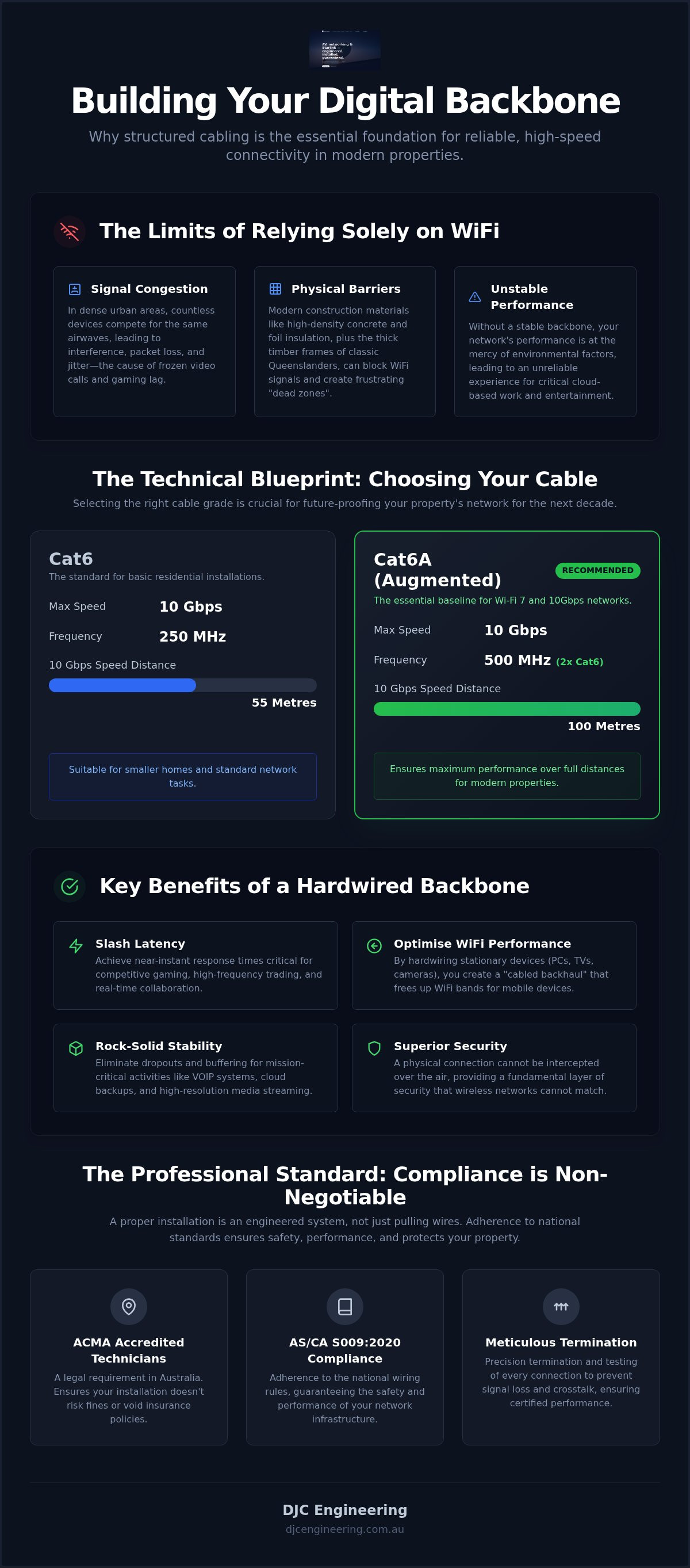
Wireless is a shared medium, and in 2026, the sheer density of devices in Brisbane inner-city hubs makes the airwaves incredibly crowded. Relying solely on wireless leads to packet loss and jitter, which are technical terms for your video calls dropping out or your gaming sessions lagging. A professional structured cabling installation Brisbane property owners invest in treats data as a critical utility, providing a dedicated highway for high-bandwidth traffic. This is no longer a luxury for smart homes running 8K streams and AI-driven security; it's a foundational requirement for any stable digital environment. For local businesses, the stakes are even higher. Cloud-based operations and VOIP systems demand near-zero latency to function correctly. Without a physical backbone, your productivity is at the mercy of environmental interference and network congestion.
Overcoming Signal Interference in South East Queensland
Modern architecture in Newstead and the CBD often utilises high-density concrete and foil-backed insulation. These materials inadvertently create Faraday cages that block wireless signals, preventing them from moving between rooms. Similarly, the sprawling, multi-storey layouts of classic Queenslanders often leave mesh systems struggling to penetrate thick timber frames and floorboards. Structured cabling bypasses physical interference by providing a direct, shielded path for data. Adhering to international structured cabling standards ensures your network remains robust, regardless of whether you are in a high-rise apartment or a renovated heritage home. This physical path eliminates the "dead zones" that plague even the most expensive wireless routers.
The Shift from "WiFi First" to "Cabled Backhaul"
To achieve peak performance from your wireless access points, they require a "wired backhaul." This technical setup involves hardwiring the access point directly to your central switch rather than letting it communicate wirelessly with other nodes. By offloading static devices like televisions, desktop PCs, and security hubs onto Cat6A cabling, you free up the 5GHz and 6GHz bands for mobile devices that actually need them. This strategic distribution of traffic ensures your home office and security monitoring remain perfectly stable during peak usage times. A meticulous structured cabling installation Brisbane service ensures that these connections are concealed and engineered for maximum throughput, providing a "set and forget" solution that supports your property's connectivity for years to come.
The Technical Blueprint: Cat6, Cat6A, and Fibre Optic Standards
A successful structured cabling installation Brisbane project isn't just about running any old wire through a wall. It requires a strategic selection of materials that match your property's throughput demands for the next decade. In 2026, the distinction between cable grades is the difference between a network that bottlenecks and one that breathes. We focus on the mechanical integrity of the link, ensuring that the physical medium supports the full speed of your hardware without interference or signal degradation.
Cat6 remains the workhorse for basic residential tasks, but it has distinct limitations. While it supports 10Gbps, it only maintains that speed over distances up to 55 metres. For modern Brisbane properties, Cat6A (Augmented) is the superior choice. It operates at a frequency of 500MHz, which is double that of standard Cat6. This extra headroom is vital for Wi-Fi 7 access points and high-resolution media servers, as it maintains 10Gbps speeds over the full 100-metre channel length. Beyond the copper itself, we must consider shielding. Electrical "noise" from nearby power lines can corrupt data packets, so we use shielded cables in high-density areas to keep your connection clean.
Even the highest grade of copper is useless if the termination is sloppy. Poor "crimping" or excessive untwisting of the pairs at the jack creates crosstalk and signal loss. We adhere to strict national training standards for cablers to ensure every termination is verified and certified. This meticulous attention to detail ensures your network performs exactly as the engineering specs intend.
Choosing the Right Cable Grade for Your Brisbane Project
- Cat6: The standard for basic residential data points, smart TVs, and printers.
- Cat6A: The 2026 gold standard. This is the minimum required for high-end gaming, 8K streaming, and future-proofing your home office.
- Fibre Optics: We use glass for residential uplinks between separate buildings, such as a studio or granny flat, and as the backbone for commercial network cabling Gold Coast projects where speed and distance are non-negotiable.
Data Hubs and Professional Server Rack Management
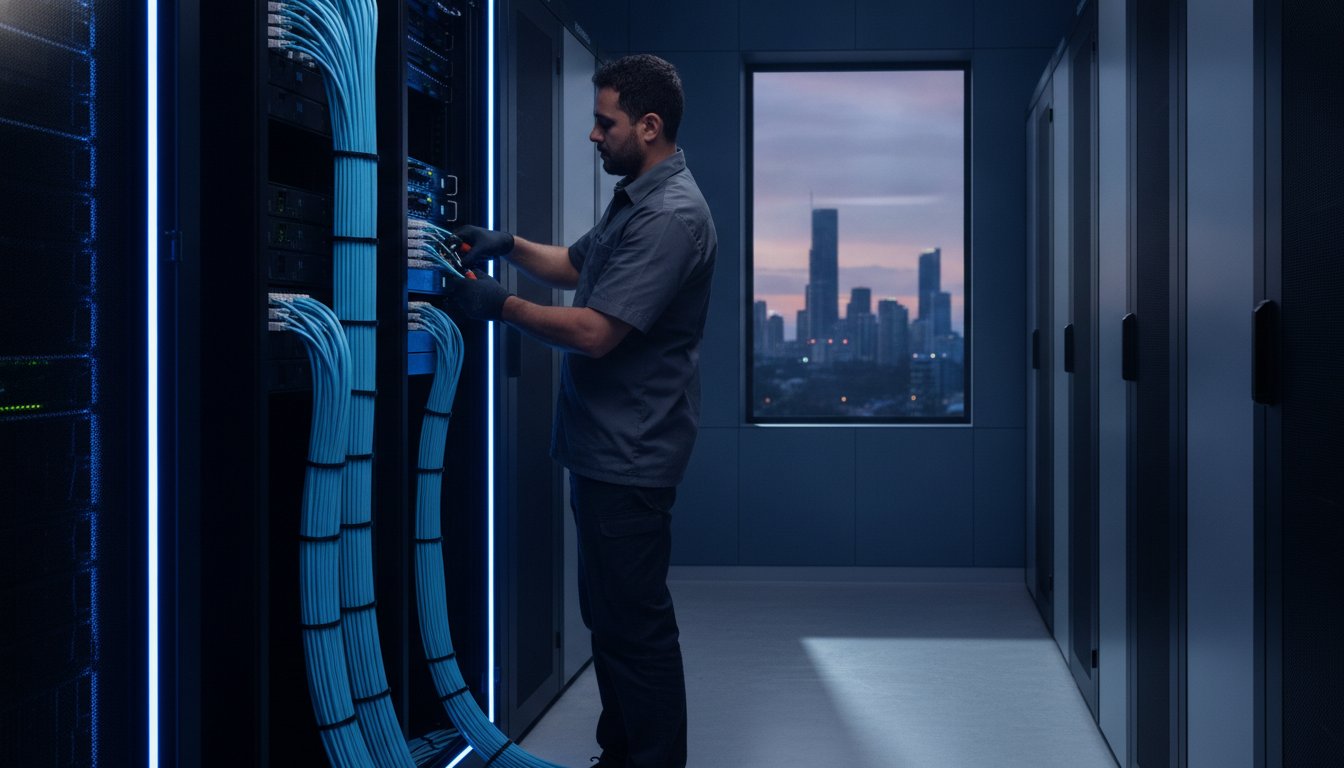
Think of the data hub as the central nervous system of your property. This is where your NBN or Starlink modem meets your switches and patch panels. A professional rack setup isn't just about aesthetics; it's about thermal management and reliability. Neat, organised cabling prevents heat buildup, which extends the life of your expensive networking hardware. Meticulous cable management also ensures that if you ever need to upgrade or troubleshoot, the process is straightforward rather than a "spaghetti" nightmare. Investing in a professionally engineered network backbone means your infrastructure remains robust, accessible, and ready for future technology shifts.
Hardwired vs Wireless: The Secret to Perfect WiFi Performance
Wireless performance is an illusion without a wired anchor. While the convenience of mobility is undeniable, the physics of radio waves means they're prone to interference, congestion, and packet loss. For Brisbane gamers, financial traders, and remote professionals, raw download speed is often a vanity metric; "ping" or latency is the only number that truly matters. A structured cabling installation Brisbane project eliminates the unpredictable "jitter" of wireless signals by providing a dedicated, interference-free path for your data. This engineered stability ends the frustrating cycle of rebooting your router every time the network chokes under load. Beyond performance, physical security is a major factor. Wireless signals are inherently broadcast beyond your walls, whereas a hardwired port provides a closed loop that is significantly harder to intercept or exploit.
Eliminating Lag for Gaming, VoIP, and Security
High-priority traffic needs a dedicated lane to function without interruption. When your gaming console, work-from-home laptop, and security hub are all fighting for the same wireless bandwidth, performance collapses. We integrate cabling as a core component of professional WiFi design, offloading static devices to copper to keep the airwaves clear for your phones and tablets. This is especially critical for security. Hardwiring your CCTV cameras is non-negotiable if you require reliable, 24/7 high-definition recording without the dropouts common in wireless "smart" cameras. All our terminations follow the strict Australian cabling standards and regulations, ensuring your security system is both compliant and robust.
Future-Proofing for WiFi 7 and Beyond
The 2026 shift toward WiFi 7 has changed the requirements for home and office infrastructure. WiFi 7 access points are capable of speeds exceeding 5Gbps, which means the old Cat5e or standard Cat6 cables found in many Brisbane properties will act as a massive bottleneck. To actually reach these speeds, your access points require a 10Gbps wired backbone. Without this physical foundation, your expensive new router is essentially a Ferrari stuck in a school zone. By installing Cat6A or fibre backhaul now, you're preparing your property for the next decade of NBN and Starlink speed upgrades. We don't just pull cables; we engineer a system that ensures your wireless network actually delivers the speeds you're paying for, today and well into the 2030s.
Planning Your Installation: Compliance, Codes, and Capacity
Success in any structured cabling installation Brisbane project begins long before the first cable is pulled through a wall. It requires a meticulous assessment of your property's current layout and future capacity needs. We don't simply "drop" cables; we engineer a system that adheres to the AS/CA S009:2020 Wiring Rules. This standard dictates the mandatory separation of services, ensuring your data lines are physically distanced from 240V electrical mains. This isn't just a matter of performance; it's a safety requirement. Keeping these services separate prevents electromagnetic interference (EMI) from corrupting your data and, more importantly, eliminates the risk of high-voltage surges entering your networking equipment during a fault.
Capacity planning is equally vital. In a modern Brisbane home, a single data point in the lounge is no longer sufficient. We recommend at least two points per room to accommodate work-from-home desks, smart TVs, and gaming consoles. For new builds, the process is straightforward; however, retrofitting classic Queenslanders or multi-storey Newstead apartments requires a more creative approach to concealment. We specialise in identifying non-destructive paths through wall cavities and sub-floors to maintain the aesthetic integrity of your property while delivering a high-performance backbone.
Navigating ACMA Regulations and Licensing
It is a common misconception that data cabling is a DIY task. In Australia, it is a legal requirement under the Telecommunications Act that all customer cabling work be performed by a registered cabler. Operating without an Open Cabler Provider Licence isn't just a risk to your network performance; it's a liability. Unlicensed work can lead to individual fines starting at $6,670 and may void your building insurance in the event of a fire. Upon completion of every project, we provide a TCA1 compliance form. This document is your proof that the work meets all relevant Australian standards and was executed by a licensed professional.
Integrating Starlink and NBN Connectivity
Your internet entry point is the most critical link in your network. Whether you are using a fixed-line NBN connection or a satellite-based system, the signal needs to be distributed effectively to be useful. Professionally engineered structured cabling distributes a Starlink installation to every room in the house, ensuring you aren't tethered to the location of the satellite modem. We manage the delicate transition from external hardware to internal copper or fibre networks, ensuring the signal remains robust as it moves from your roof to your server rack. If you want a network that is both legal and high-performing, contact our licensed technicians for a professional assessment.
The DJC Engineering Standard: Meticulous Cabling for Brisbane
At DJC Engineering, we view a structured cabling installation Brisbane project as a precision task rather than a simple utility job. Our "No Shortcuts" philosophy means we prioritise the integrity of the signal and the longevity of the setup over mere speed of completion. We don't just pull wire; we engineer a physical pathway that meets rigorous standards. This methodical approach ensures that every component, from the patch panel to the wall jack, is calibrated for peak performance. Our workflow follows a disciplined progression that begins with a comprehensive site assessment, moves through precision execution, and concludes with a final phase of technical calibration. This structured process builds a level of accountability that generic service providers simply cannot match.
Aesthetic Integration and Neat Finish
We understand that while you want 2026-level connectivity, you don't want your property looking like a data centre. Our technicians specialise in meticulous concealment, utilising wall cavities, roof spaces, and sub-floor voids to hide the "invisible" infrastructure. We use high-quality, Australian-standard wall plates and clear, professional labelling to ensure the finish is as premium as the performance. By integrating your technical infrastructure into the existing architecture, we protect your interior design from the clutter of exposed wires or messy "cowboy" patches. We treat your property with the respect it deserves, ensuring all cables and hardware are hidden for a clean, professional finish that adds tangible value to your home or office.
Testing, Certification, and Commissioning
Verification is the final, non-negotiable step in our engineering process. We don't just "plug it in and hope" that the connection holds under load. Our technicians utilise advanced diagnostic testers to certify every cable run for both speed and electrical integrity. This involves measuring signal-to-noise ratios and ensuring that every link achieves its rated bandwidth without packet loss or attenuation. This level of certification provides peace of mind that your infrastructure can handle the demands of Wi-Fi 7 and high-definition security feeds. Upon handover, we provide a comprehensive roadmap of your network, ensuring you have a clear understanding of your property's digital backbone for any future expansions or upgrades. If you are ready for a network that is engineered for the next decade, contact DJC Engineering for a meticulous assessment of your Brisbane property.
Securing Your Brisbane Property's Connectivity
Your digital requirements will only grow as we move further into the decade. A professional structured cabling installation Brisbane project ensures that your property's backbone is ready for the high-speed demands of Wi-Fi 7 and beyond. By choosing Cat6A or fibre optics and adhering to strict ACMA standards, you eliminate the frustration of intermittent dropouts while protecting your property's long-term value. We've shown how meticulous concealment and rigorous testing transform a compromised "cowboy" setup into a robust, "set and forget" network.
Don't settle for a lagging wireless experience when precision-engineered networking is within reach. Our team of ACMA licensed technicians brings SE QLD local expertise to every project, ensuring your infrastructure is both compliant and aesthetically integrated. Taking the time to plan your network capacity now prevents costly retrofits in the future. It's about more than just wires; it's about building a reliable foundation for your home or business.
Book a Meticulous Site Assessment for Your Brisbane Property and secure a decade of seamless, high-speed connectivity. We're ready to help you engineer a better way to stay connected. Future-proof your infrastructure today.
Frequently Asked Questions
Is it illegal to install my own data cabling in Brisbane?
Yes, it is illegal for an unlicensed individual to install data cabling in Australia. All work must be performed by an ACMA-registered technician to comply with the Telecommunications Act. DIY attempts can lead to individual fines starting at $6,670 and may void your home insurance in the event of a fault. Professional structured cabling installation Brisbane ensures your setup meets the mandatory AS/CA S009:2020 wiring rules, providing a safe and certified network.
What is the difference between Cat6 and Cat6A for a home network?
Cat6A is the superior choice for future-proofing your network as it supports 10Gbps speeds over the full 100-metre channel length. Standard Cat6 is limited to 10Gbps for only 55 metres. Additionally, Cat6A operates at 500MHz, which is double the frequency of Cat6. This extra bandwidth is essential for the high-throughput requirements of Wi-Fi 7 access points and ensures your home network doesn't become a bottleneck as NBN speeds continue to increase.
How much does structured cabling installation cost in Brisbane?
The investment for a network upgrade depends on several variables, including the number of data drops, the cable grade used, and the complexity of your property's layout. While hardware costs are relatively stable, the primary driver is the labour involved in precision routing and meticulous concealment. We focus on providing a thorough site assessment to determine the most efficient pathing for your specific Brisbane or Gold Coast property, ensuring a robust result.
Do I need structured cabling if I have a good WiFi mesh system?
Even the best mesh systems perform significantly better when they have a wired backhaul. Wireless nodes often lose half their potential speed as they communicate with each other over the air. By hardwiring your access points, you provide a dedicated 10Gbps lane for the backbone of your network. This offloads static traffic and ensures your mobile devices enjoy the full signal strength and stability that only a physical, engineered cable can provide.
Can you install data cabling in an existing two-storey house?
Retrofitting a two-storey house is entirely possible and is a specialty of our technical team. We utilise internal wall cavities, ceiling voids, and sub-floor spaces to route cables without damaging your home's aesthetic finish. In cases where internal access is restricted, we use discreet pathing or specialised techniques to ensure every room achieves high-speed connectivity. Our focus is always on meticulous concealment to maintain the clean, professional look of your property.
How many data points should I have in my home office?
We recommend a minimum of two data points for any modern home office. This allows you to hardwire your primary workstation and a secondary device, such as a network printer or a VoIP phone, without relying on wireless. If you are a trader, gamer, or content creator, four points provide the necessary capacity for multi-monitor setups and dedicated server links. This redundancy ensures your most critical work remains stable, secure, and lag-free.
Does structured cabling increase the value of my Brisbane property?
A professionally engineered network is a significant asset that adds genuine value to any Brisbane property. In a market where remote work is now standard, buyers prioritise high-speed, reliable connectivity as a core utility. A certified structured cabling installation Brisbane setup demonstrates that the home is future-proofed and built to a high technical standard. It eliminates the "mesh headache" for the next owner and positions the property as a premium, tech-ready residence.
What is a patch panel and do I really need one?
A patch panel is the central nervous system of your network where all individual cable runs terminate. It allows you to easily manage, label, and reconfigure your connections without putting stress on the cables themselves. You absolutely need one if you want an organised and reliable setup. It prevents the "spaghetti" mess of loose wires, improves thermal management in your server rack, and makes future troubleshooting or upgrades a simple, straightforward process for any technician.
Frequently Asked Questions
Yes, it is illegal for an unlicensed individual to install data cabling in Australia. All work must be performed by an ACMA-registered technician to comply with the Telecommunications Act. DIY attempts can lead to individual fines starting at $6,670 and may void your home insurance in the event of a fault. Professional structured cabling installation Brisbane ensures your setup meets the mandatory AS/CA S009:2020 wiring rules, providing a safe and certified network.
Cat6A is the superior choice for future-proofing your network as it supports 10Gbps speeds over the full 100-metre channel length. Standard Cat6 is limited to 10Gbps for only 55 metres. Additionally, Cat6A operates at 500MHz, which is double the frequency of Cat6. This extra bandwidth is essential for the high-throughput requirements of Wi-Fi 7 access points and ensures your home network doesn't become a bottleneck as NBN speeds continue to increase.
The investment for a network upgrade depends on several variables, including the number of data drops, the cable grade used, and the complexity of your property's layout. While hardware costs are relatively stable, the primary driver is the labour involved in precision routing and meticulous concealment. We focus on providing a thorough site assessment to determine the most efficient pathing for your specific Brisbane or Gold Coast property, ensuring a robust result.
Even the best mesh systems perform significantly better when they have a wired backhaul. Wireless nodes often lose half their potential speed as they communicate with each other over the air. By hardwiring your access points, you provide a dedicated 10Gbps lane for the backbone of your network. This offloads static traffic and ensures your mobile devices enjoy the full signal strength and stability that only a physical, engineered cable can provide.
Retrofitting a two-storey house is entirely possible and is a specialty of our technical team. We utilise internal wall cavities, ceiling voids, and sub-floor spaces to route cables without damaging your home's aesthetic finish. In cases where internal access is restricted, we use discreet pathing or specialised techniques to ensure every room achieves high-speed connectivity. Our focus is always on meticulous concealment to maintain the clean, professional look of your property.
We recommend a minimum of two data points for any modern home office. This allows you to hardwire your primary workstation and a secondary device, such as a network printer or a VoIP phone, without relying on wireless. If you are a trader, gamer, or content creator, four points provide the necessary capacity for multi-monitor setups and dedicated server links. This redundancy ensures your most critical work remains stable, secure, and lag-free.
A professionally engineered network is a significant asset that adds genuine value to any Brisbane property. In a market where remote work is now standard, buyers prioritise high-speed, reliable connectivity as a core utility. A certified structured cabling installation Brisbane setup demonstrates that the home is future-proofed and built to a high technical standard. It eliminates the "mesh headache" for the next owner and positions the property as a premium, tech-ready residence.
A patch panel is the central nervous system of your network where all individual cable runs terminate. It allows you to easily manage, label, and reconfigure your connections without putting stress on the cables themselves. You absolutely need one if you want an organised and reliable setup. It prevents the "spaghetti" mess of loose wires, improves thermal management in your server rack, and makes future troubleshooting or upgrades a simple, straightforward process for any technician.