
Commercial Network Cabling Gold Coast: The Engineered Backbone of Business
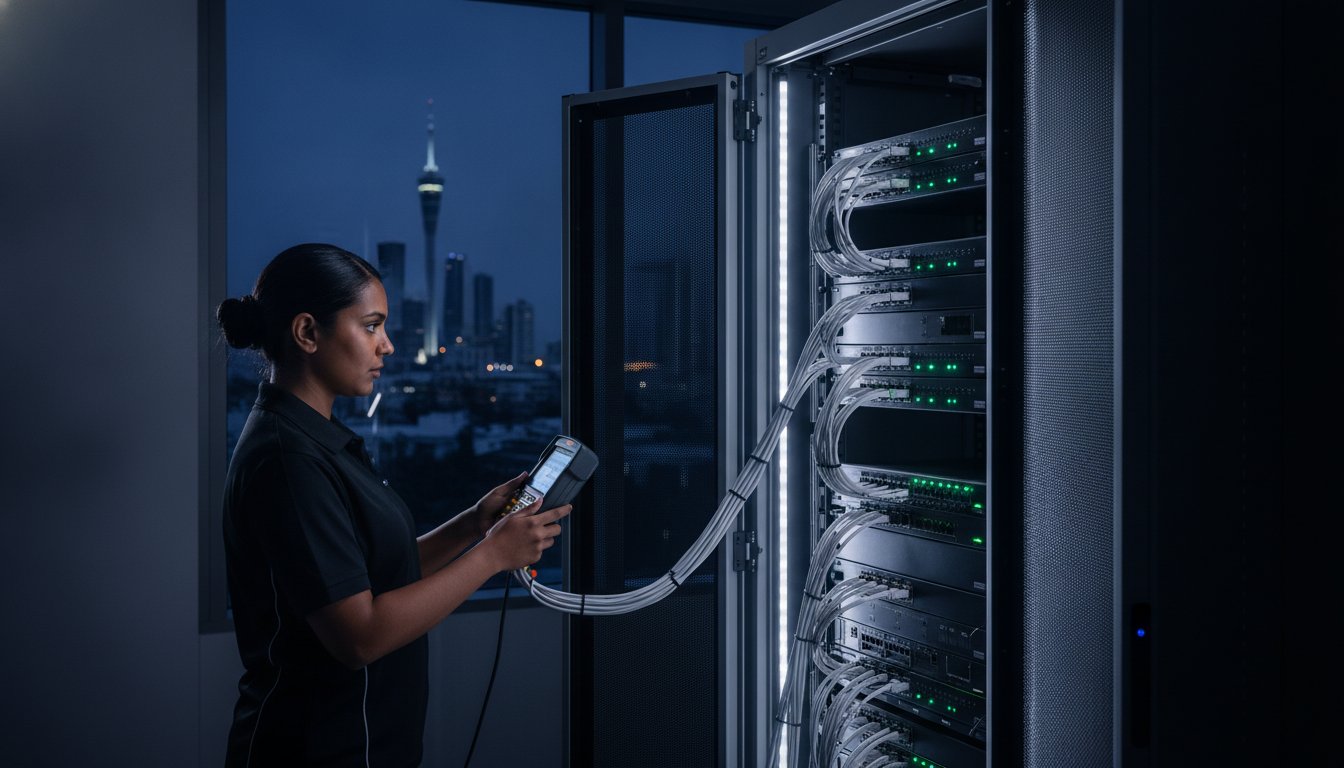
Your business's growth isn't limited by your NBN plan or your staff's talent; it's capped by the physical copper and glass hidden behind your office walls. Most business owners know the frustration of a video meeting dropping out or waiting for local files to sync while the server room hums in a tangled mess of cables. When it comes to commercial network cabling Gold Coast specialists understand that a "near enough" approach only leads to intermittent connectivity and expensive troubleshooting down the track.
We agree that you shouldn't have to think about your network; it should simply work with invisible reliability. This guide reveals how precision-engineered structured cabling eliminates current downtime while future-proofing your operations for WiFi 7 and the high-bandwidth applications of 2026. You'll discover the methodical steps involved in building a scalable backbone, from backbone-first fibre designs to the rigorous standards that ensure every terminal performs at its peak. By the end, you'll know exactly how to transform a chaotic comms room into a neat, high-performance asset that supports your long-term goals.
Key Takeaways
- Understand why structured cabling serves as a universal telecommunications infrastructure, preventing the signal crosstalk and hardware failures caused by unorganised "spaghetti" wiring.
- Learn how professional commercial network cabling Gold Coast installations use patch panels and consolidation points to provide far greater scalability than traditional point-to-point methods.
- Identify the critical hardware standards for 2026, including Cat6A for 10Gbps performance and fibre optic backbones for multi-floor or warehouse connectivity.
- Discover how to audit your future bandwidth needs by accounting for every IP device and designing redundancy to ensure a single cable break won't stall your entire department.
- Explore the benefits of a meticulous technical integration approach that prioritises neatness, concealment, and final certification for a robust network that "just works".
What is Commercial Network Cabling and Why is it the Invisible Engine of Your Business?
Your business doesn't run on thin air; it runs on a physical network of copper and glass. While most people focus on the speed of their NBN plan, the true bottleneck is often the infrastructure within the walls. For high-performing companies, commercial network cabling Gold Coast isn't just a utility; it's a precision-engineered asset that dictates the ceiling of your operational efficiency.
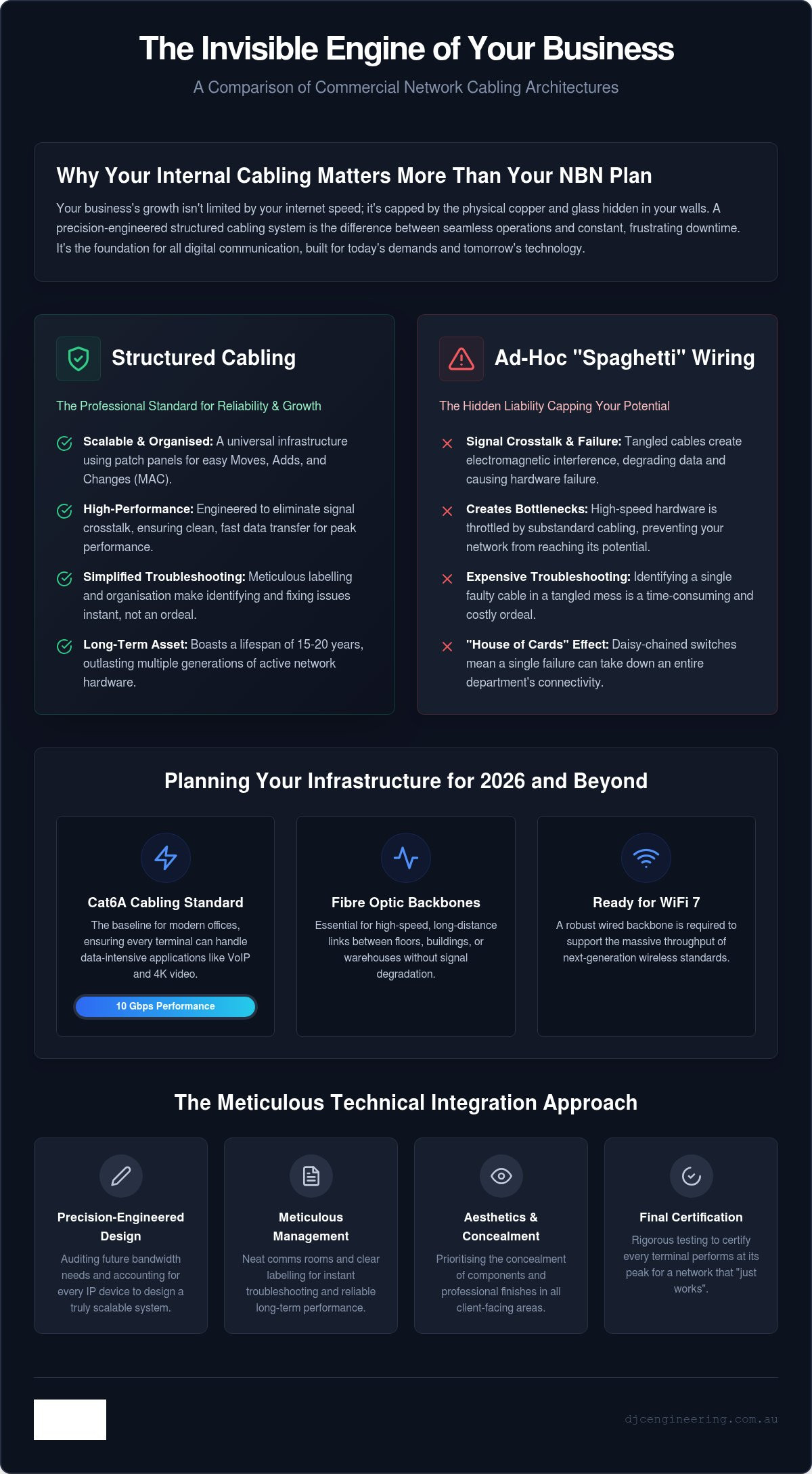
At its core, a structured cabling system is a comprehensive architecture of cables and associated hardware that provides a universal telecommunications infrastructure. Unlike ad-hoc setups where wires are added on the fly, this system is designed to handle multiple services—from data and voice to security—without needing a complete overhaul every time you hire a new staff member. Structured cabling is the engineered blueprint for all digital communication within a commercial space.
Ad-hoc "spaghetti" wiring is a liability. When cables are tangled and unorganised, they create signal crosstalk, where electromagnetic interference from one cable degrades the data on another. This leads to dropped packets, slow transfer speeds, and eventual hardware failure as your switches struggle to manage the noise. For a Gold Coast business, this translates to lost productivity, frustrated staff, and the hidden cost of downtime that eats into the bottom line. Professional engineering ensures your data moves cleanly and quickly, every single time.
The Difference Between "Just Working" and High-Performance
Basic connectivity isn't enough for the demands of 2026. Modern business applications like VoIP, 4K video conferencing, and cloud-based ERPs require massive, consistent throughput. When commissioning commercial network cabling Gold Coast enterprises must look beyond today's needs to avoid the "bottleneck effect" at the switch. This occurs when high-speed hardware is throttled by substandard cabling. We focus on ensuring the physical layer supports 10Gbps speeds, so your software never waits for your hardware to catch up.
Beyond the Walls: The Aesthetics of Engineering
A neat comms room is a functional requirement, not a luxury. Meticulous labelling and cable management aren't just for show; they make troubleshooting instant rather than an all-day ordeal. At DJC Engineering, we prioritise the concealment of components and professional finishes in client-facing areas. We treat every installation as a master-crafted project, ensuring that the robust technical setup behind the scenes is matched by a clean, professional finish in your office space. This methodical approach builds trust and ensures your infrastructure is as reliable as it is organised.
Structured Cabling vs. Point-to-Point Wiring: A Comparison
Choosing the right architecture for your commercial network cabling Gold Coast project is a decision between short-term convenience and long-term stability. Point-to-point wiring involves running a direct cable from a piece of hardware, like a server or switch, straight to a device. While this might suffice for a home office with two computers, it's a recipe for disaster in a professional environment. In contrast, a structured approach uses a hierarchical system of patch panels and consolidation points to create a flexible, universal network infrastructure.
This organised architecture simplifies Moves, Adds, and Changes (MAC). When a staff member moves desks or a new department opens, you don't need to pull new cables through the ceiling or under the floor. You simply re-patch the connection at the central rack. This engineered flexibility is why a high-quality commercial network cabling Gold Coast setup often boasts a lifespan of 15 to 20 years. It outlasts several generations of active hardware, serving as a permanent asset for the building.
The Problem with Ad-Hoc Wiring
Ad-hoc wiring often relies on "daisy-chaining," where multiple small switches are connected in a series throughout the office. This creates a "house of cards" effect; if one switch fails, every device downstream loses connectivity immediately. Identifying a single faulty cable becomes an expensive, time-consuming ordeal in a non-structured mess of tangled wires. Beyond the technical headaches, amateur wiring frequently violates Australian standards, specifically AS/CA S009. This standard mandates strict segregation and support requirements to ensure both safety and signal integrity.
Why Structured Cabling Wins for Gold Coast Offices
While the initial investment in structured cabling is higher, the long-term cost-efficiency is undeniable. It significantly reduces labour costs for future technical upgrades because the core infrastructure is already in place. Following professional cabling and installation guidelines ensures that downtime risks remain low. Faults can be isolated and repaired without taking the entire office offline. If you're planning a new fit-out, choosing a structured cabling installation from the start protects your capital investment and ensures your network remains a reliable tool rather than a constant source of frustration.
Essential Components: From Cat6A to High-Speed Fibre Optic
A network's performance is physically limited by the grade of its components. When engineering commercial network cabling Gold Coast systems, we select hardware based on its ability to handle peak loads without signal degradation. The patch panel acts as the "brain" of this setup, serving as the central termination point where every data run is organised and calibrated. High-quality server racks and cable management trays aren't just aesthetic choices; they prevent cable strain and heat buildup, ensuring your hardware operates within its designed thermal limits.
Adhering to Australian Government communications infrastructure guidelines is vital for maintaining system availability and security. These standards dictate how cables should be routed and housed to prevent accidental damage or interference. By using robust trays and meticulous labelling, we create a system that's easy to audit and nearly impossible to accidentally disconnect. This methodical approach ensures your infrastructure remains a reliable asset for years to come.
Cat6 vs. Cat6A: Making the Right Call
Installing Cat6 in a commercial environment in 2026 is often a short-sighted mistake. While Cat6 is rated for 250MHz, Cat6A operates at 500MHz and supports 10Gbps speeds over the full 100-metre distance. This extra bandwidth is essential for modern Professional WiFi Design access points, which now require multi-gigabit backhaul to function at full capacity. Cat6A also features superior shielding; this reduces alien crosstalk and ensures your data remains clean in high-density office environments where dozens of cables run in parallel.
The Power of Fibre Optic Backbones
Copper has its limits, especially in large Gold Coast warehouses or multi-storey buildings. We transition to fibre optic backbones when distances exceed 90 metres or when the environment is prone to heavy electromagnetic interference (EMI) from industrial machinery or power lines. Fibre is completely immune to EMI and provides a massive "pipe" for data to travel between comms cupboards. Modern engineering prioritises a fibre-first backbone, linking various departments into a seamless campus-wide network that can be scaled as your bandwidth requirements inevitably grow.
Planning Your Gold Coast Network Infrastructure for 2026
Planning a robust network involves more than counting the number of desks in your office. For a future-proof commercial network cabling Gold Coast installation, you must audit every single IP-enabled device that will draw on your bandwidth. Underestimating your port count today leads to messy, unmanaged switches being added later, which compromises the integrity of your engineered system. A comprehensive audit should include:
- Staff workstations and multi-monitor docking stations
- High-definition VoIP handsets and conferencing hardware
- Wireless Access Points (WAPs) requiring multi-gigabit backhaul
- IP-based security cameras and biometric access control readers
- Smart building sensors and automated HVAC controllers
Redundancy is a core pillar of professional design. We engineer paths so that a single cable break or hardware fault won't take down an entire department. This often involves dual-homing critical devices or ensuring your backbone has diverse paths through the building. Additionally, integrated security is now a standard requirement. High-performance cabling provides the necessary power and data for CCTV installation Gold Coast projects, ensuring your surveillance feeds remain lag-free and high-resolution regardless of the network load.
The Gold Coast climate presents unique challenges that generic providers often overlook. High humidity and sub-tropical heat can lead to condensation and thermal throttling in poorly ventilated server rooms. Our planning process includes environmental assessments to ensure your racks have adequate airflow and humidity control. This proactive approach prevents the premature failure of expensive networking hardware and maintains consistent uptime during our intense summer months.
The 2026 Office Environment
Modern offices are becoming complex smart ecosystems. Your cabling must now support a vast array of IoT sensors and automated building features that monitor everything from room occupancy to air quality. We also account for the rise of hybrid work, which demands high-bandwidth conferencing suites that can't afford a single frame of lag. We ensure your infrastructure can handle the power requirements of PoE++ (Power over Ethernet) devices, which deliver up to 90W to power everything from high-end cameras to thin-client workstations.
Local Compliance and Standards
Compliance isn't optional; it's a legal requirement. All commercial cabling work in Australia must be performed by ACMA-licensed technicians to meet safety and insurance standards. Using a Data Cabling Gold Coast checklist ensures that every run is tested and certified against national standards like AS/CA S009. We provide full documentation, including as-built diagrams and Fluke test results, so you have a clear map of your digital assets. If you're ready to build a network that lasts, contact our engineering team for a technical assessment of your site.
The DJC Engineering Approach: Meticulous Technical Integration
At DJC Engineering, we don't just pull cables through ceilings; we design and commission high-performance digital environments. Our philosophy is built on a foundation of zero shortcuts and master-crafted finishes. For us, commercial network cabling Gold Coast projects are an exercise in technical precision. We treat every server rack as a functional centrepiece, ensuring that the final setup is as organised and beautiful as it is robust. This meticulous attention to detail prevents the common failures associated with rushed, uncertified work.
Our workflow follows a disciplined progression from initial assessment to final calibration. We begin with technical heatmapping and site audits to identify potential interference zones and optimal routing paths. Once the physical installation is complete, our technicians perform rigorous certification testing. We provide documented proof that every run meets or exceeds the required bandwidth standards. This methodical verification process ensures that when we hand over the keys to your new network, it's ready to handle peak loads without a single dropped packet.
Managing multiple contractors for networking, security, and AV often leads to communication gaps and technical conflicts. We eliminate this friction by acting as a single, accountable point of contact for all your technical integration needs. Whether we are linking your high-speed backbone to a new security array or a boardroom AV suite, our team ensures every system communicates seamlessly. This holistic approach results in a unified infrastructure where every component is engineered to support the others.
Why We Reject the "Cheap and Fast" Model
Budget cabling providers often rely on inferior materials and hurried labour to keep costs down. The hidden costs of this "cheap and fast" model are significant: increased signal interference, frequent packet loss, and even potential fire hazards from non-compliant materials. We use only premium, tested components for every Gold Coast installation. By choosing a licensed specialist who understands the mechanical engineering behind the wire, you avoid the expensive cycle of constant repairs and premature hardware failure.
Ready for a High-Performance Upgrade?
Upgrading a live office environment requires a surgical approach to minimise disruption. We specialise in staged cut-overs and out-of-hours commissioning to ensure your staff stays productive while we modernise your infrastructure. Our team begins with a comprehensive site assessment to map your existing assets and identify the most efficient path toward a 2026-ready network. If you're tired of intermittent connectivity and unorganised comms rooms, it's time to invest in a system that "just works." Organise a professional network assessment with the DJC Engineering team today.
Build a High-Performance Foundation for Your Business
Your digital infrastructure is the invisible engine that drives your business performance. Investing in precision-engineered commercial network cabling Gold Coast ensures that your operations remain resilient against the bandwidth demands of 2026 and beyond. By transitioning to a structured approach with Cat6A and fibre optic backbones, you eliminate the "bottleneck effect" and create a scalable system ready for WiFi 7 and high-definition applications.
At DJC Engineering, we pride ourselves on being specialists in high-performance SE QLD infrastructure. Our ACMA licensed technicians reject the "cheap and fast" model in favour of precision-engineered server rack management and master-crafted finishes. We ensure every terminal is certified and every cable is meticulously organised, giving you a comms room that is as functional as it is professional. Substandard wiring shouldn't cap your company's potential.
Book a meticulous network cabling assessment for your Gold Coast business and take the first step towards a network that simply works. Your business deserves a backbone that is built to last.
Frequently Asked Questions
What is the difference between data cabling and structured cabling?
Data cabling refers to the individual wires that transmit information between devices, while structured cabling is a pre-planned, modular system designed for scalability. Think of data cabling as a single connection and structured cabling as the entire architectural framework. A structured approach uses standardised hardware and patch panels to provide a universal telecommunications infrastructure. This makes it far easier to manage than a collection of individual, unorganised data runs.
Does my Gold Coast business really need Cat6A, or is Cat6 enough?
Cat6A is the recommended standard for commercial network cabling Gold Coast projects in 2026. While Cat6 supports 1Gbps, Cat6A handles 10Gbps over the full 100 metre distance and offers a 500MHz frequency. This extra bandwidth is essential for modern WiFi 7 access points and high-bandwidth cloud applications. Installing Cat6 now often results in an obsolete system within a few years as data demands continue to climb.
How long does a commercial network cabling installation typically take?
Installation timeframes vary based on the number of outlets and the building's physical complexity. A small office fit-out with 20 outlets might take two to three days; however, a large warehouse or multi-storey project can span several weeks. We focus on meticulous execution rather than rushing, as haste leads to signal interference and messy server racks. We provide a detailed schedule after the initial site assessment.
Can I use my existing electrical cables for data networking?
No, electrical power cables cannot be used to transmit network data. They operate on entirely different frequencies and voltages. Power lines also generate electromagnetic interference that can corrupt data signals. Professional installers ensure that data and power cables are physically segregated in accordance with Australian Standards. This prevents signal degradation and maintains safety across the entire commercial infrastructure.
Why should I hire a specialist instead of a general electrician for data cabling?
Specialists focus on signal integrity and technical integration rather than just getting power to a point. While a general electrician understands power, they often lack the specific testing equipment and expertise required for high-frequency data transmission. A specialist ensures every run is certified for its rated speed, uses proper bend radii, and implements precise cable management to prevent packet loss and crosstalk.
What are the Australian standards for commercial network cabling?
All commercial installations must comply with the AS/CA S009:2020 standard for installation and AS/CA S008:2020 for cabling products. These standards, enforced by the ACMA, dictate safety requirements, cable segregation, and termination methods. Adhering to these rules is a legal requirement in Australia. It ensures your system is safe, reliable, and compliant with insurance policies and local building codes.
How often should I have my commercial network cabling tested?
You should have your cabling professionally tested during the initial installation and then every three to five years. Periodic testing identifies physical wear, loose terminations, or environmental damage that can lead to intermittent connectivity. If you notice a drop in data transfer speeds or experience frequent network drops, an immediate Fluke test is necessary to pinpoint the exact location of the fault.
Can structured cabling help improve our office WiFi signal?
Yes, a robust wired backbone is the foundation of any high-performance WiFi network. Wireless Access Points require high-speed wired connections to the central switch to function at full capacity. By installing Cat6A runs to strategic ceiling points, you provide the necessary backhaul for WiFi 7 and beyond. This eliminates the bottleneck effect where fast wireless devices are slowed down by substandard cabling behind the walls.
Frequently Asked Questions
Upgrading a live office environment requires a surgical approach to minimise disruption. We specialise in staged cut-overs and out-of-hours commissioning to ensure your staff stays productive while we modernise your infrastructure. Our team begins with a comprehensive site assessment to map your existing assets and identify the most efficient path toward a 2026-ready network. If you're tired of intermittent connectivity and unorganised comms rooms, it's time to invest in a system that "just works." Organise a professional network assessment with the DJC Engineering team today. Your digital infrastructure is the invisible engine that drives your business performance. Investing in precision-engineered commercial network cabling Gold Coast ensures that your operations remain resilient against the bandwidth demands of 2026 and beyond. By transitioning to a structured approach with Cat6A and fibre optic backbones, you eliminate the "bottleneck effect" and create a scalable system ready for WiFi 7 and high-definition applications. At DJC Engineering, we pride ourselves on being specialists in high-performance SE QLD infrastructure. Our ACMA licensed technicians reject the "cheap and fast" model in favour of precision-engineered server rack management and master-crafted finishes. We ensure every terminal is certified and every cable is meticulously organised, giving you a comms room that is as functional as it is professional. Substandard wiring shouldn't cap your company's potential. Book a meticulous network cabling assessment for your Gold Coast business and take the first step towards a network that simply works. Your business deserves a backbone that is built to last.
Data cabling refers to the individual wires that transmit information between devices, while structured cabling is a pre-planned, modular system designed for scalability. Think of data cabling as a single connection and structured cabling as the entire architectural framework. A structured approach uses standardised hardware and patch panels to provide a universal telecommunications infrastructure. This makes it far easier to manage than a collection of individual, unorganised data runs.
Cat6A is the recommended standard for commercial network cabling Gold Coast projects in 2026. While Cat6 supports 1Gbps, Cat6A handles 10Gbps over the full 100 metre distance and offers a 500MHz frequency. This extra bandwidth is essential for modern WiFi 7 access points and high-bandwidth cloud applications. Installing Cat6 now often results in an obsolete system within a few years as data demands continue to climb.
Installation timeframes vary based on the number of outlets and the building's physical complexity. A small office fit-out with 20 outlets might take two to three days; however, a large warehouse or multi-storey project can span several weeks. We focus on meticulous execution rather than rushing, as haste leads to signal interference and messy server racks. We provide a detailed schedule after the initial site assessment.
No, electrical power cables cannot be used to transmit network data. They operate on entirely different frequencies and voltages. Power lines also generate electromagnetic interference that can corrupt data signals. Professional installers ensure that data and power cables are physically segregated in accordance with Australian Standards. This prevents signal degradation and maintains safety across the entire commercial infrastructure.
Specialists focus on signal integrity and technical integration rather than just getting power to a point. While a general electrician understands power, they often lack the specific testing equipment and expertise required for high-frequency data transmission. A specialist ensures every run is certified for its rated speed, uses proper bend radii, and implements precise cable management to prevent packet loss and crosstalk.
All commercial installations must comply with the AS/CA S009:2020 standard for installation and AS/CA S008:2020 for cabling products. These standards, enforced by the ACMA, dictate safety requirements, cable segregation, and termination methods. Adhering to these rules is a legal requirement in Australia. It ensures your system is safe, reliable, and compliant with insurance policies and local building codes.
You should have your cabling professionally tested during the initial installation and then every three to five years. Periodic testing identifies physical wear, loose terminations, or environmental damage that can lead to intermittent connectivity. If you notice a drop in data transfer speeds or experience frequent network drops, an immediate Fluke test is necessary to pinpoint the exact location of the fault.
Yes, a robust wired backbone is the foundation of any high-performance WiFi network. Wireless Access Points require high-speed wired connections to the central switch to function at full capacity. By installing Cat6A runs to strategic ceiling points, you provide the necessary backhaul for WiFi 7 and beyond. This eliminates the bottleneck effect where fast wireless devices are slowed down by substandard cabling behind the walls.