
Structured Cabling Brisbane: The Engineered Backbone of Modern Networking

Your cutting-edge WiFi 7 mesh system and high-definition 4K security cameras are only as effective as the underlying physical copper and fibre infrastructure concealed within your premises. It's a prevalent frustration for many businesses across South East Queensland: significant investment in hardware, only to be plagued by persistent WiFi dead zones and network bottlenecks during peak operational hours. A professional data cabling installation in Brisbane, however, ensures your valuable technology performs to its true potential, rather than being hindered by an under-engineered or outdated setup.
While a cluttered server rack might seem an unavoidable headache, that disarray is often a symptom of a system not engineered for sustained reliability. At DJC Engineering Pty Ltd, we understand the complexities of the latest Australian regulatory requirements and the need for a tidy, robust finish. This guide will demonstrate how a meticulously designed structured cabling system eradicates troubleshooting nightmares and establishes a scalable, future-proof foundation for your business operations.
We'll delve into why Cat6A cabling has become the essential baseline for commercial performance and illustrate how strict adherence to the AS/CA S009:2020 Wiring Rules safeguards your assets. By the conclusion of this article, you will possess the knowledge to confidently transition from a fragile network to a resilient, engineered backbone supporting everything from Starlink connections to sophisticated security integration.
Key Takeaways
- Learn why a professional data cabling installation in Brisbane is the essential backbone for high-performance WiFi 7, Starlink, and integrated security systems.
- Understand your legal obligations under the AS/CA S009:2020 Wiring Rules and why only ACMA-licenced technicians can certify your infrastructure with TCA1 forms.
- Discover the six core subsystems of structured cabling that eliminate network bottlenecks and replace messy, unreliable wiring with a modular, scalable topology.
- Identify why Cat6A has become the mandatory minimum for modern commercial environments to support 10 Gbps speeds and high-power PoE++ devices.
- See how meticulous server rack management and systematic labelling reduce troubleshooting time and prevent costly operational downtime in South East Queensland.
What is Structured Cabling? Defining the Modern Network Foundation
Structured cabling is far more than a simple collection of wires; it's a meticulously engineered asset designed to provide a universal telecommunications infrastructure. Unlike the haphazard "point-to-point" wiring often found in older Brisbane commercial buildings, Structured Cabling organises your network into a modular topology that supports multiple hardware applications. When you commission a professional data cabling installation Brisbane, you're choosing to eliminate the "spaghetti" of unorganised wires that typically results in signal interference and maintenance headaches. This engineered foundation is the absolute prerequisite for high-performance Professional WiFi Design & Installation. Without a robust physical backbone, even the most expensive wireless access points will suffer from latency and dropouts.
The Modular Advantage for Brisbane Businesses
The primary benefit of a structured approach lies in its modularity. Brisbane businesses are rarely static; they grow, restructure, and relocate departments. In an unorganised setup, adding a single workstation often involves running a fresh cable directly from the main server, adding to a growing mess. A modular system uses a systematic layout of patch panels and horizontal cabling, allowing for seamless "Moves, Adds, and Changes" (MACs) without the need for invasive re-cabling. This precision reduces the risk of human error and significantly cuts down on downtime during technical upgrades or troubleshooting sessions. Modular infrastructure is the key to maintaining 99.9% network uptime for your business operations.
Universal Connectivity Standards
A unified cabling system allows a single property to support data, voice, security, and AV systems simultaneously. This streamlined approach is essential for efficient property management in SE QLD, as it creates a predictable environment where every port is capable of delivering multiple services. This flexibility is particularly important when integrating diverse technologies, such as supporting starlink installation rural qld systems into a local network. By adhering to a single topology, we ensure that your CCTV cameras, VoIP phones, and Starlink dishes all operate on a robust, high-speed framework. This standardisation prevents the need for proprietary wiring for every new piece of hardware, future-proofing your technical infrastructure for years to come.
The Six Subsystems of an Engineered Cabling Infrastructure
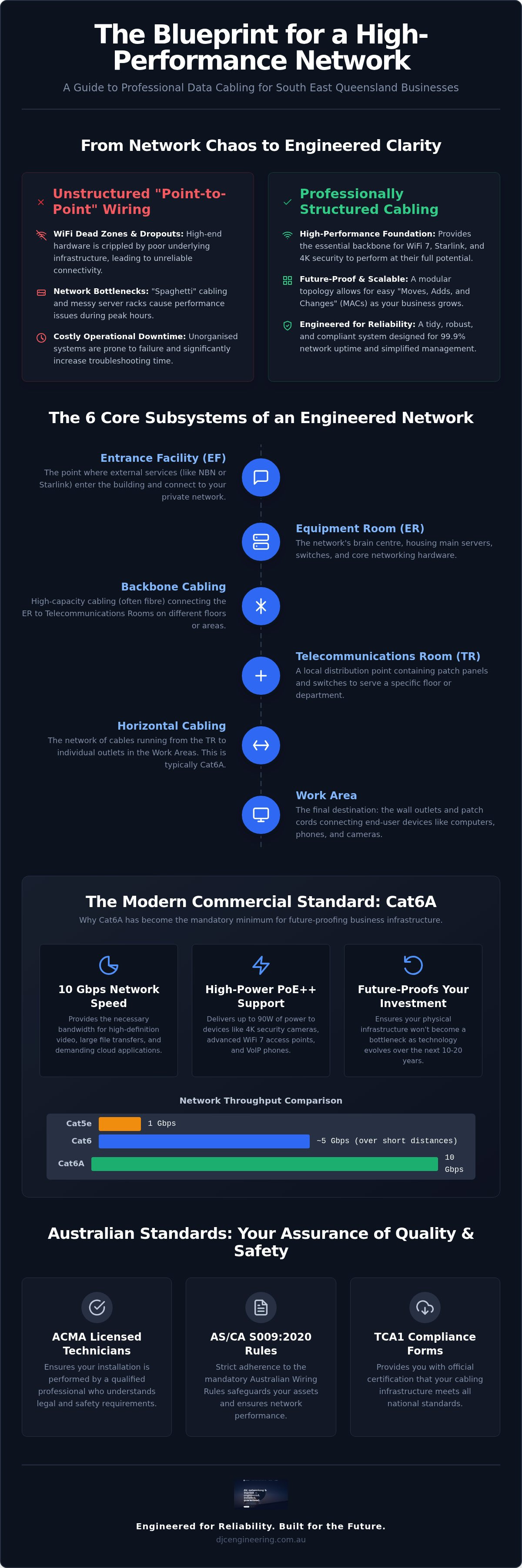
A professional data cabling installation Brisbane is defined by its adherence to a rigid, six-part architecture. Each subsystem serves a specific purpose, and if one link is weak, the entire network suffers. These subsystems include:
- Entrance Facilities (EF)
- Equipment Rooms (ER)
- Backbone Cabling
- Telecommunications Rooms (TR)
- Horizontal Cabling
- Work Areas
Missing or poorly designed subsystems are the primary cause of network bottlenecks, leading to frustrating packet loss and high latency. We treat each stage as a precision engineering project, ensuring every component is robust enough to support demanding applications like commercial security system installation Gold Coast. Adhering to Australian Cabling Standards is non-negotiable for safety and performance; it's the difference between a system that lasts five years and one that lasts twenty.
From Entrance Facilities to the Equipment Room
The Entrance Facility (EF) is the critical point where external services, such as NBN or Starlink, enter your building. It's the gateway for your digital connectivity. Moving deeper, the Equipment Room (ER) serves as the network's brain centre. This space houses your main server racks, switches, and core hardware. We prioritise meticulous rack management and environmental controls here because heat is the enemy of hardware longevity. Our technicians ensure every cable is combed, systematically labelled, and secured to maintain airflow. This level of neatness isn't just for aesthetics; it's a functional requirement for 99.9% uptime. Connecting these spaces is the Backbone Cabling, which handles the heavy lifting of data traffic between floors. We often use fibre optics for this subsystem to prevent the speed degradation common in copper over long distances.
Horizontal Cabling and the Work Area
Horizontal cabling acts as the vital link between the telecommunications room and individual wall outlets. This is where the majority of your physical cabling resides. When conducting a data cabling installation Brisbane, we ensure horizontal runs are protected from electrical interference and physical stress. If this stage is rushed or cables are kinked during installation, you'll face signal interference that even the best mesh WiFi cannot fix. The Work Area is the final destination where users connect their PCs, VoIP phones, or printers. We focus on high-quality termination at both ends to prevent data errors. For a high-performance finish that stands up to peak operational hours, consider how a professionally commissioned network can transform your daily business operations.
Australian Cabling Standards: Why ACMA Compliance and TCA1 Forms Matter
In Australia, networking isn't just about speed; it's about strict legal compliance. Every data cabling installation Brisbane must adhere to the AS/CA S009:2020 Wiring Rules. These rules aren't suggestions. They're mandatory standards enforced by the Australian Communications and Media Authority (ACMA). It's a legal requirement to use an ACMA-licenced technician for any work that connects to the telecommunications network. This isn't just a hurdle for contractors; it's a safeguard for property owners. Upon completion, you should always demand a 'TCA1' form. This document is your registered cabler's formal declaration that the work meets all national safety and performance standards. Compliance ensures your commercial property is protected from electrical hazards and potential fire risks caused by substandard wiring.
The Dangers of 'Shortcut' Cabling by Unlicenced Installers
Unlicenced installers often take shortcuts that compromise your network's physical integrity. One of the most common errors is the improper separation of data cables from electrical power lines. When data lines are run too close to 240V circuits, electromagnetic interference (EMI) occurs. This leads to 'crosstalk', a technical phenomenon where signals from one pair of wires bleed into another, significantly degrading your internet speeds. While a cheap installation might seem functional at first, it will fail to meet the rigorous bandwidth requirements of modern WiFi 7 or high-speed backbone transfers. When we perform a data cabling installation Brisbane, we focus on maintaining the physical shielding necessary for high-performance results. When deciding between Cat6A vs Fibre Optics for your infrastructure, the quality of the installation matters just as much as the cable type.
Accreditation and Accountability in SE QLD
A Registered Cabler isn't just someone with a crimping tool. They've undergone specific, rigorous training to understand the complexities of the Telecommunications (Cabling Provider) Rules 2025. At DJC Engineering, we prioritise meticulous documentation as a core part of our workflow. This accountability is vital for your business's risk management. For instance, commercial network cabling Gold Coast projects must be certified to ensure your property insurance remains valid. If a fire or electrical fault is traced back to unlicenced cabling work, insurers may refuse your claim, leaving your business exposed to massive financial loss. We provide the technical precision and the paperwork to prove your network is built to the highest Australian standards.
Cat6A vs Fibre Optics: Future-Proofing Your Technical Infrastructure
Choosing the right medium is the most critical decision in any data cabling installation Brisbane. While Category 6 (Cat 6) was the workhorse for years, its 1 Gbps limit is no longer sufficient for the data-intensive environment of 2026. Category 6A (Cat 6A) has emerged as the mandatory minimum for professional office fit-outs, offering 10 Gbps speeds over the full 100-metre distance. Fibre optics, meanwhile, provide virtually unlimited bandwidth capacity, but they require specialised termination and are typically reserved for the high-speed backbone of a network. We advise clients to view their cabling as a ten-year investment; cutting costs on copper today often leads to expensive rip-and-replace projects within just a few years.
A major driver for Cat 6A adoption is the increasing demand for high-power Power over Ethernet (PoE++). Modern systems, including high-performance security camera installation Gold Coast, rely on data cables to deliver both signal and electricity. Cat 6A cables feature thicker copper conductors and improved insulation, which manage the heat generated by PoE much more effectively than thinner Cat 6 alternatives. This ensures your security infrastructure remains stable under heavy operational loads without the risk of thermal degradation or signal attenuation.
Bandwidth Demands in 2026
The digital landscape has shifted. 8K video conferencing and heavy cloud-based operations now place immense pressure on internal cabling. If your network lacks sufficient bandwidth, you'll experience frustrating lag during critical business meetings. Future-proofing your property now saves thousands in re-cabling costs over the next decade by ensuring your infrastructure can handle the next generation of hardware. Headroom is the capacity for future speed upgrades without new wires. By installing Cat 6A, you provide the necessary headroom to support Wi-Fi 7 and beyond, ensuring your Brisbane business remains competitive and technically agile.
Fibre Optics for Long-Distance Reliability
Copper cabling has a hard physical limit. Once a run exceeds 90 metres, signal degradation becomes a significant issue, leading to dropped packets and reduced speeds. Fibre optics are the immune solution to electromagnetic interference (EMI), making them essential for Brisbane industrial zones where heavy machinery can disrupt copper signals. We integrate fibre backbones for large estates or commercial complexes to connect separate structures or floors with zero latency. This hybrid approach, using fibre for the backbone and Cat 6A for the horizontal runs, creates a robust and scalable network. If you're ready to upgrade your property's performance, contact us for a professional network assessment today.
Data Cabling Installation Brisbane: The DJC Engineering Difference
DJC Engineering Pty Ltd doesn't just pull cables through ceilings; we engineer technical infrastructure. Many providers offer a quick and cheap data cabling installation Brisbane, but these often result in the messy "spaghetti" racks that make future maintenance impossible. We position ourselves as master technicians who prioritise precision over cost-cutting shortcuts. Our approach is rooted in accountability. We see every project through from the initial site audit to the final verification of every single data point. This methodical workflow ensures your network isn't just functional, but optimised for the specific environmental and logistical challenges of South East Queensland.
Meticulous Server Rack Management
An organised server rack is a functional necessity, not a luxury. When cables are tangled and unlabelled, airflow is restricted. This lack of ventilation is a primary cause of hardware overheating and premature failure. Our technicians employ a systematic approach to rack management, using strict colour-coding and robust documentation. Every patch lead is combed and secured to maintain accessibility. This neatness facilitates rapid troubleshooting; if a fault occurs, your IT team can identify the specific link in seconds rather than hours. By investing in a clean, professional setup now, you significantly reduce future labour costs associated with network changes or repairs.
Commissioning and Final Verification
We don't consider a job finished until we've proven the performance of every link. Using advanced Fluke testers, we verify that your installation meets its rated speed, whether that's 1 Gbps for legacy systems or 10 Gbps for modern Cat6A setups. This final commissioning phase identifies any micro-fractures or termination issues that could cause intermittent packet loss or high latency during peak hours. We provide our clients with a complete map of their network infrastructure, ensuring you have total visibility over your physical assets. This level of transparency is why Brisbane business owners trust us to deliver high-performance results with a clean finish. If you're ready to secure the backbone of your business, organise a professional data cabling audit for your Brisbane property today.
Securing Your Digital Future with Engineered Infrastructure
Your property's digital performance shouldn't be left to chance or unlicenced shortcuts. A professional data cabling installation Brisbane transforms your network from a source of frustration into a robust, high-speed asset. By adhering to the AS/CA S009:2020 standards and prioritising Cat6A or fibre backbones, you ensure your infrastructure supports the bandwidth demands of Wi-Fi 7 and advanced security systems for years to come.
At DJC Engineering, our licenced ACMA technicians bring master-level expertise to every project across South East Queensland. We specialise in neat, engineered server rack management that prioritises hardware longevity and rapid troubleshooting. Don't settle for "good enough" when you can have a system built with local reliability and technical precision. It's time to eliminate bottlenecks and build a foundation that actually works. Book a meticulous network infrastructure assessment with DJC Engineering today and experience the difference that meticulous engineering makes to your daily business operations.
Frequently Asked Questions
Is structured cabling only for large offices or can small Brisbane businesses benefit?
Small Brisbane businesses benefit significantly from structured cabling by creating a modular foundation that grows with them. It isn't just for skyscrapers; even a small office with five workstations gains 99.9% network reliability and easier troubleshooting. An organised setup prevents the "spaghetti" wiring that causes downtime during technical upgrades. This engineered approach ensures that as you add more devices or cloud services, your network remains stable and high-performing.
Can I use my existing electrical contractor for data cabling installation in Brisbane?
You should only use a contractor who holds a current ACMA cabling registration. While many general electrical contractors are skilled in power wiring, data cabling requires specific expertise in signal integrity and high-frequency interference. A specialised data cabling installation Brisbane ensures that your network complies with AS/CA S009:2020 standards. This distinction is critical because poor data termination leads to packet loss and slow speeds that power-focused contractors might overlook.
What is the difference between Cat6 and Cat6A for a 2026 installation?
Cat6A is the mandatory minimum for 2026 because it supports 10 Gbps speeds over a full 100-metre distance. Standard Cat6 is limited to 1 Gbps and struggles with the heat generated by modern high-power PoE++ devices. Choosing Cat6A provides the necessary headroom for Wi-Fi 7 and 8K video conferencing. It's a strategic investment that prevents the need for a costly rip-and-replace project when your bandwidth demands inevitably increase next year.
How long does a typical structured cabling system last before it needs upgrading?
A meticulously engineered structured cabling system typically has a functional lifespan of 10 to 15 years. This longevity depends on using high-quality components like Cat6A or fibre optics from the start. By following a modular design, you can upgrade individual hardware components without replacing the physical wires behind your walls. Regular audits and professional rack management ensure the system remains robust and scalable as new digital technologies emerge over the next decade.
Will structured cabling improve my WiFi signal throughout the building?
Structured cabling provides the essential physical backbone that makes high-performance WiFi possible. Wireless access points perform best when they have a dedicated, high-speed wired connection back to the core switch. By installing data points in strategic locations, you eliminate the reliance on unreliable wireless mesh hops. This hardwired foundation removes dead zones and ensures every corner of your building receives the full bandwidth provided by your NBN or Starlink service.
What is a TCA1 form and why do I need one for my Queensland business?
A TCA1 form is a Telecommunications Compliance Certificate that every registered cabler must provide upon completing a data cabling installation Brisbane. It's your legal proof that the work complies with Australian safety and performance standards. Queensland business owners need this document for insurance validity and risk management. If a fault or fire occurs, having a valid TCA1 form proves the installation was performed by a licenced professional according to national regulations.
Can structured cabling support my CCTV and alarm systems simultaneously?
Modern structured cabling is designed to support data, voice, CCTV, and alarm systems simultaneously on a single unified network. This universal connectivity simplifies property management and reduces the need for multiple proprietary wiring systems. By using high-quality Cat6A, you can power your security cameras via PoE while maintaining high-speed data for your workstations. This integrated approach ensures all your technical infrastructure communicates seamlessly through a central, organised equipment room.
What are the benefits of fibre optic cabling for a Gold Coast estate?
Fibre optic cabling is the ideal solution for Gold Coast estates or large commercial complexes because it overcomes the 90-metre limit of copper. It provides total immunity to electromagnetic interference, which is vital in industrial zones or areas with heavy electrical loads. Fibre backbones allow you to connect separate buildings or floors with zero latency and massive bandwidth. This ensures your high-speed internet remains consistent across sprawling properties without signal degradation.
Frequently Asked Questions
Small Brisbane businesses benefit significantly from structured cabling by creating a modular foundation that grows with them. It isn't just for skyscrapers; even a small office with five workstations gains 99.9% network reliability and easier troubleshooting. An organised setup prevents the "spaghetti" wiring that causes downtime during technical upgrades. This engineered approach ensures that as you add more devices or cloud services, your network remains stable and high-performing.
You should only use a contractor who holds a current ACMA cabling registration. While many general electrical contractors are skilled in power wiring, data cabling requires specific expertise in signal integrity and high-frequency interference. A specialised data cabling installation Brisbane ensures that your network complies with AS/CA S009:2020 standards. This distinction is critical because poor data termination leads to packet loss and slow speeds that power-focused contractors might overlook.
Cat6A is the mandatory minimum for 2026 because it supports 10 Gbps speeds over a full 100-metre distance. Standard Cat6 is limited to 1 Gbps and struggles with the heat generated by modern high-power PoE++ devices. Choosing Cat6A provides the necessary headroom for Wi-Fi 7 and 8K video conferencing. It's a strategic investment that prevents the need for a costly rip-and-replace project when your bandwidth demands inevitably increase next year.
A meticulously engineered structured cabling system typically has a functional lifespan of 10 to 15 years. This longevity depends on using high-quality components like Cat6A or fibre optics from the start. By following a modular design, you can upgrade individual hardware components without replacing the physical wires behind your walls. Regular audits and professional rack management ensure the system remains robust and scalable as new digital technologies emerge over the next decade.
Structured cabling provides the essential physical backbone that makes high-performance WiFi possible. Wireless access points perform best when they have a dedicated, high-speed wired connection back to the core switch. By installing data points in strategic locations, you eliminate the reliance on unreliable wireless mesh hops. This hardwired foundation removes dead zones and ensures every corner of your building receives the full bandwidth provided by your NBN or Starlink service.
A TCA1 form is a Telecommunications Compliance Certificate that every registered cabler must provide upon completing a data cabling installation Brisbane. It's your legal proof that the work complies with Australian safety and performance standards. Queensland business owners need this document for insurance validity and risk management. If a fault or fire occurs, having a valid TCA1 form proves the installation was performed by a licenced professional according to national regulations.
Modern structured cabling is designed to support data, voice, CCTV, and alarm systems simultaneously on a single unified network. This universal connectivity simplifies property management and reduces the need for multiple proprietary wiring systems. By using high-quality Cat6A, you can power your security cameras via PoE while maintaining high-speed data for your workstations. This integrated approach ensures all your technical infrastructure communicates seamlessly through a central, organised equipment room.
Fibre optic cabling is the ideal solution for Gold Coast estates or large commercial complexes because it overcomes the 90-metre limit of copper. It provides total immunity to electromagnetic interference, which is vital in industrial zones or areas with heavy electrical loads. Fibre backbones allow you to connect separate buildings or floors with zero latency and massive bandwidth. This ensures your high-speed internet remains consistent across sprawling properties without signal degradation.