
Projector and Screen Installation Service Gold Coast: Professional AV Integration
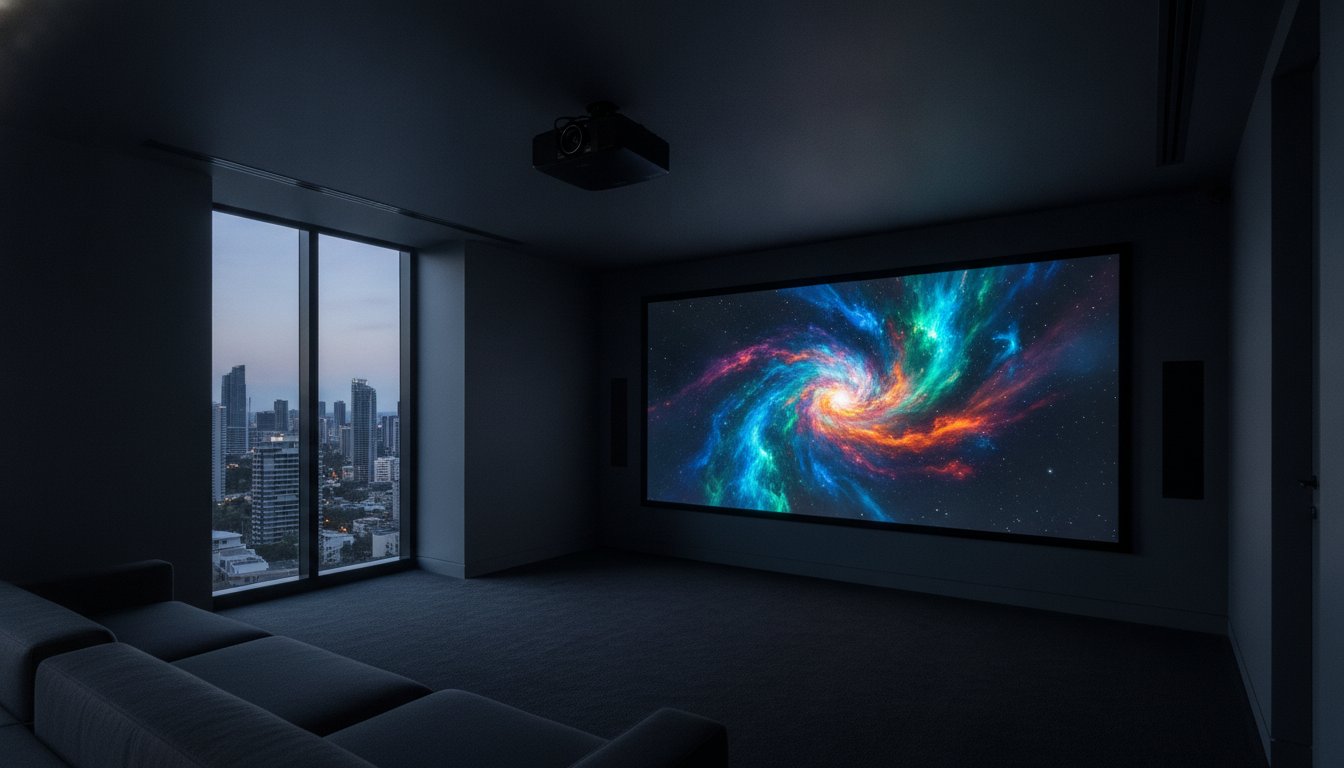
A high-end 4K projector is only as good as the technical engineering behind its placement. You might have the latest triple-laser hardware, but if the image is skewed or messy cables are draped across your ceiling, the cinematic magic is lost. Most homeowners agree that visible wiring and distorted alignment turn a premium investment into a source of frustration. Our professional projector and screen installation service on the Gold Coast is designed to eliminate these compromises, ensuring your hardware performs exactly as the manufacturers intended.
We promise to show you how meticulous calibration and structured cabling turn any room into a high-performance theatre. By adhering to strict Australian standards like AS/CA S009:2020, we deliver a clean finish where components are concealed and the 4K image is perfectly squared. This guide details our methodical approach to AV integration, from physical mounting and signal testing to seamless synchronisation with your existing smart home network and streaming services. You'll learn how a disciplined, engineering-led installation creates a robust setup that's easy to use and visually flawless.
Key Takeaways
- Learn why precise engineering, including throw distance calculations and ambient light management, is the foundation of a high-performance home cinema.
- Discover how a professional projector and screen installation service ensures a clean aesthetic by concealing all structured cabling behind walls and ceilings.
- Understand the technical differences between laser and lamp light sources to select the hardware that best suits your room's environmental conditions.
- See how meticulous calibration and high-bandwidth HDMI integration are required to deliver perfectly aligned, distortion-free 4K image quality.
- Find out how local expertise in South East Queensland building styles leads to a more robust and permanent AV setup compared to generic retail solutions.
The Importance of Precision in Projector and Screen Installation
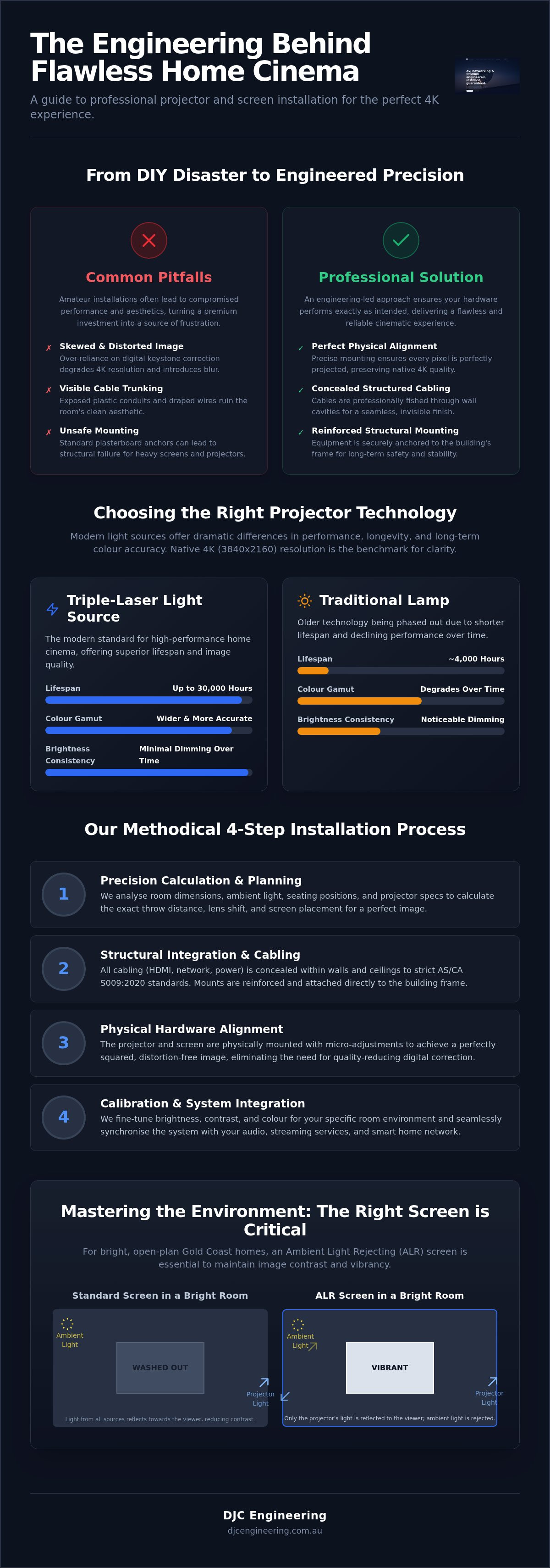
Precision is everything. A professional projector and screen installation service involves more than just finding a stud in the ceiling; it requires calculating the exact optical axis and throw distance for your specific room dimensions. If the projector is mounted even a few centimetres off-centre, the resulting image will be skewed. While many amateurs rely on digital keystone correction to "fix" a crooked picture, this is a technical compromise. Digital correction scales the image pixels, which effectively degrades your 4K resolution and introduces unwanted blur. We focus on physical alignment to ensure every pixel lands exactly where it should.
Modern AV systems are no longer standalone units. They are data-intensive hubs that require a robust infrastructure to function without lag. Integrating commercial network cabling Gold Coast standards into a residential setup ensures your system has the high-bandwidth backbone needed for 4K streaming and smart home control. Understanding Video Projector Technology allows us to match your cabling requirements with the specific hardware specs, preventing the signal dropouts that plague lower-quality installations.
Avoiding the "DIY Disaster": Common Pitfalls
Many DIY attempts fail because they underestimate the mechanical stresses and geometric requirements of a projection system. Common issues we frequently rectify include:
- Incorrect Offset Calculations: Every projector has a specific vertical and horizontal offset. Failing to account for this leads to images that sit too high or too low for the screen.
- Structural Failure: Large motorised screens are heavy. Standard plasterboard anchors won't hold them. We use reinforced mounting techniques to ensure your equipment stays securely attached to the building's frame.
- Visible Trunking: Surface-mounted plastic conduits ruin the room's aesthetic. We specialise in concealed cabling, fishing wires through wall cavities for a seamless, professional finish.
The Impact of Room Lighting and Acoustics
Gold Coast homes often feature large windows and open-plan designs that invite significant light bleed. This environment makes screen material choice a critical technical decision rather than an aesthetic one. Ambient Light Rejecting (ALR) screens are often necessary to maintain contrast levels in rooms that aren't perfectly blacked out. Beyond the visuals, we consider how the screen's physical presence interacts with your soundstage. Positioning the screen too close to corner-loaded speakers can create acoustic reflections that muddy the dialogue, so we balance the visual centre with your audio sweet spot for a cohesive cinematic experience.
Selecting the Right Gear: Projector Tech and Screen Materials
Choosing the right hardware in 2026 requires a shift in focus from basic brand names to technical specifications that match your specific environment. A high-performance projection system is a synergy between the light engine and the reflecting surface. Native 4K resolution (3840 x 2160) is now the benchmark for large-scale viewing, providing the pixel density necessary to prevent pixelation on displays over 120 inches. When evaluating brightness, look past vague marketing claims and focus on ANSI lumens. High-end consumer models now offer up to 5,000 ANSI lumens, which is essential for maintaining image punch in the bright, airy homes typical of South East Queensland.
Light source technology has evolved significantly. Traditional lamps are being phased out in favour of triple-laser light sources. These units offer a wider colour gamut and a lifespan of up to 30,000 hours, ensuring your initial calibration remains accurate for years without the dimming associated with older bulbs. For smaller Australian living spaces where a traditional ceiling mount isn't feasible, Ultra Short Throw (UST) projectors provide a massive image from just centimetres away. Our projector and screen installation service prioritises hardware that offers these long-term performance benefits while fitting the structural constraints of your room.
Projector Technologies: 4K, Laser, and Beyond
The technical benefits of native 4K resolution are most apparent in fast-moving content like sports or gaming. High-end gaming projectors in 2026 now feature refresh rates up to 240Hz, making them a viable alternative to premium monitors. Laser projectors are the preferred choice for a low-maintenance home cinema because they offer instant on/off functionality and consistent brightness. This reliability is crucial when integrating the system with a wider home network, as it reduces the technical variables that can lead to system hang-ups.
Screen Materials and Gain Explained
The screen is just as important as the projector. Ambient Light Rejection (ALR) materials are designed to reflect the projector's light toward the viewer while absorbing light from windows or ceiling fixtures. This is a technical requirement for Gold Coast homes with significant light bleed. Screen Gain is another vital metric; a gain of 1.0 reflects light equally, while higher gain screens focus light for a brighter image at the cost of narrower viewing angles. For those who want a truly "hidden" setup, acoustically transparent screens allow for professional audio visual installations where the speakers are mounted directly behind the image, creating a perfect synergy between sound and vision.
Fixed Frame vs. Motorised Screens: Finding Your Ideal Configuration
Deciding between a fixed frame or a motorised screen isn't merely a matter of taste; it's a technical choice based on your room's architecture and usage. A professional projector and screen installation service begins with a structural assessment to determine if your ceiling can support the weight of a motorised housing or if a wall-mounted frame is more suitable. While a fixed screen provides a permanent cinematic focal point, motorised options offer a "stealth" solution that maintains the clean lines of a multi-purpose living space when the system is powered down.
When to Choose a Fixed Frame Screen
For a dedicated media room, a fixed frame screen is the superior choice for image consistency. These screens use a high-tension mounting system that pulls the material taut from all four sides, creating a surface that is perfectly flat. This level of tension is vital for native 4K projection, as even a minor ripple in the fabric can cause light to refract incorrectly, blurring the fine detail of the image. Fixed screens are mechanically simple, meaning there are no motors to fail and no power requirements at the screen site, which simplifies the overall engineering process.
The Versatility of Motorised and Recessed Options
Many modern Gold Coast homes feature open-plan designs where a large, permanent screen might clash with the interior décor. Motorised screens solve this by retracting into a slimline housing. For the ultimate minimalist finish, we often perform recessed installations where the screen housing is hidden entirely within the ceiling cavity. This requires precise alignment with the building's joists and dedicated electrical runs to power the motor. When integrated with smart home automation, the screen can be programmed to descend automatically when you activate your "Cinema" scene, synchronising with your projector and lighting. Similar principles of seamless integration are used in corporate environments by Averett Pte. Ltd., who specialise in bespoke AV and collaboration solutions for intelligent meeting rooms.
If you choose a drop-down screen, tab-tensioning is a critical technical requirement. Standard motorised screens are prone to developing "waves" or edge curls over time, especially in the humid coastal environment of South East Queensland. Tab-tensioned models use a system of side cables to pull the material flat as it unrolls, ensuring the screen remains a high-performance surface for years. We prioritise these robust configurations to prevent the image distortion that ruins the viewing experience in less meticulous setups.
A professional projector and screen installation service follows a rigorous, engineering-led workflow rather than a "drill and hang" approach. We begin with a meticulous site assessment, using laser-levelling tools to determine the exact optical centre for the projector mount. This precision ensures that the light path is perpendicular to the screen surface, preventing the geometric distortion that ruins image clarity. Structural integrity is our next priority; we reinforce ceiling joists and use vibration-dampening mounts to ensure the equipment remains stable, even when heavy bass from a subwoofer is present during high-action scenes. If you require this level of engineering for a commercial venue, you can find out more about professional AV integration services.
Structured Cabling and Signal Integrity
Modern 4K displays at 120Hz demand immense bandwidth that standard retail cables often fail to deliver over long distances. We install shielded Cat6 or Fibre HDMI cabling to maintain signal integrity from your source equipment to the projector. Integrating a professional WiFi design is also essential for 2026-era smart projectors that rely on high-speed data for buffer-free streaming. We organise these connections at a central head-end, using managed AV cabinets that provide proper ventilation and neat cable routing, which makes future upgrades or troubleshooting straightforward.
Professional Calibration: Beyond the Factory Settings
The final commissioning phase is where we turn raw hardware into a cinematic environment. Factory presets are designed for showroom floors, not your specific Gold Coast media room. We manually adjust the lens shift and zoom to achieve perfect pixel-to-screen alignment without using resolution-killing digital scaling. Our technicians then fine-tune the colour balance, gamma, and contrast ratios to account for your room's specific light levels and screen gain. This meticulous projector and screen installation service ensures skin tones look natural and black levels remain deep and detailed.
We also verify that the audio-sync is perfectly timed with the visual output and that your control system responds instantly to commands. This methodical verification process is what separates a premium installation from a generic setup. If you're ready to transform your space with a high-performance system, contact DJC Engineering today to discuss your custom AV project.
Why Gold Coast Homeowners Trust DJC Engineering for AV Projects
Gold Coast homeowners choose us because we don't treat a projector and screen installation service as a simple retail add-on. We understand that South East Queensland housing presents unique challenges, from high humidity levels that affect screen tensioning to specific building materials used in coastal properties. Unlike generic national retailers who lack local accountability, we apply a master technician's lens to every project. This means we account for everything from the structural load-bearing capacity of your ceiling to the thermal management of your AV cabinet, ensuring your system doesn't just look good on day one but remains reliable for years.
Our expertise extends beyond cinema rooms. We provide a total technology solution by integrating your AV system with other critical infrastructure. For instance, our work in security camera installation Gold Coast uses the same high-bandwidth structured cabling principles we apply to home theatres. This ensures your home network is robust enough to handle simultaneous 4K streams and high-definition surveillance feeds without data bottlenecks or signal dropouts. We believe that a truly smart home requires a unified engineering approach where every component works in harmony.
Licensed and Accredited Technical Specialists
Every project we undertake in SE QLD is backed by licensed technicians who prioritise technical infrastructure over quick fixes. We refuse to take shortcuts like using inferior cables or skipping the structural reinforcement of a motorised screen mount. This commitment to rigorous standards provides a level of accountability that generic service providers can't match. Our meticulous finish is the gold standard because we treat the "hidden" parts of the job, such as the concealed cabling and the cooling systems, with the same care as the visible hardware.
Future-Proofing Your Home Entertainment
Technology moves fast, so we design our systems to be adaptable. By installing oversized conduit and high-capacity network switches, we ensure your home can handle the next generation of 8K streaming or immersive audio formats without needing a complete refit. We focus on the robustness of the physical setup, from the cabling backbone to the mounting hardware, so your environment is ready for future hardware upgrades. This local reliability and ongoing support mean our clients can enjoy high-performance results with the confidence that their investment is protected against technical obsolescence.
Engineering Your Ultimate Home Cinema Experience
Achieving a true cinematic environment requires more than just high-end hardware; it demands a disciplined approach to technical integration. We've detailed how the foundation of a flawless image lies in precise geometric calibration and the use of high-bandwidth structured cabling to support 4K streaming. By choosing a professional projector and screen installation service, you avoid the aesthetic and performance compromises associated with visible wiring and poor alignment.
Our licensed SE QLD specialists adhere to meticulous technical standards to deliver a clean finish with entirely concealed cabling. We focus on the robustness of the infrastructure, ensuring your system's prepared for future hardware shifts and data requirements. Whether you're configuring a dedicated media room or a multi-purpose living space, our engineering-led process ensures your investment performs at its peak. It's about delivering a result that meets rigorous standards rather than just meeting basic requirements.
Enquire about your professional AV installation on the Gold Coast to transform your home theatre today. We're ready to help you build a high-performance system that brings the cinema experience directly into your home.
Frequently Asked Questions
How much space do I need for a projector and screen installation?
You generally need a room depth of 3.5 to 5 metres for a standard 100-inch display, though this depends on the projector's throw ratio. While dedicated media rooms are ideal, our projector and screen installation service also caters to smaller Gold Coast living spaces using Ultra Short Throw technology. We calculate the exact throw distance and seating position to ensure the image fills your field of vision without causing eye strain or pixelation.
Can I install a projector in a room with lots of windows?
Yes, provided you use the right technical combination of hardware. In bright Gold Coast homes, we recommend high-lumen projectors paired with Ambient Light Rejecting (ALR) screens. These screens reflect the projector's light while absorbing light from windows or ceiling fixtures. Without this pairing, the image will appear washed out. We also suggest motorised blackout blinds to achieve a true cinema environment during daylight hours, ensuring your high-performance setup remains usable at any time.
What is the difference between a 4K projector and a 4K TV?
Scale and immersion are the primary differences. While 4K TVs are limited by physical panel size, a professional projector and screen installation service delivers images of 120 inches or more for a genuine cinema feel. Projectors use reflected light, which is often easier on the eyes than direct backlighting. However, projectors require more precise environmental control and technical calibration to match the contrast levels and black depth of a premium 4K television.
Do I need to upgrade my WiFi for a 4K projector setup?
Reliable streaming of 4K content requires high-bandwidth data. If your current network struggles with buffering, we often recommend a professional WiFi design or hardwiring your projector with structured cabling. Modern smart projectors rely on a stable connection for high-definition apps and firmware updates. As part of our technical integration, we assess your network's capacity to ensure it can handle the 25 to 50 Mbps required for a smooth, buffer-free 4K stream.
Is it better to mount a projector on the ceiling or a shelf?
Ceiling mounting is almost always superior for both performance and aesthetics. It places the projector in a fixed, calibrated position that won't be bumped, maintaining your precise lens shift and focus settings. Shelf mounting often leads to alignment issues and visible cabling. A ceiling mount also keeps the hardware out of the line of sight and allows for a hidden finish where wires are chased through the ceiling cavity for a professional result.
How long does a professional projector installation typically take?
A professional installation typically takes between four and eight hours. This duration covers the physical mounting of hardware, pulling structured cabling through wall or ceiling cavities, and the final technical calibration. More complex projects involving recessed motorised screens or integrated control systems may require a full day. We follow a disciplined workflow to ensure every component meets our rigorous engineering standards before the system is commissioned for use in your Gold Coast home.
Can you hide the cables inside a brick or concrete wall?
Yes, we can conceal cables in solid walls using specialised chasing techniques or slimline decorative conduits if internal routing isn't feasible. For Gold Coast properties with brick or concrete internal walls, we often identify alternative paths through ceiling or floor cavities first. If we must chase the wall, we ensure the finish is neat and structurally sound. Our priority is always to deliver a clean finish with no visible wiring or messy external cables.
Do I need a special screen for an Ultra Short Throw (UST) projector?
Yes, Ultra Short Throw projectors require a specific ALR screen with a serrated micro-structure. Because UST projectors sit directly below the screen and throw light at a steep upward angle, a standard screen would reflect that light toward the ceiling. These specialised screens are engineered to catch light from below and reflect it horizontally toward the seating area. Using a generic screen with a UST projector results in a dim, washed-out image that lacks contrast.
Frequently Asked Questions
You generally need a room depth of 3.5 to 5 metres for a standard 100-inch display, though this depends on the projector's throw ratio. While dedicated media rooms are ideal, our projector and screen installation service also caters to smaller Gold Coast living spaces using Ultra Short Throw technology. We calculate the exact throw distance and seating position to ensure the image fills your field of vision without causing eye strain or pixelation.
Yes, provided you use the right technical combination of hardware. In bright Gold Coast homes, we recommend high-lumen projectors paired with Ambient Light Rejecting (ALR) screens. These screens reflect the projector's light while absorbing light from windows or ceiling fixtures. Without this pairing, the image will appear washed out. We also suggest motorised blackout blinds to achieve a true cinema environment during daylight hours, ensuring your high-performance setup remains usable at any time.
Scale and immersion are the primary differences. While 4K TVs are limited by physical panel size, a professional projector and screen installation service delivers images of 120 inches or more for a genuine cinema feel. Projectors use reflected light, which is often easier on the eyes than direct backlighting. However, projectors require more precise environmental control and technical calibration to match the contrast levels and black depth of a premium 4K television.
Reliable streaming of 4K content requires high-bandwidth data. If your current network struggles with buffering, we often recommend a professional WiFi design or hardwiring your projector with structured cabling. Modern smart projectors rely on a stable connection for high-definition apps and firmware updates. As part of our technical integration, we assess your network's capacity to ensure it can handle the 25 to 50 Mbps required for a smooth, buffer-free 4K stream.
Ceiling mounting is almost always superior for both performance and aesthetics. It places the projector in a fixed, calibrated position that won't be bumped, maintaining your precise lens shift and focus settings. Shelf mounting often leads to alignment issues and visible cabling. A ceiling mount also keeps the hardware out of the line of sight and allows for a hidden finish where wires are chased through the ceiling cavity for a professional result.
A professional installation typically takes between four and eight hours. This duration covers the physical mounting of hardware, pulling structured cabling through wall or ceiling cavities, and the final technical calibration. More complex projects involving recessed motorised screens or integrated control systems may require a full day. We follow a disciplined workflow to ensure every component meets our rigorous engineering standards before the system is commissioned for use in your Gold Coast home.
Yes, we can conceal cables in solid walls using specialised chasing techniques or slimline decorative conduits if internal routing isn't feasible. For Gold Coast properties with brick or concrete internal walls, we often identify alternative paths through ceiling or floor cavities first. If we must chase the wall, we ensure the finish is neat and structurally sound. Our priority is always to deliver a clean finish with no visible wiring or messy external cables.
Yes, Ultra Short Throw projectors require a specific ALR screen with a serrated micro-structure. Because UST projectors sit directly below the screen and throw light at a steep upward angle, a standard screen would reflect that light toward the ceiling. These specialised screens are engineered to catch light from below and reflect it horizontally toward the seating area. Using a generic screen with a UST projector results in a dim, washed-out image that lacks contrast.