
Off-Grid Internet Australia: The Engineered Guide to Remote Connectivity in 2026
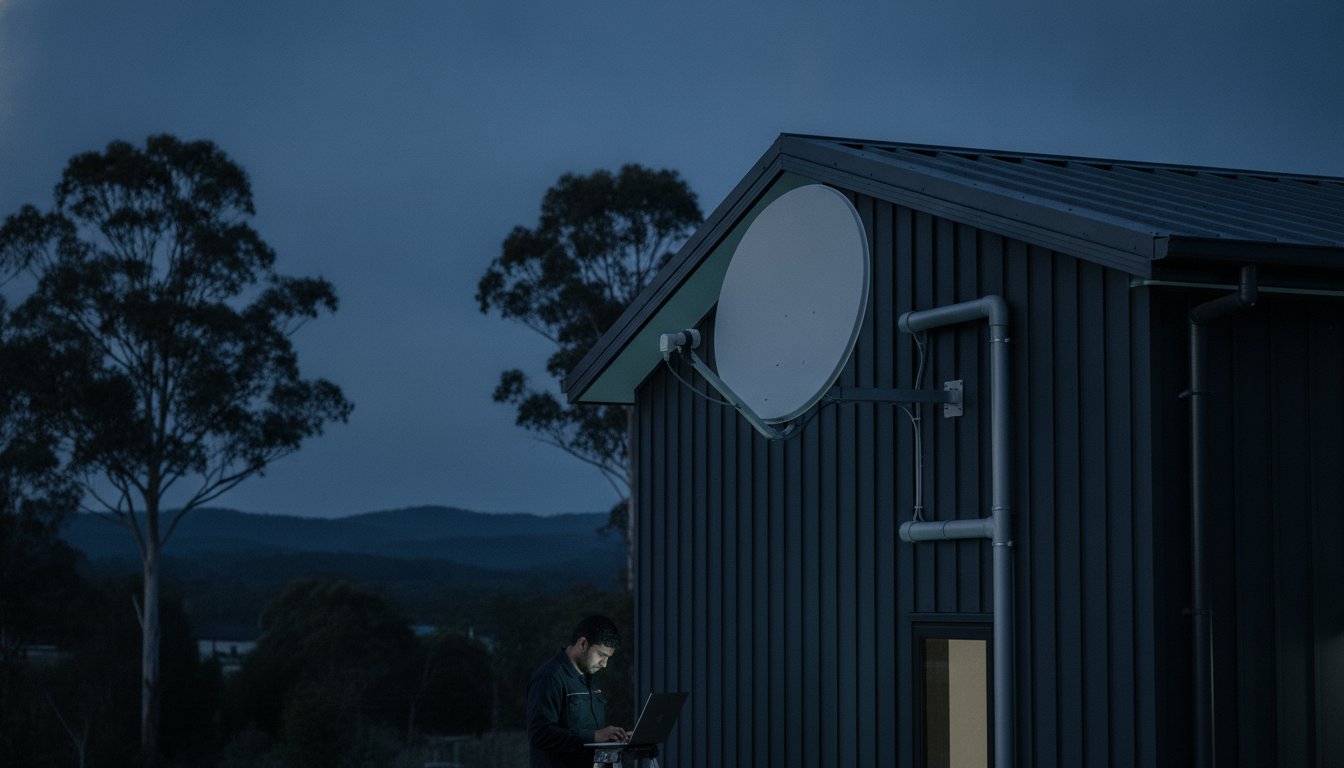
Reliable off-grid internet is a precision infrastructure project, not just a gadget you buy at a retail store and hope for the best. For property owners seeking effective rural internet solutions queensland presents a specific set of environmental hurdles, from tropical downpours that disrupt satellite signals to local wildlife that views exposed cabling as a snack. You've likely dealt with the frustration of a video call dropping the moment the clouds turn grey or the annoyance of a WiFi signal that dies before it reaches the workshop or granny flat.
We believe that living in the bush shouldn't mean settling for second-rate connectivity. This guide will show you how to achieve city-speed, reliable internet on your remote property through professional satellite engineering and robust wireless distribution. We'll examine the technical requirements for Starlink and NBN configurations in 2026, the mechanical secrets to pest-proofing your installation with proper conduit, and how to blanket your entire acreage in a high-performance signal that survives the harshest Australian elements. By the end, you'll understand how a methodical, engineered approach can transform your property's digital capabilities.
Key Takeaways
- Understand the shift from traditional geostationary satellites to Low Earth Orbit (LEO) technology to achieve low-latency, city-speed connectivity in remote areas.
- Learn why professional-grade roof mounts and engineered placement are essential for avoiding signal obstructions and protecting hardware during severe weather events.
- Discover how to use Point-to-Point (PtP) wireless bridges to extend high-speed WiFi coverage across your entire property, including sheds and granny flats.
- Identify the specific technical requirements for rural internet solutions queensland acreage owners need to survive tropical downpours and prevent pest damage to cabling.
- Recognise the value of an ACMA-licensed installation to ensure your off-grid network is robust, neatly concealed, and ready to integrate with security and CCTV systems.
Off-Grid Internet Options in Australia: The 2026 Landscape
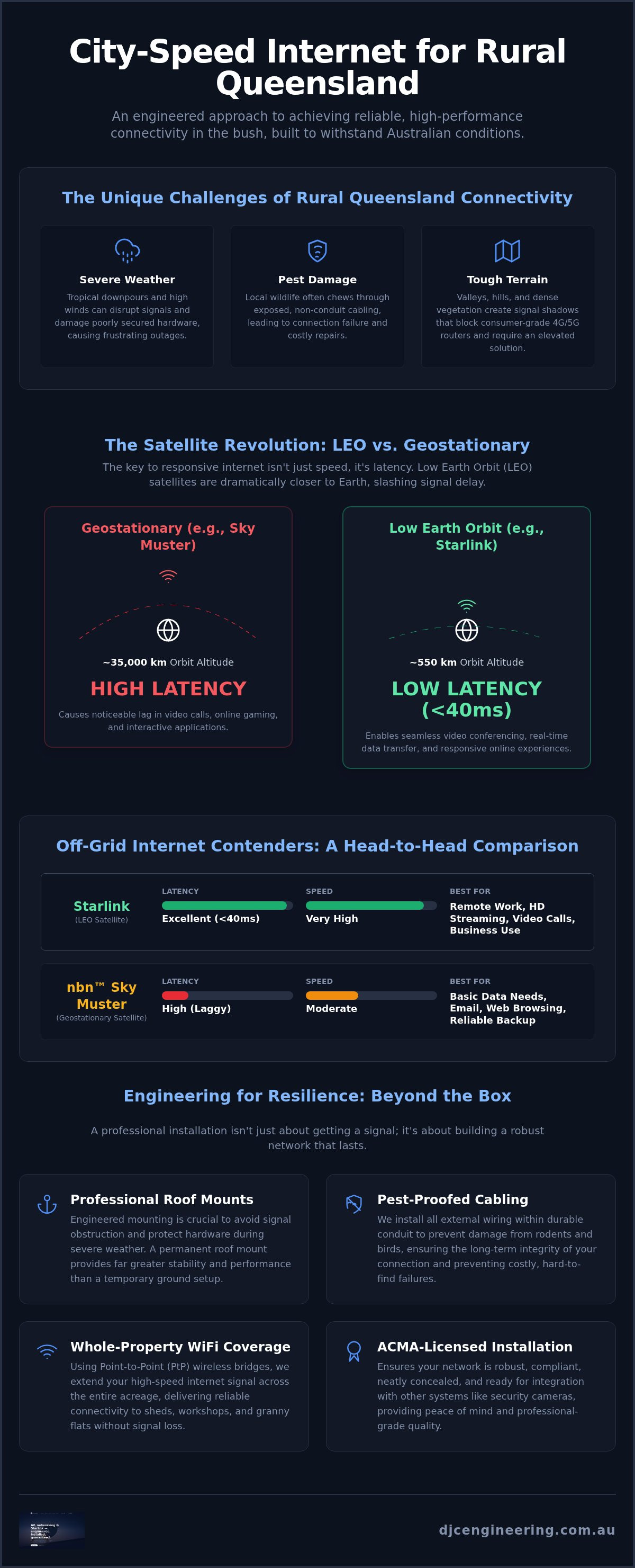
Off-grid internet refers to any connectivity that operates entirely independent of traditional terrestrial copper or fibre infrastructure. In 2026, the landscape for rural internet solutions queensland property owners depend on is defined by a massive shift from geostationary satellites to Low Earth Orbit (LEO) technology. The History of Internet in Australia highlights how far we have come from the days of unstable dial-up to the high-speed satellite arrays we install today. For the modern remote worker, the primary metric isn't just download speed; it's latency. While older systems relied on satellites positioned 35,000 kilometres away, LEO systems orbit much closer, reducing the 'ping' to levels that allow for seamless video conferencing and real-time data transfer.
Standard mobile 4G or 5G dongles often fail in the Gold Coast hinterland or the Scenic Rim. The local topography, characterised by deep valleys and dense vegetation, creates signal shadows that consumer-grade hardware cannot penetrate. Relying on a 'plug-and-play' mobile router in these areas usually results in constant dropouts. Achieving a stable connection in these environments requires a methodical assessment of the local terrain and the selection of a system that can bypass ground-level obstructions entirely.
Satellite Internet: Starlink vs. nbn™ Sky Muster
Starlink currently leads the market for high-speed, low-latency performance on Queensland acreages. It provides the bandwidth necessary for high-definition streaming and professional-grade video calls, making it the preferred choice for those running businesses from the bush. In contrast, nbn™ Sky Muster remains a reliable backup for basic data needs, though its high latency makes it difficult for interactive tasks like gaming or live conferencing. From an engineering perspective, the hardware requirements differ significantly. A Starlink dish is a compact, motorised unit that requires a clear field of view, whereas a Sky Muster dish is a larger, static installation that must be securely bolted to withstand regional wind loads.
Fixed Wireless and External High-Gain Antennae
Fixed wireless remains a contender when a property has a clear Line of Sight (LoS) to a nearby tower. We often utilise high-gain external antennae to 'grab' a signal from a distant tower that would be invisible to a standard phone or internal router. This setup requires precise alignment and professional mounting to maintain stability during heavy weather. While effective in some regional pockets, we generally treat fixed wireless as a secondary or backup solution for the most remote Queensland sites where satellite provides a more consistent and robust primary link.
Comparing the Contenders: Which System Suits Your Property?
Choosing the right hardware for your property involves more than just checking a coverage map. While retail providers often sell kits as a one-size-fits-all solution, the reality of rural internet solutions queensland residents face is far more demanding. You need to weigh up the resilience of the hardware against our local climate. While the National Broadband Network (NBN) provides a baseline for regional connectivity, LEO satellite systems like Starlink offer a different performance profile that often better suits acreage living and high-demand professional use.
Assessing weather resilience is critical in South East Queensland. Our summer storms bring intense hail and wind that can shift a poorly secured dish by just a few millimetres, which is enough to degrade your signal or cause total failure. While modern dishes are designed to be tough, their motorised components are vulnerable if they aren't mounted with the correct torque and bracing. The hidden cost of a DIY setup often reveals itself after the first big storm when you're forced to realign hardware that should have been professionally secured from the start. A permanent roof mount is almost always superior to a mobile "Roam" setup for a fixed residence, as it eliminates the micro-dropouts caused by ground-level obstructions.
Performance Benchmarks for Rural Users
Latency is the metric that defines your user experience. High latency makes video conferencing feel disjointed and slow. If you intend to work from home, aim for a system with a "ping" under 40ms. Upload speeds are equally vital. If you plan to monitor off-grid security cameras from town, you need a stable 10 to 20 Mbps upload capacity to handle high-definition video streams. During a heavy downpour, all satellite signals experience some "rain fade," but an engineered setup with high-gain components recovers faster and maintains a more stable link than a standard retail kit.
Hardware Durability in the Australian Environment
The Queensland sun is brutal on cheap plastics. Standard indoor cabling will perish and crack within months if exposed to high UV levels. We use shielded, outdoor-rated cabling protected by UV-stabilised conduit to ensure longevity and signal integrity. Wildlife is another factor that DIYers often overlook. Cockatoos and rodents can chew through unprotected lines, causing expensive and avoidable outages. Managing heat is the final hurdle. Ensuring your routers and power supplies are housed in ventilated areas prevents thermal throttling on 40-degree summer days. For a setup that survives these specific rural internet solutions queensland challenges, it pays to consult with a specialist in high-performance networking.
Engineering the Setup: Power, Mounting, and Surge Protection
Treating a satellite installation as a simple weekend DIY project often leads to systemic failures. Sticking a high-performance dish on a fence post or a flimsy timber pole is a recipe for signal obstruction and physical hardware damage. In regional Queensland, the wind loads during storm season are significant. A dish that wobbles by even a few degrees will lose its lock on the LEO satellite constellation, resulting in the "micro-dropouts" that plague unprofessionally installed systems. True rural internet solutions queensland property owners can rely on require a structural approach to mounting that prioritises rigidity and long-term alignment.
Surge protection is another critical engineering requirement that retail kits ignore. South East Queensland is a high-lightning zone; a strike nearby can send a massive electrical surge through your networking gear, frying your router and dish instantly. We integrate dedicated surge arrestors and ensure proper grounding of all external hardware to defend your investment. This level of protection aligns with the infrastructure standards seen in the Australian Government's Regional Connectivity Program, which emphasises the need for robust, resilient telecommunications in the bush. When we engineer a setup, we aren't just looking for a signal; we're building a system that survives the elements.
Professional Starlink Installation Standards
Our installation process involves meticulous cable routing that goes far beyond basic functionality. We never leave cables exposed to the elements or local wildlife. Instead, we utilise UV-rated conduit and concealed entry points to ensure your cabling lasts for decades. Before any bolts are tightened, we perform detailed obstruction mapping. This technical assessment ensures a 100% clear view of the sky, even on properties with heavy timber or steep terrain. By using heavy-duty, roof-specific mounts, we eliminate dish movement entirely, ensuring your connection stays locked on even when the wind picks up.
Power Management for Off-Grid Systems
For homes running entirely on solar and battery storage, power management is a primary concern. A Starlink Gen 3 system typically draws between 75W and 100W during standard operation, which is a significant load on a 24/7 battery bank. We help clients calculate this draw accurately to ensure their energy storage isn't depleted overnight. To improve efficiency, we often recommend DC-to-DC conversion. This technical shift avoids the energy loss associated with running an inverter just to power your router. We also configure automated sleep schedules to preserve battery life during extended overcast periods, ensuring your essential rural internet solutions queensland link remains active when you need it most.
Distributing Signal: WiFi for Sheds, Paddocks, and Acreage
Standard indoor routers are designed for suburban brick homes, not sprawling Queensland properties. Expecting a consumer-grade router to push a signal through a metal-clad shed or 50 metres across a paddock is unrealistic. For effective rural internet solutions queensland owners need a distribution strategy that treats the entire property as a single network. This involves moving beyond a single access point and implementing hardware that can survive the heat and humidity of the Australian bush. Achieving a reliable signal in these environments requires an engineered approach to signal propagation and hardware placement.
Point-to-Point (PtP) Wireless Bridges
A Point-to-Point (PtP) wireless bridge allows you to beam your high-speed internet from the main house to a secondary building without the significant cost and mess of digging trenches for cables. These systems use a dedicated transmitter and receiver to create a virtual cable through the air, maintaining high-speed throughput over distances ranging from 100 metres to several kilometres. We select hardware specifically for its ability to maintain a stable link during the heavy rain events common in South East Queensland, ensuring your workshop or granny flat stays connected even when the weather turns. It's an efficient way to extend your Starlink or NBN link without compromising on speed.
Professional WiFi Design and Heatmapping
Achieving total coverage across an acreage requires more than just adding "boosters" or generic mesh nodes. We use technical WiFi design and heatmapping to identify signal dead zones before the physical installation begins. This methodical approach allows us to organise access points so you experience seamless roaming, meaning your devices stay connected as you move from the kitchen to the stables or the pool area. We prioritise the concealment of components and the use of outdoor-rated access points that won't perish in the sun.
This robust network backbone is also the foundation for security camera installation. By extending your high-performance signal to the perimeter of your property, you can monitor gates, livestock, and machinery in real-time. While wireless links are efficient for long distances, commercial network cabling remains the gold standard for high-bandwidth devices like 4K cameras or media servers that require absolute reliability. If you're ready to fix your property's dead zones and achieve professional connectivity, contact us for a professional WiFi assessment.
Professional Off-Grid Setups: The DJC Engineering Advantage
DJC Engineering Pty Ltd approaches off-grid projects as integrated systems rather than isolated hardware installs. We serve South East Queensland and Northern New South Wales with a meticulous, no-shortcuts workflow. Generic retail providers often leave you with a mess of exposed cables and a signal that drops out during the first summer storm. We take a different route. Our licensed ACMA technicians understand the intersection of telecommunications and security, ensuring your rural internet solutions queensland setup is robust enough to handle the next decade of technological shifts.
Our process begins with a rigorous site assessment to identify topographical challenges and potential signal obstructions. We don't just find a signal; we engineer the path for it. This methodical progression moves from initial signal testing to physical execution and final calibration. We verify every link in the chain, from the satellite dish to the furthest outdoor access point. This disciplined approach builds trust because the results are verifiable and high-performing. We prioritise quality and precision over speed, ensuring the final setup is as neat as it is powerful.
Tailored Connectivity for Hinterland Properties
The Gold Coast hinterland and surrounding regional areas present unique environmental hurdles. Deep valleys and dense timber can create persistent blackspots that standard hardware simply cannot overcome. We provide custom solutions for high-end residential and commercial sites that require 100% uptime. Our local knowledge allows us to anticipate these issues before they cause an outage. For those specifically looking into satellite options, our Starlink installation rural QLD guide offers deeper technical insights into optimising these LEO systems for the local climate.
Meticulous Finishes and Long-Term Reliability
We prioritise the physical quality of our work just as much as the digital throughput. Neatness is a core requirement of our service. We focus on the concealment of components and the use of heavy-duty, UV-stabilised materials to prevent environmental degradation. You won't find loose wires or flimsy mounts in a DJC Engineering Pty Ltd installation. Every component is secured to withstand high wind zones and the intense heat of the Queensland sun. This ensures your infrastructure remains functional long after the initial commissioning.
Once the installation is complete, we perform a final system verification to ensure every device on your property is receiving a stable, high-speed signal. We don't consider a project finished until we've calibrated the network for peak performance. This commitment to precision ensures that your rural internet solutions queensland investment provides total peace of mind. Contact DJC Engineering Pty Ltd for a professional off-grid internet assessment to begin your property's digital transformation.
Secure Your Property's Digital Future
Achieving city-speed connectivity on a remote property is a matter of precise engineering rather than luck. We've explored how LEO satellite technology, when paired with professional-grade mounting and Point-to-Point wireless bridges, can eliminate the dropouts and dead zones that plague standard retail setups. For those seeking effective rural internet solutions queensland weather conditions won't defeat, the priority must be on a robust, meticulous installation that protects hardware from both tropical storms and local wildlife.
Our licensed SE QLD technicians bring specialist Starlink and networking expertise to every project, ensuring your components are neatly concealed and your signal is optimised for long-term reliability. We don't take shortcuts because we know that off-grid performance depends on rigorous standards and high-quality infrastructure. You don't have to settle for unstable connections or limited coverage in the bush. Take the first step toward seamless connectivity across your entire acreage and Get a Professional Off-Grid Internet Consultation today. Your remote property deserves a network that works as hard as you do.
Frequently Asked Questions
Can I get Starlink if I live completely off the grid with only solar power?
Yes, you can certainly operate Starlink on a completely off-grid solar system. Many of the rural internet solutions queensland residents choose are powered by standalone battery banks. The key is ensuring your solar array and battery storage can handle the continuous 24/7 draw. We recommend a technical assessment of your energy capacity to prevent your network from draining your batteries during extended overcast periods or overnight.
How much power does an off-grid satellite internet system actually use?
A standard Starlink Gen 3 system typically draws between 75W and 100W during normal operation. Over a 24-hour period, this equates to roughly 1.8kWh to 2.4kWh of energy consumption. If you're on a tight energy budget, we can configure DC-to-DC conversion to improve efficiency. This technical adjustment removes the need for an inverter, saving a significant percentage of power that would otherwise be lost as heat.
Is Starlink better than nbn Sky Muster for a farm in Queensland?
Starlink generally outperforms nbn™ Sky Muster for high-demand farm operations. While Sky Muster provides a reliable baseline, its high latency makes interactive tasks difficult. Starlink's Low Earth Orbit technology delivers latency under 40ms, which is essential for video conferencing and real-time data. For a modern farm requiring high-speed connectivity across multiple buildings, Starlink is the superior choice for performance, though Sky Muster remains a viable low-cost backup.
How do I get WiFi to my shed if it is 100 metres from the house?
Extending signal to a shed 100 metres away is best achieved using Point-to-Point (PtP) wireless bridges. This technology beams a dedicated signal from the main house to a receiver on the shed, creating a high-speed link without the need for expensive trenching. Once the link is established, we install an outdoor access point to provide full WiFi coverage inside the workshop, ensuring your machinery and mobile devices stay connected.
Do I need a special roof mount for Starlink in high-wind or cyclonic areas?
High-wind and cyclonic regions in Queensland require professional-grade, heavy-duty roof mounts. Standard retail mounts are often insufficient for the wind loads experienced during our storm seasons. A mount that flexes or vibrates will cause the dish to lose its satellite lock, leading to constant dropouts. We use reinforced, structural mounts that are specifically engineered to remain rigid, protecting your hardware and maintaining a stable high-speed connection in harsh conditions.
Can I monitor my security cameras remotely using off-grid satellite internet?
You can monitor security cameras remotely if your off-grid system has sufficient upload bandwidth. Most rural internet solutions queensland property owners install require at least 10 to 20 Mbps of upload speed to stream high-definition video without lag. Starlink typically provides this capacity, allowing you to check live CCTV feeds from your smartphone even when you're away from the property. We integrate these cameras directly into your network backbone for maximum reliability.
What happens to my internet connection during a heavy tropical storm?
During an intense tropical downpour, you may experience "rain fade," which is a temporary weakening of the satellite signal. While all satellite systems are susceptible to heavy water vapour, an engineered installation recovers much faster than a DIY setup. By performing meticulous obstruction mapping and using precision mounting, we ensure your dish has the best possible signal-to-noise ratio, allowing it to maintain a link through all but the most extreme weather events.
Is it worth paying for a professional internet installation on a rural property?
Professional installation is a worthwhile investment for long-term reliability and performance. A licensed technician performs technical tasks that DIYers often miss, such as UV-stabilised conduit routing, electrical surge protection, and precise signal optimisation. We ensure your cabling is protected from pests and the elements, preventing expensive hardware failures. This methodical approach results in a neat, high-performance network that adds genuine value and functionality to your rural property.
Frequently Asked Questions
Yes, you can certainly operate Starlink on a completely off-grid solar system. Many of the rural internet solutions queensland residents choose are powered by standalone battery banks. The key is ensuring your solar array and battery storage can handle the continuous 24/7 draw. We recommend a technical assessment of your energy capacity to prevent your network from draining your batteries during extended overcast periods or overnight.
A standard Starlink Gen 3 system typically draws between 75W and 100W during normal operation. Over a 24-hour period, this equates to roughly 1.8kWh to 2.4kWh of energy consumption. If you're on a tight energy budget, we can configure DC-to-DC conversion to improve efficiency. This technical adjustment removes the need for an inverter, saving a significant percentage of power that would otherwise be lost as heat.
Starlink generally outperforms nbn™ Sky Muster for high-demand farm operations. While Sky Muster provides a reliable baseline, its high latency makes interactive tasks difficult. Starlink's Low Earth Orbit technology delivers latency under 40ms, which is essential for video conferencing and real-time data. For a modern farm requiring high-speed connectivity across multiple buildings, Starlink is the superior choice for performance, though Sky Muster remains a viable low-cost backup.
Extending signal to a shed 100 metres away is best achieved using Point-to-Point (PtP) wireless bridges. This technology beams a dedicated signal from the main house to a receiver on the shed, creating a high-speed link without the need for expensive trenching. Once the link is established, we install an outdoor access point to provide full WiFi coverage inside the workshop, ensuring your machinery and mobile devices stay connected.
High-wind and cyclonic regions in Queensland require professional-grade, heavy-duty roof mounts. Standard retail mounts are often insufficient for the wind loads experienced during our storm seasons. A mount that flexes or vibrates will cause the dish to lose its satellite lock, leading to constant dropouts. We use reinforced, structural mounts that are specifically engineered to remain rigid, protecting your hardware and maintaining a stable high-speed connection in harsh conditions.
You can monitor security cameras remotely if your off-grid system has sufficient upload bandwidth. Most rural internet solutions queensland property owners install require at least 10 to 20 Mbps of upload speed to stream high-definition video without lag. Starlink typically provides this capacity, allowing you to check live CCTV feeds from your smartphone even when you're away from the property. We integrate these cameras directly into your network backbone for maximum reliability.
During an intense tropical downpour, you may experience "rain fade," which is a temporary weakening of the satellite signal. While all satellite systems are susceptible to heavy water vapour, an engineered installation recovers much faster than a DIY setup. By performing meticulous obstruction mapping and using precision mounting, we ensure your dish has the best possible signal-to-noise ratio, allowing it to maintain a link through all but the most extreme weather events.
Professional installation is a worthwhile investment for long-term reliability and performance. A licensed technician performs technical tasks that DIYers often miss, such as UV-stabilised conduit routing, electrical surge protection, and precise signal optimisation. We ensure your cabling is protected from pests and the elements, preventing expensive hardware failures. This methodical approach results in a neat, high-performance network that adds genuine value and functionality to your rural property.