
Integrating Access Control with CCTV in QLD: The Professional Guide
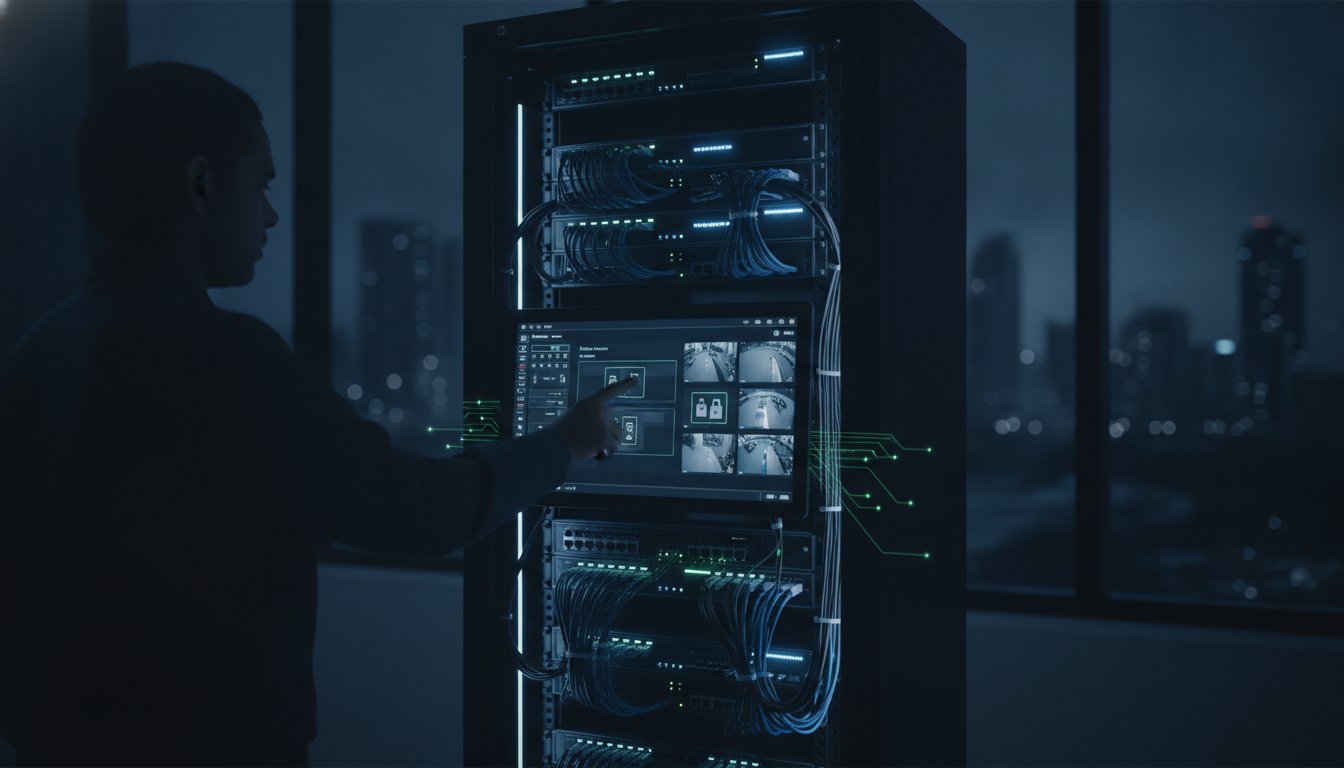
What if your security system did more than just record a crime after the fact? Imagine a setup where a gate swipe instantly triggers a high-definition camera feed, all managed through one interface without a second of lag. For many Gold Coast business owners, the reality is far messier. You are likely dealing with separate apps for doors and cameras, "ghosting" footage during critical incidents, or a tangle of cables left behind by a previous installer. If you are tired of systems that fail during a classic Queensland storm season, it is time to demand better. Integrating access control with cctv qld is a technical engineering task that, when done correctly, turns fragmented hardware into a high-performance shield for your assets.
We understand that a reliable security infrastructure is built on precision, not shortcuts. You deserve a system where every component communicates flawlessly over a dedicated network backbone. This guide provides the professional roadmap you need to unify your security. We will cover the essential Australian standards for cabling, the specific licensing requirements for QLD technicians, and the hardware configurations that ensure your data remains secure and accessible. From managing footage retention for licensed venues to selecting the right structured cabling, we will show you how to build a system that works every time you need it.
Key Takeaways
- Master the "Single Pane of Glass" management concept to control doors, gates, and high-definition camera feeds from one unified interface.
- Understand the technical mechanics of integrating access control with cctv qld to provide instant visual verification for every entry event across your facility.
- Learn why professional structured cabling and network segmentation are essential to prevent high-resolution video streams from disrupting your office internet.
- Navigate the critical Australian Standards and QLD licensing requirements that ensure your integrated security system meets insurance and legal benchmarks.
- Discover how to protect your hardware against South East Queensland's unique environmental challenges, including salt air corrosion and high humidity.
What is Integrated Access Control and CCTV?
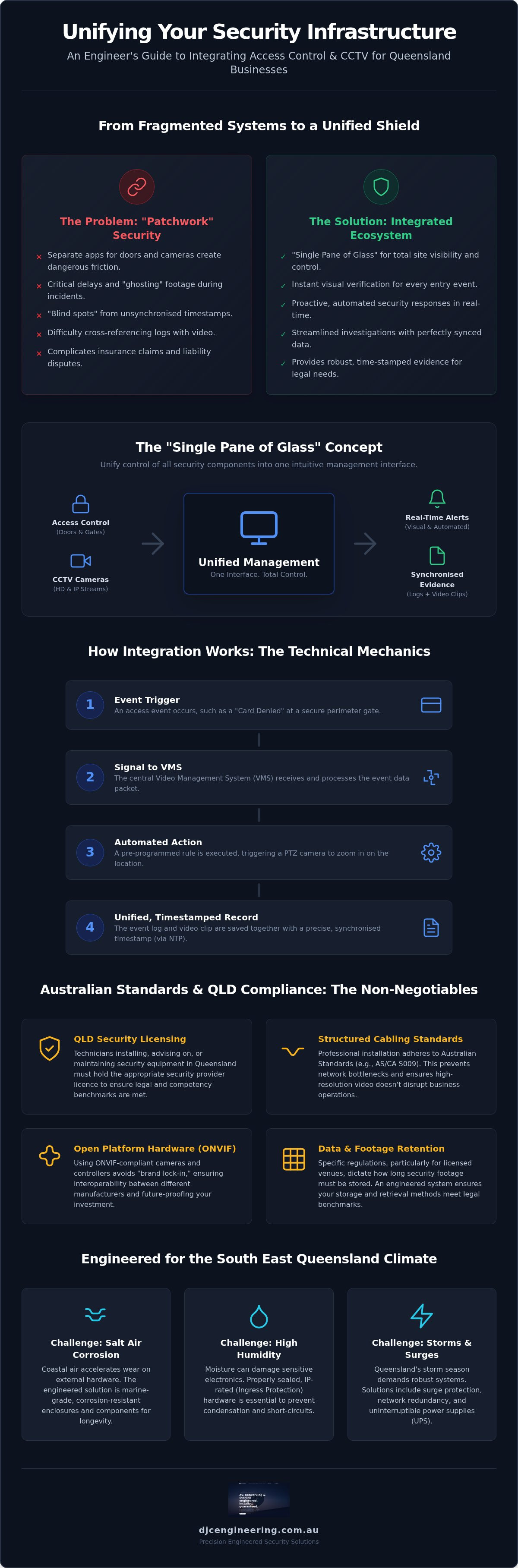
Security is no longer a collection of isolated devices. It's an engineered ecosystem where hardware and software communicate via a dedicated network to provide total site visibility. At its core, integrating access control with cctv qld involves the precise synchronisation of entry events with visual verification data. Instead of just seeing that a specific credential was used at a side gate, you see the exact video footage of the person at the moment the strike plate released. This shift moves your operations from reactive monitoring, where you check tapes after a theft, to proactive, automated security responses that happen in real-time.
The "Single Pane of Glass" concept is the gold standard for modern facilities. This refers to a unified management interface where doors, gates, and cameras are all controlled from one screen. This level of oversight is often achieved through Physical Security Information Management (PSIM), a software category designed to collect data from unconnected security applications to provide a comprehensive user experience. For a South East Queensland business owner, this means no more toggling between different software packages or mobile apps to verify a simple alarm.
The Problem with Standalone "Patchwork" Security
Relying on separate apps for cameras and access control creates dangerous friction. During a security breach, every second counts. Fumbling with different logins and interfaces leads to critical delays that could allow an intruder to escape or a situation to escalate. Disconnected systems also make it nearly impossible to cross-reference access logs with footage, especially if the timestamps aren't perfectly synced. This creates "blind spots" in your security posture that can complicate insurance claims or liability disputes. If you can't prove exactly who was at a door during an incident with clear, time-stamped video, your coverage may be at risk.
Real-World Benefits for SE QLD Businesses
A unified system delivers tangible results for local operations. Consider a Brisbane warehouse manager who receives an automated visual alert on their smartphone the moment a secure rear door is forced. They don't just get a notification; they see the live feed immediately. Investigations become streamlined because you can search for specific events, such as "Loading Dock 2", and view the matching footage instantly, rather than scrubbing through hours of tape. Beyond security, integrating access control with cctv qld provides operational insights into site flow and staff safety, ensuring your facility runs at peak efficiency without compromising on protection.
How Access Control and CCTV Integration Works: The Technical Mechanics
Successful integration relies on a central "brain" known as the Video Management System (VMS). While standalone systems operate in silos, a VMS aggregates data from both your cameras and entry points into a unified stream. Modern IP-based hardware makes this possible by using standardised communication protocols to share data packets across your network. This isn't a simple hardware bridge; it's a deep software handshake that allows different devices to speak the same language. When you focus on integrating access control with cctv qld, you're building a system where every digital event carries a visual receipt.
Trigger-based actions are the most powerful outcome of this technical synergy. For example, a "Card Denied" event at a secure perimeter can be programmed to trigger a high-definition PTZ (Pan-Tilt-Zoom) camera to automatically zoom in on the person's face. This happens instantly, without human intervention. To ensure this data is useful for legal or insurance purposes, time-synchronisation is non-negotiable. We use Network Time Protocol (NTP) servers to ensure every camera and door controller is synced to the millisecond. This precision provides the evidentiary weight required by Queensland authorities if an incident leads to a police investigation.
Hardware Compatibility: Why "Open Platform" Matters
Avoid the trap of "brand lock-in" by choosing open-platform hardware. We prioritise ONVIF-compliant cameras and controllers because they allow different brands to work together seamlessly. This flexibility means you can integrate high-quality legacy analogue cameras into a modern IP system using encoders, saving on initial hardware costs. Selecting an open platform also future-proofs your Gold Coast facility for upcoming AI-driven analytics, such as facial recognition or automated number plate recognition (ANPR), without needing to rip and replace your entire infrastructure.
Power over Ethernet (PoE) and System Stability
System stability often fails at the power supply level. Professional-grade PoE switches are essential for integrated setups because they provide both data and power through a single cable. However, many "cowboy" installers fail to calculate the total power budget. A high-draw motorised PTZ camera or an active door strike can cause the system to brown out or drop frames if the switch is under-powered. Our approach involves meticulous power calculations and the use of redundant power supplies for mission-critical links. If you're concerned about your current setup's reliability, our licensed security technicians can perform a comprehensive audit of your network's power capacity to ensure 24/7 uptime.
The Engineered Backbone: Structured Cabling and Network Design
A high-performance security system is only as strong as the physical infrastructure supporting it. Many businesses struggle with lag or system crashes because they attempt to run high-resolution video streams over a standard, unoptimised office network. Without proper commercial network cabling in Gold Coast, the massive data throughput required for 4K video will overwhelm your hardware. When integrating access control with cctv qld, we design the network from the ground up, ensuring your security traffic is logically separated from your daily business operations.
Network segmentation via Virtual Local Area Networks (VLANs) is essential for both performance and security. By isolating your security traffic, you prevent guest WiFi users or large file transfers from interfering with your camera feeds. We strictly avoid shortcuts like "daisy-chaining" cameras, which creates bandwidth bottlenecks and single points of failure. Instead, we use a star topology where every device has a dedicated run to a central switch. Meticulous concealment of these runs is equally vital; we ensure all cabling is protected and hidden to prevent tampering and environmental wear. Professional cable management is the primary factor in system longevity.
Cat6 vs Fibre for Integrated Security
For most standard installations, Cat6 cabling provides more than enough bandwidth for integrated systems. However, for multi-building campuses or long-distance gate access, we transition to Fibre optics to eliminate signal loss and interference. As we move into 2026, your infrastructure must be capable of handling the heavy data loads of 4K and even 8K streams. Using high-quality, shielded cabling ensures your system remains robust against the electromagnetic interference common in industrial Brisbane zones.
Optimising Integration for Starlink and NBN
Managing upload bandwidth is a specific challenge for regional sites using NBN or Starlink installations. Since remote viewing relies on your connection's upload capacity, we configure your router to prioritise security data packets during peak office usage. This ensures your visual verification always takes precedence over background updates. We also implement local "Edge" storage on cameras and recorders. This redundancy prevents data loss during internet outages, ensuring your access logs and video remain intact even when the cloud is unreachable.
Australian Standards and Compliance for QLD Businesses
Compliance is the difference between a functional security tool and a legal liability. When integrating access control with cctv qld, your system must adhere to specific Australian Standards to ensure its reliability and the admissibility of its data. AS/NZS 2201 governs the design and installation of intruder alarm systems, while AS/NZS 62676 is the benchmark for video surveillance. These standards aren't just suggestions. They dictate everything from image resolution to system redundancy. If your integrated setup doesn't meet these benchmarks, your business insurance provider may have grounds to void your coverage following a claim.
Privacy is another critical factor for Queensland operations. While Queensland doesn't have a dedicated workplace surveillance act like New South Wales, businesses are still bound by the Privacy Act 1988 (Cth) and the Invasion of Privacy Act 1971 (Qld). This means you must provide clear signage at all entrances to notify staff and the public that they are being recorded. Your system must also be configured to respect private areas. Recording video in change rooms or bathrooms is a criminal offence under Section 227A of the Criminal Code (Qld). A professional installation ensures your "Single Pane of Glass" management doesn't inadvertently breach these strict legal boundaries.
QLD Security Licensing: What to Check
Never assume a general electrician is qualified to install your security infrastructure. In Queensland, the installation of security equipment requires a Class 1 Security Provider Licence issued by the Office of Fair Trading. Technicians providing advice or monitoring services must hold a Class 2 licence. Using an unlicensed "sparky" for specialised security integration is a massive risk. It compromises the technical integrity of the system and leaves you without the formal documentation required for police evidence. You can verify a provider's credentials through the QLD Government's online register to ensure they are authorised to perform the work.
Data Privacy and Cyber Security
An integrated system is a network-connected device, which makes it a potential target for remote hacking. Hardening your security network involves more than just setting a strong password. We implement rigorous firmware update schedules and disable unnecessary network services on integrated controllers to close entry points for data breaches. You should also consider data sovereignty. Many "off-the-shelf" cloud systems store footage on overseas servers, which can complicate compliance with Australian data privacy laws. We prioritise local storage or Australian-based cloud nodes to keep your sensitive security data within our legal jurisdiction. To ensure your facility meets every legal and technical benchmark, contact our licensed security technicians for a professional compliance audit.
Professional Security Integration in South East Queensland
South East Queensland presents a unique set of challenges for sophisticated electronic security. While many generic providers treat an install in Brisbane the same as one in a dry, inland climate, we understand that salt air corrosion and high humidity are the primary enemies of system longevity. Integrating access control with cctv qld requires hardware that is not only technically advanced but physically resilient. We specify high IP-rated enclosures and corrosion-resistant components for all coastal installations to prevent premature component failure. Having local Gold Coast support means you aren't waiting days for a technician when a gate sensor fails; we provide the rapid response necessary to keep your facility secure.
When you invest in a commercial security system installation in Gold Coast, the physical environment is just the first hurdle. High-density commercial zones often suffer from significant radio frequency interference which can disrupt wireless links. Our approach prioritises hard-wired reliability and meticulous shielding to ensure your data packets reach the server without packet loss or jitter. This grounded, methodical approach ensures your system performs during the intense storm seasons that frequently cripple inferior setups.
The DJC Engineering Site Audit
Every project begins with a rigorous site audit. We don't just count doors; we evaluate the physical entry points and ambient lighting conditions to ensure optimal camera placement. A camera that looks great at midday might be useless at 2 am if the infrared bounce-back from a nearby wall blinds the sensor. We also assess your existing network infrastructure to determine if your current switches can handle the additional PoE load or if a dedicated security backbone is required. This assessment identifies potential bottlenecks before they become expensive problems during the execution phase.
Meticulous Installation and Calibration
Our "No Shortcuts" rule is the foundation of our reputation. Every cable is neatly run, concealed, and clearly labelled at both ends to simplify future maintenance. We calibrate every camera view to ensure there are no blind spots and that the motion-trigger zones for your access control events are precise. Once the hardware is commissioned, we provide comprehensive staff training. A system is only effective if your team can actually use it during a high-pressure incident. We ensure your operators are confident in pulling reports and viewing live feeds before we sign off on the project. For a technical security audit of your facility, Contact DJC Engineering to speak with a licensed specialist.
Secure Your Facility with a Unified Infrastructure
Achieving a seamless, high-performance security environment requires more than just buying the right cameras. It demands a meticulously engineered backbone where every entry event is instantly verified by visual data. By integrating access control with cctv qld, you eliminate the delays of fragmented systems and build a robust shield that stands up to the unique environmental demands of the Gold Coast and Brisbane. Whether it's ensuring your cabling meets strict Australian Standards or configuring a network that won't crash under 4K data loads, precision is the only path to 24/7 reliability.
At DJC Engineering, we don't take shortcuts. Our team consists of licensed QLD security technicians who specialise in expert network and WiFi design. We pride ourselves on meticulous structured cabling standards that ensure your components are concealed, protected, and perfectly calibrated. You don't have to settle for messy patchwork setups that fail during a heavy Queensland storm. Book a Technical Security Audit for Your QLD Business today to transform your fragmented hardware into a professional, integrated ecosystem. Your site’s security deserves a master technician’s touch.
Frequently Asked Questions
Can I integrate my existing CCTV cameras with a new access control system?
Yes, you can usually integrate existing cameras if they are IP-based and support open protocols like ONVIF. We use a Video Management System (VMS) to create a software handshake between your current CCTV and new access controllers. For older analogue systems, we install encoders to bring them into the digital network. Integrating access control with cctv qld this way saves on hardware costs while modernising your security posture without a full replacement.
What is the best VMS for a small business in Brisbane?
The ideal VMS for a Brisbane business prioritises ease of use without sacrificing technical depth. Platforms like Inner Range Inception or Milestone are excellent for smaller sites because they offer a "single pane of glass" interface. This allows you to manage gate access and camera feeds from one screen. We recommend systems with local Australian support to ensure you have rapid assistance if you need to pull footage for an incident.
Does integrating security systems slow down my office internet?
A professionally engineered system will not slow down your office internet. We use network segmentation and VLANs to isolate security traffic from your general business data. This ensures high-bandwidth 4K video streams stay on their own "lane" within your internal network. Your external NBN or Starlink connection is only utilised when viewing footage remotely, and we configure bitrate limits to ensure this doesn't disrupt your daily office operations.
Are there specific QLD licences required for security system installers?
In Queensland, any person installing or maintaining security equipment must hold a Class 1 Security Provider Licence. This is issued by the Office of Fair Trading and ensures the technician has passed criminal history checks and met competency standards. Using an unlicensed installer isn't just a risk to your hardware; it can lead to your business insurance claim being denied if your system fails to meet Australian Standards during a loss.
Can I view my integrated security system remotely on my phone?
Yes, remote viewing is a standard feature of modern integrated setups. You can receive real-time alerts on your phone if a secure door is accessed or an alarm triggers. We set up secure, encrypted tunnels for this traffic to ensure your feeds aren't exposed to the public internet. This allows you to verify site safety from anywhere in the world while maintaining strict data privacy and cyber security for your staff.
How does humidity in South East Queensland affect security hardware?
Humidity and salt air in South East Queensland are major causes of hardware failure. Moisture leads to corrosion on circuit boards and terminals, causing systems to lag or fail during storm seasons. We address this by specifying high IP-rated hardware and using moisture-resistant sealants on all external connections. Our meticulous approach to cable management and junction box sealing ensures your infrastructure survives the harsh subtropical environment without constant maintenance calls.
What is the difference between an integrated system and a unified system?
An integrated system links two separate platforms using a software bridge, while a unified system is built as one single product. Integrating access control with cctv qld allows you to pick the best camera brand and the best door controllers independently. A unified system offers a simpler setup but often forces "brand lock-in." We focus on high-level integration because it allows for a more tailored, high-performance solution for complex facility requirements.
Do I need a monthly subscription for integrated security software?
Not necessarily. Many professional systems use a perpetual licence model, where you pay an upfront fee for the software and hardware with no ongoing monthly costs. Cloud-hosted systems, however, usually require a subscription for data storage and remote features. We evaluate your long-term budget to determine if a self-hosted local server or a subscription-based cloud model is the most cost-effective way to maintain your integrated security infrastructure over the next decade.
Frequently Asked Questions
Yes, you can usually integrate existing cameras if they are IP-based and support open protocols like ONVIF. We use a Video Management System (VMS) to create a software handshake between your current CCTV and new access controllers. For older analogue systems, we install encoders to bring them into the digital network. Integrating access control with cctv qld this way saves on hardware costs while modernising your security posture without a full replacement.
The ideal VMS for a Brisbane business prioritises ease of use without sacrificing technical depth. Platforms like Inner Range Inception or Milestone are excellent for smaller sites because they offer a "single pane of glass" interface. This allows you to manage gate access and camera feeds from one screen. We recommend systems with local Australian support to ensure you have rapid assistance if you need to pull footage for an incident.
A professionally engineered system will not slow down your office internet. We use network segmentation and VLANs to isolate security traffic from your general business data. This ensures high-bandwidth 4K video streams stay on their own "lane" within your internal network. Your external NBN or Starlink connection is only utilised when viewing footage remotely, and we configure bitrate limits to ensure this doesn't disrupt your daily office operations.
In Queensland, any person installing or maintaining security equipment must hold a Class 1 Security Provider Licence. This is issued by the Office of Fair Trading and ensures the technician has passed criminal history checks and met competency standards. Using an unlicensed installer isn't just a risk to your hardware; it can lead to your business insurance claim being denied if your system fails to meet Australian Standards during a loss.
Yes, remote viewing is a standard feature of modern integrated setups. You can receive real-time alerts on your phone if a secure door is accessed or an alarm triggers. We set up secure, encrypted tunnels for this traffic to ensure your feeds aren't exposed to the public internet. This allows you to verify site safety from anywhere in the world while maintaining strict data privacy and cyber security for your staff.
Humidity and salt air in South East Queensland are major causes of hardware failure. Moisture leads to corrosion on circuit boards and terminals, causing systems to lag or fail during storm seasons. We address this by specifying high IP-rated hardware and using moisture-resistant sealants on all external connections. Our meticulous approach to cable management and junction box sealing ensures your infrastructure survives the harsh subtropical environment without constant maintenance calls.
An integrated system links two separate platforms using a software bridge, while a unified system is built as one single product. Integrating access control with cctv qld allows you to pick the best camera brand and the best door controllers independently. A unified system offers a simpler setup but often forces "brand lock-in." We focus on high-level integration because it allows for a more tailored, high-performance solution for complex facility requirements.
Not necessarily. Many professional systems use a perpetual licence model, where you pay an upfront fee for the software and hardware with no ongoing monthly costs. Cloud-hosted systems, however, usually require a subscription for data storage and remote features. We evaluate your long-term budget to determine if a self-hosted local server or a subscription-based cloud model is the most cost-effective way to maintain your integrated security infrastructure over the next decade.