
How Structured Cabling Improves WiFi Performance: The Hardwired Secret to Fast Wireless
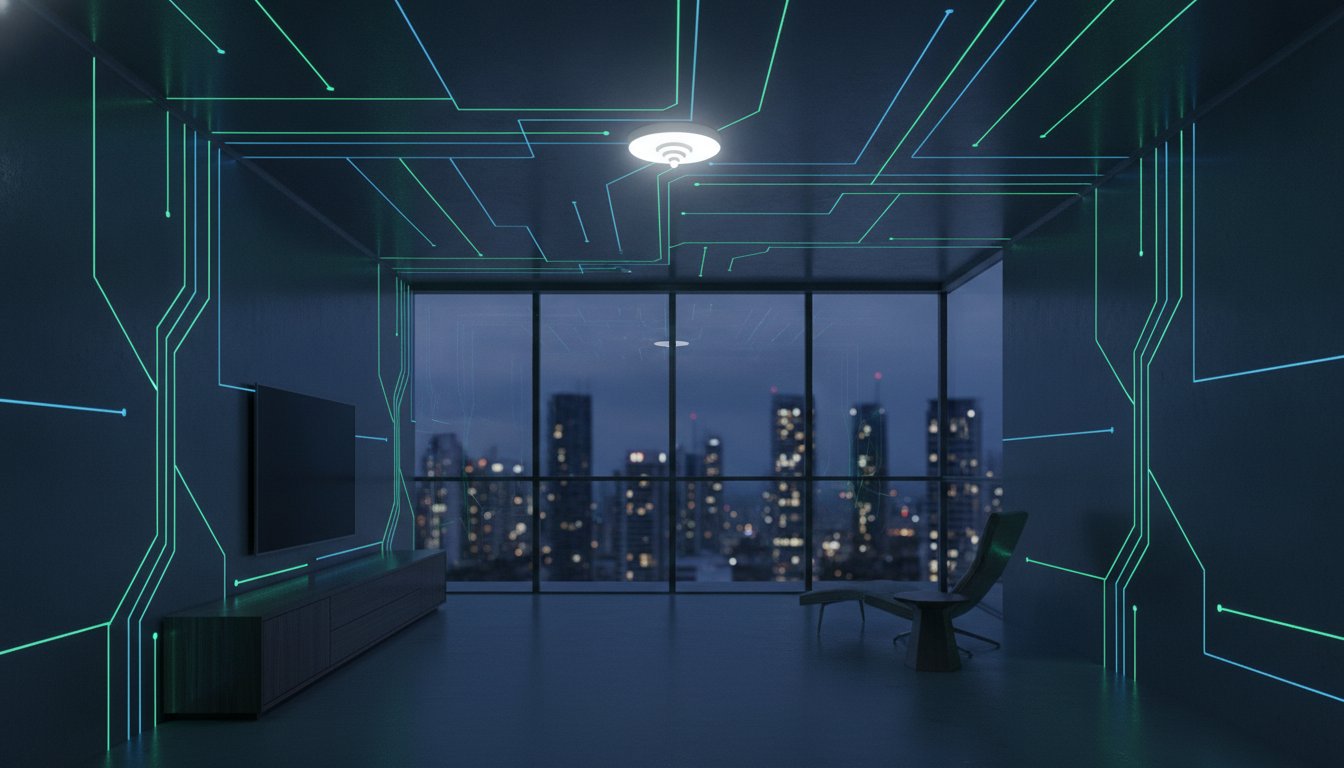
Your high-speed WiFi isn't actually wireless. It is a common misconception that going wireless means getting rid of cables, but the truth is that the most stable networks in Brisbane and the Gold Coast rely on a sophisticated physical infrastructure. Understanding how structured cabling improves wifi performance is the secret to moving beyond the limitations of standard consumer hardware and achieving a professional-grade connection.
We understand the headache of constant buffering during critical video calls or discovering dead zones in the far corners of a large property. You have likely tried rebooting the router or moving it to a different room, only to find the interference from neighbouring networks still causes frustrating lag. The bottleneck usually isn't the airwaves themselves, but the absence of a dedicated, hardwired backbone to support your wireless access points.
This guide explains why professional data cabling acts as the engine for your wireless environment, providing the necessary backhaul to eliminate signal dropouts and congestion. We will detail how a meticulous installation of Cat6A cabling prepares your property for the high-speed demands of WiFi 7, ensuring low-latency gaming, smooth streaming, and seamless roaming that handles the digital requirements of a modern lifestyle.
Key Takeaways
- Learn why an engineered wired backbone is the only reliable way to eliminate persistent dead zones and signal dropouts in large SE QLD properties.
- Discover exactly how structured cabling improves wifi performance by establishing a high-speed "wired backhaul" that prevents data bottlenecks at your access points.
- Understand why low latency is more critical than raw speed for applications like Zoom and gaming, and how hardwiring reduces your network's response time.
- Explore the Power over Ethernet (PoE) advantage, allowing you to position access points in optimal ceiling locations without requiring nearby power outlets.
- Find out why investing in professional Cat6A installation today ensures your infrastructure is ready to handle the massive throughput of future WiFi 7 standards.
The Myth of Wireless: Why WiFi Needs a Wired Foundation
Wireless is a bit of a misnomer. In a high-performance environment, air is often the weakest link. WiFi operates on shared radio frequencies where devices compete for "airtime fairness." When too many devices attempt to communicate simultaneously, the network slows down. This is exactly where understanding how structured cabling improves wifi performance becomes vital; it moves the heavy lifting from the air to a dedicated, physical path. By offloading the majority of your data traffic to a hardwired line, you free up the airwaves for mobile devices that actually need them, resulting in a more stable environment for everyone.
What is Structured Cabling in an Australian Context?
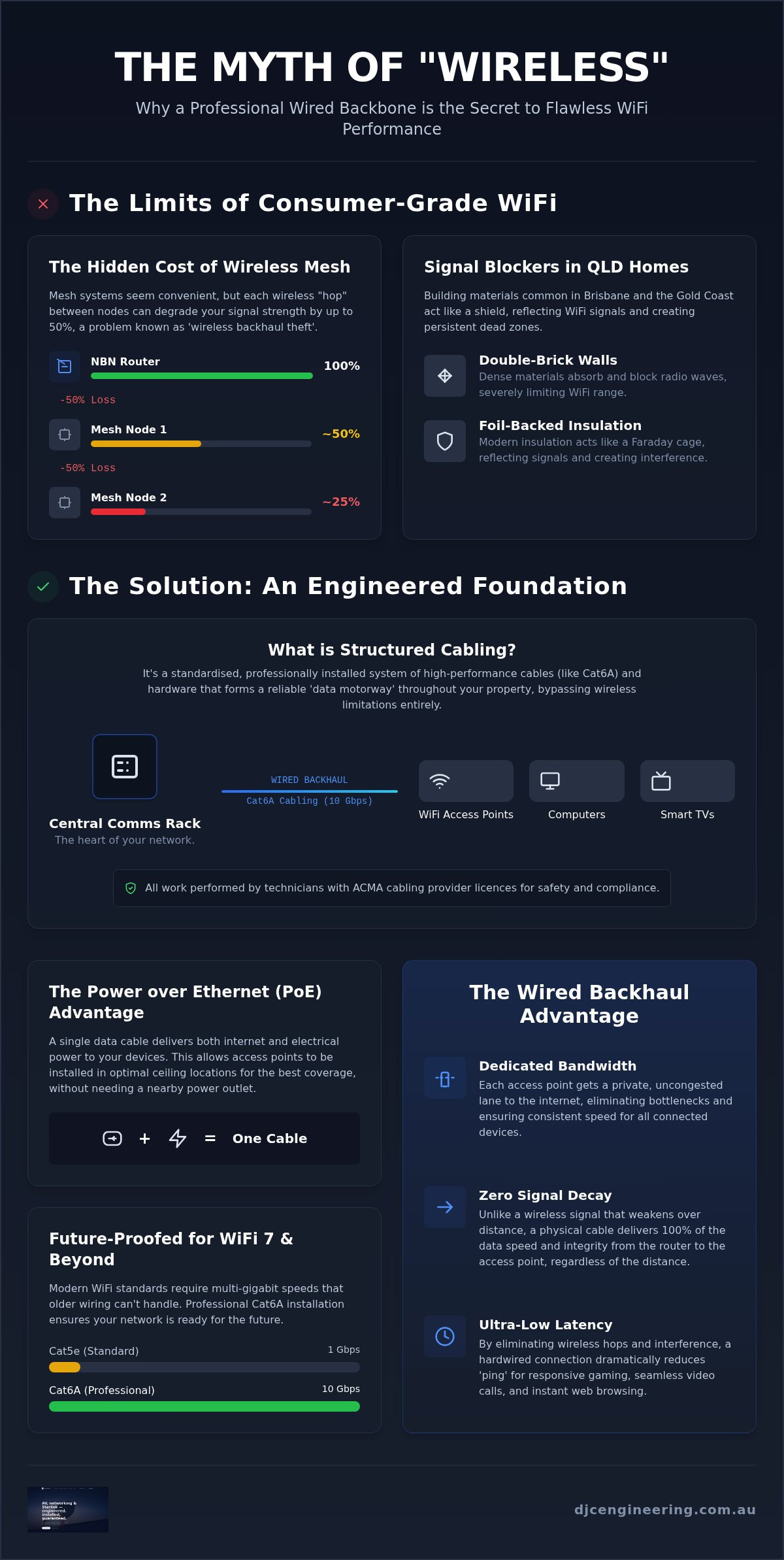
In the Gold Coast and Brisbane, professional Structured cabling refers to a standardised system of cabling and associated hardware that provides a comprehensive telecommunications infrastructure. Instead of running haphazard point-to-point wires through a ceiling cavity, we install a centralised hub, typically a wall-mounted comms rack, using high-grade Cat6 or Cat6A copper. This engineered backbone serves as the foundation for every digital service in your property, from security cameras to Starlink and NBN connections. In Australia, this work isn't a DIY project; it must be performed by technicians who hold ACMA cabling provider licences to ensure compliance with strict national safety and performance standards. This professional approach ensures that every termination is precise and every cable run is protected from electrical interference.
The Limitations of Wireless Mesh Systems
Many homeowners turn to "convenience wireless" solutions like Mesh systems to fix dead zones. While easy to set up, they come with a hidden cost. Every wireless "hop" between Mesh nodes typically degrades your throughput by roughly 50 percent because the nodes must use a portion of their radio bandwidth just to communicate with each other. This is known as wireless backhaul theft, and it's the primary cause of high ping and jitter during gaming or video calls. In South East Queensland, building materials often make this problem worse. Double-brick internal walls and modern foil-backed insulation act as a Faraday cage, reflecting signals and creating persistent dead spots. Professional data cabling bypasses these physical obstructions entirely, delivering a clean data stream directly to each access point. This hardwired foundation ensures that your "performance wireless" network actually reaches the speeds promised on the box by providing a dedicated motorway for your data to travel through.
Understanding Backhaul: How Cabling Feeds Your Access Points
Think of your WiFi access points as local distribution centres. If the motorway leading to those centres is congested or narrow, the local deliveries will fail regardless of how fast the local vans are. This is the essence of wired backhaul. It is the dedicated data motorway that feeds your wireless network. This physical connection is the primary reason for how structured cabling improves wifi performance; it ensures that the high-speed data from your modem reaches the access point without being throttled by signal drop-off.
Invisible congestion occurs when too many wireless devices compete for the same radio frequencies. Even if your router is capable of high speeds, it cannot process data faster than the airwaves allow. By using structured cabling to connect every fixed access point back to a central switch, you remove the "wireless-to-wireless" chatter that plagues Mesh systems. A physical copper connection provides 100 percent reliability. It operates with zero susceptibility to the signal fluctuations that cause lag during peak usage times.
- Dedicated Bandwidth: Each access point has a private lane to the internet, rather than sharing airtime.
- Zero Signal Decay: Data remains at full strength over the entire length of the cable run.
- Reduced Latency: Physical wires eliminate the processing delays found in wireless repeaters.
WiFi 6, 6E, and WiFi 7: The Need for Speed
Modern WiFi standards like WiFi 6E and WiFi 7 have fundamentally changed the requirements for internal wiring. These access points are now capable of delivering wireless speeds that exceed 1Gbps, meaning a standard Cat5e or even some older Cat6 cable runs will act as a bottleneck. To achieve the full potential of these devices, we utilise Cat6A cabling to support 2.5Gbps or 10Gbps wired uplinks. 10GBASE-T is the gold standard for 2026 home networks, providing the necessary bandwidth to ensure your wireless hardware isn't starved of data. This future-proofing is a core part of how structured cabling improves wifi performance in high-demand environments.
Symmetrical Speeds and NBN/Starlink Performance
Maximising your internet plan requires a stable injection point. For those using an NBN 1000 plan or a Starlink connection, the performance at the device depends entirely on the quality of the link between the satellite dish or NBN box and your router. Structured cabling ensures that these high-speed signals are preserved across the entire property without the packet loss common in wireless relays. This is particularly crucial for regional users who depend on our Starlink: High-Speed Internet Guide for Rural QLD to maintain consistent uptime. If you're looking to stabilise your connection, our team provides meticulous Networking & Structured Cabling services to ensure your hardware performs exactly as advertised.
Eliminating Interference and Latency with Hardwired Connections
Speed is often the headline, but latency is the real metric of network quality. Latency, or "ping," refers to the time it takes for a data packet to travel from your device to a server and back. For high-stakes applications like competitive gaming or professional Zoom calls, a high-speed connection with high latency is practically useless. This is a primary factor in how structured cabling improves wifi performance; by providing a direct, physical path for data, you bypass the inherent delays of wireless transmission. While WiFi signals must wait for a clear gap in the radio frequencies to send data, a hardwired connection operates with constant, dedicated access.
The physical environment inside your walls also poses a threat to signal integrity. Electrical cables running alongside data lines can create electromagnetic interference (EMI), leading to packet loss and retransmissions. We mitigate this by using shielded cabling, often referred to as Foiled Twisted Pair (FTP), which protects the data stream from "noise" generated by household appliances and power circuits. To maintain this integrity at the termination point, we utilise professional patch panels. These components provide a secure, organised interface that prevents signal degradation and ensures that every cable run meets its rated performance standard from the comms rack to the wall plate.
Reducing the Noise Floor in Dense Areas
In high-density areas like Brisbane and Gold Coast apartment blocks, "WiFi pollution" is a significant hurdle. When dozens of neighbouring routers operate on the same frequencies, the available airwaves become crowded, raising the noise floor and slowing down your connection. One of the most effective ways to combat this is to offload static devices, such as smart TVs, desktop PCs, and gaming consoles, onto a wired connection. This clears the air for mobile devices that truly need the wireless bandwidth. Wired connections support "Full Duplex" communication, meaning they can send and receive data simultaneously. This is a massive technical advantage over the "Half Duplex" nature of WiFi, which must take turns sending and receiving, effectively doubling your network's efficiency during heavy use.
Stability for High-Bandwidth Applications
Achieving a buffer-free experience for 4K and 8K streaming requires more than just raw megabits; it requires a perfectly steady stream of data. Any minor fluctuation in the wireless environment can cause a high-resolution video to drop in quality or pause entirely. By hardwiring your primary entertainment and work hubs, you ensure the stability required for these high-bandwidth applications. This infrastructure also enables seamless WiFi roaming. When your access points are coordinated via a wired switch, the system can intelligently hand off your device from one room to another without dropping the connection. To see how this looks in practice, explore our guide on Professional WiFi Design & Installation to understand the engineering behind a seamless SE QLD network.
Strategic Placement and Power: The PoE Advantage
Power over Ethernet (PoE) is the technical lynchpin that transforms a standard network into a high-performance system. By delivering both electrical power and high-speed data through a single Ethernet cable, PoE eliminates the need for licensed electricians to install 240V power points in ceiling cavities or high on walls. This flexibility is fundamental to how structured cabling improves wifi performance; it allows for meticulous placement based on signal requirements rather than the location of existing electrical outlets. When you aren't tethered to a wall socket, you can position hardware exactly where the radio frequency (RF) design dictates.
One often overlooked benefit in South East Queensland is the ability to centralise your power backup. By connecting the main PoE switch in your comms rack to an Uninterruptible Power Supply (UPS), your entire WiFi network remains operational during local storms or brownouts. This level of reliability is impossible with standalone desk routers that rely on individual wall sockets throughout the property. A single, high-quality UPS ensures that your wireless backbone stays alive, providing a level of accountability and uptime that consumer-grade setups simply cannot match.
Ceiling-Mounted Access Points vs. Desk Routers
The centre of the ceiling is the prime real estate for wireless transmission. Most consumer routers sit on desks or entertainment units, where signals are immediately absorbed by timber furniture, plasterboard walls, and floor-level obstacles. Mounting an access point on the ceiling provides an unobstructed, top-down signal path that mimics the way professional lighting is designed. This approach ensures maximum coverage across the floor plan while maintaining a clean, minimalist aesthetic. All cabling remains concealed within the ceiling void, terminating neatly at the access point without unsightly power bricks or tangled leads. This strategic flexibility is a core reason how structured cabling improves wifi performance in complex residential and commercial layouts.
Integrating Security and AV Systems
A robust wired infrastructure does not just serve your WiFi; it acts as the engineered backbone for your entire property. The same Cat6A cabling used for your wireless access points can simultaneously support high-definition CCTV cameras and sophisticated audio-visual systems. This unified approach allows us to organise all networking gear into a single, ventilated comms rack, making troubleshooting and future upgrades significantly easier. For business owners, this level of precision is essential, as detailed in our guide to Commercial Network Cabling Gold Coast. If you are ready to upgrade your property's infrastructure, contact us for a professional WiFi design and installation to ensure every component is calibrated for peak performance.
Future-Proofing Your SE QLD Property with Professional Data Cabling
Investing in a robust network infrastructure is about more than just immediate speed; it is about long-term accountability. In the rapidly evolving digital landscape of 2026, "doing it right once" is a financial strategy that saves thousands in future retrofitting costs. As wireless standards like WiFi 7 become the norm, the demand for high-capacity backhaul increases. This is the ultimate proof of how structured cabling improves wifi performance; it ensures that your physical infrastructure can handle the massive data throughput of tomorrow without requiring you to tear out your walls again in three years.
While Category 6 (Cat6) remains a viable option for basic installations, Category 6A (Cat6A) has become the baseline standard for any professional project in Brisbane or the Gold Coast. With its 500 MHz bandwidth and support for 10G Ethernet over full 100-metre runs, Cat6A provides the necessary thermal management for high-power PoE++ applications. For larger estates or commercial sites, we often integrate optical fibre to handle extreme distances or provide a lightning-fast link between separate buildings. Every installation we perform undergoes rigorous fluke testing. This verification process is how structured cabling improves wifi performance by guaranteeing that every termination meets the required standards for signal-to-noise ratio and crosstalk, ensuring the hardware performs at its absolute peak from day one.
The DJC Engineering Approach to Meticulous Installs
Our commitment to quality is visible in the details that most providers overlook. We refuse to take shortcuts like "daisy-chaining" access points or using inferior copper-clad aluminium (CCA) cables that degrade in the humid SE QLD climate. Instead, we focus on neatness, concealed components, and robust setups that stand up to local environmental challenges. Whether we are navigating the tight ceiling cavities of a Gold Coast high-rise or the sprawling floor plans of a Brisbane commercial centre, our licenced technicians prioritise precision. We understand how local building materials, such as foil-backed insulation and double-brick walls, impact signal propagation, and we design our cabling routes to bypass these obstacles entirely.
Ready to Upgrade Your Connectivity?
The transition from a frustrating, lag-heavy network to a precision-engineered system begins with a thorough technical assessment. We don't guess; we measure. By evaluating your property's specific layout and your current bandwidth demands, we can design a structured cabling solution that eliminates dead zones for good. This methodical workflow moves from initial assessment to final calibration, ensuring a professional finish that looks as good as it performs. If you are ready to experience the difference that an engineered backbone makes, contact DJC Engineering to book your professional assessment and secure a future-proof network for your home or business.
Engineered Reliability for Your Digital Lifestyle
A high-performance network is no longer a luxury; it's a fundamental requirement for modern South East Queensland properties. We have explored how an engineered backbone eliminates the inherent bottlenecks of wireless mesh systems and why Power over Ethernet provides the strategic flexibility needed for optimal ceiling placement. Understanding how structured cabling improves wifi performance allows you to move away from temporary fixes and toward a permanent, robust infrastructure that handles WiFi 7 and high-bandwidth streaming with ease.
At DJC Engineering, our ACMA licenced technicians specialise in technical integration across Gold Coast and Brisbane, delivering expert Starlink and NBN network designs that prioritise precision over shortcuts. We ensure every cable run is meticulously terminated and verified to handle the next generation of digital demands, providing you with a network that is both neat and incredibly powerful. Our methodical approach ensures that your connectivity is stable, fast, and completely seamless throughout your entire property.
Get a Professional WiFi & Cabling Assessment from DJC Engineering today to eliminate lag and future-proof your connectivity. It is time to stop fighting with your WiFi and start enjoying a high-speed connection that simply works.
Frequently Asked Questions
Does structured cabling actually increase my NBN speed?
Structured cabling doesn't increase the raw speed provided by your NBN provider, but it ensures that speed actually reaches your devices. WiFi signals naturally degrade over distance and through walls, meaning a 1000Mbps plan might only deliver 200Mbps over wireless. By hardwiring your primary hardware, you eliminate this overhead. This is a key example of how structured cabling improves wifi performance by providing a lossless path for your high-speed internet data.
Can I use existing phone lines for structured data cabling?
No, older phone lines are typically Category 3 cables, which are incapable of handling modern high-speed data. They lack the necessary twists and shielding required for NBN or Starlink speeds. For a reliable network, we replace these obsolete lines with high-grade Cat6 or Cat6A cabling. This upgrade transforms your property's infrastructure into a professional-grade system capable of supporting 10Gbps speeds and advanced security hardware without interference.
Is Cat6 or Cat6A better for a Gold Coast home in 2026?
Category 6A is the superior choice for Gold Coast homes in 2026. While Cat6 supports gigabit speeds, Cat6A is specifically engineered to handle 10Gbps over longer distances and provides better heat dissipation for high-power PoE++ devices. Choosing Cat6A ensures your home is ready for the massive throughput of WiFi 7. It is a one-time investment that prevents the need for expensive cable replacements as internet speeds continue to climb.
How many data points do I need for a standard four-bedroom house?
For a standard four-bedroom house, we typically recommend between 12 and 16 data points. This includes two points per bedroom for flexibility, two for the home office, and multiple points at the main entertainment hub for TVs and gaming consoles. We also include dedicated ceiling points for wireless access points. This structured approach ensures every high-bandwidth device is hardwired, leaving the airwaves clear for mobile phones and tablets to operate without congestion.
Will structured cabling help my Starlink connection perform better?
Yes, structured cabling is the most effective way to stabilise a Starlink connection. While the satellite dish provides the raw data, distributing that signal across a large property using only the Starlink router often leads to dropouts. By using a wired injection point, we can feed multiple access points throughout your home. This ensures that the high-speed satellite signal is preserved and delivered consistently to every corner of your property without wireless lag.
Can I install structured cabling myself or do I need a licenced technician?
In Australia, all data and telecommunications cabling must be installed by an ACMA licenced technician. It is illegal and unsafe to perform this work yourself, as it must comply with strict AS/CA S009 standards. Our team at DJC Engineering holds the necessary registrations to ensure your installation is compliant, safe, and professionally terminated. Using a professional also gives you the benefit of fluke testing, which verifies that every cable run meets its rated performance.
How does cabling improve WiFi roaming between different floors?
Cabling provides the essential communication link that allows multiple access points to work as a single, unified network. When your APs are connected via a wired backhaul, they can communicate instantly to manage "handoffs" as you move between floors. This prevents the common issue where a phone "clings" to a weak signal from a distant router. A wired foundation is the secret to achieving seamless roaming and consistent signal strength in multi-storey Gold Coast homes.
What is the typical lifespan of a professional structured cabling system?
A professionally installed structured cabling system typically has a lifespan of 15 to 20 years. By using high-quality Cat6A copper and robust termination components, the physical infrastructure will remain relevant through multiple generations of hardware upgrades. While you might swap out your routers or access points every few years, the engineered backbone stays in place. This longevity is why we prioritise meticulous installation and quality materials over quick, low-cost shortcuts that fail prematurely.
Frequently Asked Questions
In the Gold Coast and Brisbane, professional Structured cabling refers to a standardised system of cabling and associated hardware that provides a comprehensive telecommunications infrastructure. Instead of running haphazard point-to-point wires through a ceiling cavity, we install a centralised hub, typically a wall-mounted comms rack, using high-grade Cat6 or Cat6A copper. This engineered backbone serves as the foundation for every digital service in your property, from security cameras to Starlink and NBN connections. In Australia, this work isn't a DIY project; it must be performed by technicians who hold ACMA cabling provider licences to ensure compliance with strict national safety and performance standards. This professional approach ensures that every termination is precise and every cable run is protected from electrical interference.
The transition from a frustrating, lag-heavy network to a precision-engineered system begins with a thorough technical assessment. We don't guess; we measure. By evaluating your property's specific layout and your current bandwidth demands, we can design a structured cabling solution that eliminates dead zones for good. This methodical workflow moves from initial assessment to final calibration, ensuring a professional finish that looks as good as it performs. If you are ready to experience the difference that an engineered backbone makes, contact DJC Engineering to book your professional assessment and secure a future-proof network for your home or business. A high-performance network is no longer a luxury; it's a fundamental requirement for modern South East Queensland properties. We have explored how an engineered backbone eliminates the inherent bottlenecks of wireless mesh systems and why Power over Ethernet provides the strategic flexibility needed for optimal ceiling placement. Understanding how structured cabling improves wifi performance allows you to move away from temporary fixes and toward a permanent, robust infrastructure that handles WiFi 7 and high-bandwidth streaming with ease. At DJC Engineering, our ACMA licenced technicians specialise in technical integration across Gold Coast and Brisbane, delivering expert Starlink and NBN network designs that prioritise precision over shortcuts. We ensure every cable run is meticulously terminated and verified to handle the next generation of digital demands, providing you with a network that is both neat and incredibly powerful. Our methodical approach ensures that your connectivity is stable, fast, and completely seamless throughout your entire property. Get a Professional WiFi & Cabling Assessment from DJC Engineering today to eliminate lag and future-proof your connectivity. It is time to stop fighting with your WiFi and start enjoying a high-speed connection that simply works.
Structured cabling doesn't increase the raw speed provided by your NBN provider, but it ensures that speed actually reaches your devices. WiFi signals naturally degrade over distance and through walls, meaning a 1000Mbps plan might only deliver 200Mbps over wireless. By hardwiring your primary hardware, you eliminate this overhead. This is a key example of how structured cabling improves wifi performance by providing a lossless path for your high-speed internet data.
No, older phone lines are typically Category 3 cables, which are incapable of handling modern high-speed data. They lack the necessary twists and shielding required for NBN or Starlink speeds. For a reliable network, we replace these obsolete lines with high-grade Cat6 or Cat6A cabling. This upgrade transforms your property's infrastructure into a professional-grade system capable of supporting 10Gbps speeds and advanced security hardware without interference.
Category 6A is the superior choice for Gold Coast homes in 2026. While Cat6 supports gigabit speeds, Cat6A is specifically engineered to handle 10Gbps over longer distances and provides better heat dissipation for high-power PoE++ devices. Choosing Cat6A ensures your home is ready for the massive throughput of WiFi 7. It is a one-time investment that prevents the need for expensive cable replacements as internet speeds continue to climb.
For a standard four-bedroom house, we typically recommend between 12 and 16 data points. This includes two points per bedroom for flexibility, two for the home office, and multiple points at the main entertainment hub for TVs and gaming consoles. We also include dedicated ceiling points for wireless access points. This structured approach ensures every high-bandwidth device is hardwired, leaving the airwaves clear for mobile phones and tablets to operate without congestion.
Yes, structured cabling is the most effective way to stabilise a Starlink connection. While the satellite dish provides the raw data, distributing that signal across a large property using only the Starlink router often leads to dropouts. By using a wired injection point, we can feed multiple access points throughout your home. This ensures that the high-speed satellite signal is preserved and delivered consistently to every corner of your property without wireless lag.
In Australia, all data and telecommunications cabling must be installed by an ACMA licenced technician. It is illegal and unsafe to perform this work yourself, as it must comply with strict AS/CA S009 standards. Our team at DJC Engineering holds the necessary registrations to ensure your installation is compliant, safe, and professionally terminated. Using a professional also gives you the benefit of fluke testing, which verifies that every cable run meets its rated performance.
Cabling provides the essential communication link that allows multiple access points to work as a single, unified network. When your APs are connected via a wired backhaul, they can communicate instantly to manage "handoffs" as you move between floors. This prevents the common issue where a phone "clings" to a weak signal from a distant router. A wired foundation is the secret to achieving seamless roaming and consistent signal strength in multi-storey Gold Coast homes.
A professionally installed structured cabling system typically has a lifespan of 15 to 20 years. By using high-quality Cat6A copper and robust termination components, the physical infrastructure will remain relevant through multiple generations of hardware upgrades. While you might swap out your routers or access points every few years, the engineered backbone stays in place. This longevity is why we prioritise meticulous installation and quality materials over quick, low-cost shortcuts that fail prematurely.