
Commercial WiFi Design Brisbane: The Master Technician’s Guide to Business Connectivity

Why does your office network perform perfectly at 7:00 am but begin to stutter and drop video calls the moment your full team arrives? Most Brisbane businesses treat connectivity as a hardware purchase, yet true reliability is actually a complex engineering challenge. If you've struggled with dead zones in industrial sheds or frustrating hand-over gaps when roaming between access points, you know that a standard off-the-shelf solution isn't enough for a professional environment.
At DJC Engineering Pty Ltd, we understand that a stable network is the invisible backbone of your company. This master technician’s guide to commercial wifi design brisbane focuses on eliminating those technical bottlenecks through meticulous RF modelling and high-performance infrastructure. You'll learn how to master the engineering principles required to deliver symmetrical high-speed coverage and seamless transitions across your entire site. We will detail the physical installation standards and calibration steps needed to support 2026-standard WiFi 7 devices and enterprise-grade NBN connections, ensuring your business stays connected through rigorous ACMA-compliant standards and a no-shortcuts approach to cabling.
Key Takeaways
- Understand why high-density environments require strategic Radio Frequency mapping rather than simple hardware placement to maintain stable, enterprise-grade connections.
- Identify how specific Australian building materials, from Boral plasterboard to Brisbane CBD glazing, impact signal penetration and learn to engineer around these physical barriers.
- Follow a methodical five-step workflow for commercial wifi design brisbane that uses predictive modelling and onsite validation to eliminate dead zones before installation begins.
- Distinguish between simple signal strength and true network capacity to ensure your infrastructure handles the 2026 surge of WiFi 7 devices and high-speed data feeds.
- Discover why the "AP-on-a-stick" method is the only reliable way to physically verify signal performance and future-proof your office against peak-hour congestion.
The Blueprint for Connectivity: What Defines Professional Commercial WiFi Design?
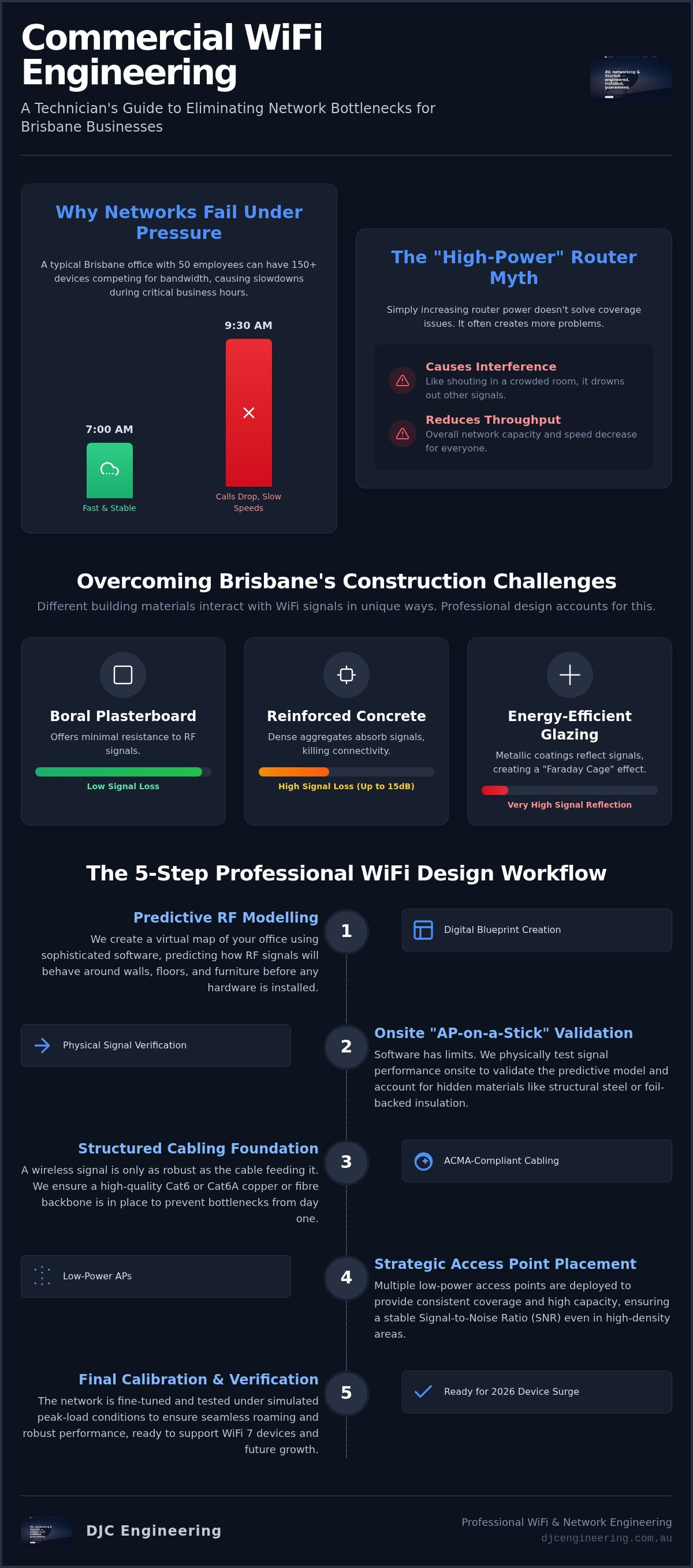
Professional commercial wifi design brisbane isn't about searching for a "strong" signal or buying the most expensive router on the shelf. It's the strategic mapping of Radio Frequency (RF) signals to match the specific architectural layout of your workspace. While a residential setup might focus on getting a signal to the back bedroom, commercial design is built around density and reliability. In a modern Brisbane office, fifty employees often bring 150 devices into the building, each competing for a slice of the available bandwidth. If your network hasn't been engineered to handle that specific load, it will fail during your most critical business hours.
Investing in a professionally engineered network provides a long-term ROI that saves your business from the recurring costs of "fixing" a poor setup. Every time a staff member has to restart their computer to reconnect to the network, or a video conference stutters during a client pitch, your bottom line takes a hit. We view the network as a structural component of your business. This design process always starts with the physical backbone. A wireless signal is only as robust as the copper or fibre feeding it. Without high-quality structured cabling (typically Cat6 or Cat6A) acting as the foundation, even the most advanced access points will be bottlenecked from day one.
The Myth of the High-Power Router
Many business owners believe that "turning up the power" on a router will extend its reach and solve dead zones. In reality, this often causes co-channel interference and actually reduces total throughput. Think of it like a crowded boardroom. One person shouting at the top of their lungs makes it impossible for anyone else to be heard clearly. A superior design uses multiple low-power access points that work in harmony to provide consistent coverage without overlapping. Signal-to-Noise Ratio (SNR) is the measure of signal strength relative to background interference; it's the primary metric that determines whether your data stream remains stable or drops out when the office gets busy.
Predictive Modelling vs. Passive Guesswork
We use sophisticated software simulations to create a virtual map of your Brisbane office, allowing us to predict how RF signals will behave before we ever drill a hole. This predictive modelling accounts for wall thickness and floor layouts, but software alone has its limits. It cannot always detect hidden structural steel or the foil-backed insulation common in South East Queensland industrial sheds. This is why a professional wireless site survey is essential to validate the virtual model against the physical reality of your building. For a deeper look at our technical standards, explore our guide on Professional WiFi Design & Installation. This meticulous approach ensures that your final installation delivers the high-performance results your business requires.
RF Physics: Overcoming Brisbane’s Commercial Construction Challenges
Successful commercial wifi design brisbane requires a deep understanding of the physical environment before a single cable is pulled. Brisbane’s architectural landscape is a mix of heritage double-brick, modern reinforced concrete, and standard Boral plasterboard. Each material interacts with Radio Frequency (RF) signals differently. While plasterboard offers minimal resistance, the dense aggregates in reinforced concrete can absorb up to 15dB of signal strength, effectively killing connectivity between floors. In the Brisbane CBD, energy-efficient glazing presents a unique hurdle. The metallic coatings used in modern high-rises to reflect heat also reflect WiFi signals, creating a "Faraday Cage" effect that traps internal signals while blocking external ones.
Frequency choice is the next critical variable. The 2.4GHz band travels further and penetrates walls better, but it's plagued by congestion in multi-tenanted buildings. Conversely, the 6GHz band utilised by WiFi 6E and WiFi 7 offers massive throughput but struggles to pass through even a single internal wall. Adhering to Wi-Fi Design Best Practices involves balancing these frequencies based on the specific attenuation of your building materials. This meticulous balancing act is a core tenet of commercial wifi design brisbane. Our team uses spectral analysis to map these invisible barriers, ensuring your hardware placement is mathematically sound rather than just convenient. If you're planning a new fit-out, consulting with a network specialist early can prevent costly retrofitting later.
Interference in High-Density Areas
In high-density hubs like Fortitude Valley or Eagle Farm, the airwaves are crowded. It isn't just other WiFi networks causing issues; industrial machinery, security sensors, and even poorly shielded microwave ovens create non-WiFi interference. We perform detailed spectral scans to identify these noise sources. This allows for precise channel planning that avoids the "hidden node" problem common in multi-tenanted commercial buildings, where overlapping signals cause devices to constantly drop and reconnect.
Outdoor and Industrial Considerations
Brisbane’s subtropical climate introduces environmental variables that residential hardware simply cannot handle. High humidity in SE QLD can subtly degrade RF propagation in outdoor spaces like cafes or logistics yards because water molecules absorb signal energy. For these environments, we deploy ruggedised, IP-rated hardware designed to withstand salt air and high temperatures. In large warehouses, we also account for multipath interference, where signals bounce off metal racking and concrete floors, creating "echoes" that confuse standard receivers. We calibrate for these reflections to ensure a stable, high-speed connection regardless of the facility's scale.
Coverage vs. Capacity: Engineering for the 2026 Device Surge
Full bars of signal don't guarantee a functional network. While coverage describes the physical reach of a wireless signal, capacity determines how many simultaneous data streams that signal can actually support. In a residential setting, a single access point might handle a handful of devices with ease. However, professional commercial wifi design brisbane must account for a much higher density. We calculate the device-per-AP ratio by assuming every employee carries at least three active connections: a laptop, a smartphone, and a tablet or smartwatch. For a Brisbane office with thirty staff, your network isn't managing 30 users; it's managing 90 competing signals before you even consider guests or shared hardware.
A critical component of managing this load is a feature known as Airtime Fairness. This technical protocol acts as a traffic controller, preventing older, legacy devices from hogging the available bandwidth. Without it, a single 2018-era laptop struggling with a weak signal can slow down the entire network by forcing the access point to wait for its slower data packets. In a modern business environment, high download speeds are secondary to low latency. Applications like 4K video conferencing and VoIP (Voice over IP) are extremely sensitive to jitter. If your network design prioritises raw speed over stable, low-latency transmission, your video calls will continue to stutter regardless of how many "bars" your devices show.
The Smart Office Capacity Crunch
The rise of commercial IoT has added a new layer of complexity to network engineering. Smart lighting, security sensors, and integrated AV systems all require constant, low-bandwidth connections that can clutter the primary frequency bands. We solve this through meticulous VLAN segmentation. By isolating these IoT devices and guest traffic onto their own virtual networks, we ensure that sensitive business data remains secure and unencumbered by background chatter. For a deeper look at how we integrate these complex requirements, explore our analysis of Commercial WiFi Systems tailored for Queensland businesses.
Designing for Seamless Roaming
Dropped calls during office roaming are usually the result of poor "hand-over" engineering. We implement the 802.11k, 802.11v, and 802.11r standards to ensure devices transition between access points without a break in connectivity. Without these protocols, you encounter "sticky clients," where a device clings to a distant, weak access point because it hasn't been told a better, closer option is available. Correct AP placement and power calibration are the only ways to force a clean hand-over, ensuring your staff can move from the boardroom to their desk without losing a single second of a live call.
The Meticulous Workflow: From Site Survey to Final Calibration
Our approach to commercial wifi design brisbane follows a disciplined, five-step engineering workflow: Consultation, Predictive Modelling, Onsite Validation, Installation, and Commissioning. We refuse to rely on the "shortcut" methods like video call surveys that some providers offer, as digital cameras cannot measure Radio Frequency interference or attenuation. Instead, we use the "AP-on-a-stick" method. This involves placing a temporary access point on a tripod at the planned height and location to physically verify signal penetration through your specific building materials before a single hole is drilled. This onsite validation ensures that the theoretical model matches the physical reality of your Brisbane workspace.
The foundation of this setup is the structured cabling. All our installations are performed by ACMA licensed technicians, ensuring compliance with Australian telecommunications standards like AS/NZS 62368.1:2026. Once the physical infrastructure is in place, we move to final calibration. This isn't just about checking if the lights are on; it's a rigorous validation process using professional diagnostic tools to ensure every square metre of your office meets the design specifications. We don't consider a project finished until the post-installation data confirms the network is performing exactly as engineered.
Heatmapping: The Science of Visualising Signal
Professional heatmapping is the science of making the invisible visible. Using industry-standard tools like Ekahau or AirMagnet, we generate a colour-coded map of your signal coverage and quality. This process identifies "grey zones" where signal strength is marginal and signal leakage where your network might be bleeding into the street or neighbouring offices. We engineer a precise amount of overlap between access points, which is essential for the seamless roaming protocols discussed earlier, preventing dead spots as staff move through the building.
The Backbone: Structured Cabling and PoE
A high-performance wireless network is only as capable as the copper or fibre backbone feeding it. We utilise Power over Ethernet (PoE) to deliver both data and power through a single cable, allowing us to mount access points in optimal high-ceiling positions or remote corners without needing separate electrical outlets. At DJC, we prioritise a clean, professional finish with meticulous focus on concealed components and neat cable management, ensuring your infrastructure is as aesthetically pleasing as it is robust. If you're ready for a network built on these rigorous standards, contact our engineering team today to begin your onsite assessment.
Future-Proofing Infrastructure: WiFi 7 and Starlink Integration
As we move through 2026, WiFi 7 has transitioned from a bleeding-edge luxury to the operational standard for new enterprise deployments. A forward-thinking commercial wifi design brisbane must now account for features like Multi-Link Operation (MLO). This technology allows devices to connect across the 5GHz and 6GHz bands simultaneously, which dramatically reduces latency and increases reliability for high-density offices. By engineering your network to support 320MHz channel widths, we ensure your internal infrastructure can actually distribute the full capacity provided by 10Gbps NBN Enterprise Ethernet or high-speed satellite feeds without creating a local bottleneck.
For businesses located in fringe-urban areas of Brisbane or the Gold Coast where fixed-line fibre is unavailable, Starlink for Business has become a vital primary connection. However, the raw speed of a satellite dish is often wasted by a poor internal distribution network. We specialise in marrying these modern backbones with high-performance internal WiFi systems. This requires a shift away from "good enough" consumer hardware toward a meticulously calibrated environment where every access point is positioned to maximise the specific throughput characteristics of the 6GHz spectrum.
Starlink for Commercial SE QLD
The standard Starlink router provided in the box is insufficient for commercial capacity and lacks the advanced routing features required for a secure business environment. We typically put the Starlink hardware into bypass mode, handing over the heavy lifting to professional-grade gateways and firewalls. This setup allows for better traffic shaping, VLAN management, and robust security protocols. To ensure the 99.9% uptime targets required for modern operations, we focus on meticulous mounting of the high-performance hardware kit, ensuring a clear line of sight and protection from the harsh South East Queensland elements.
The DJC Standard of Excellence
At DJC Engineering, we approach every project with the mindset of a master technician. We don't take shortcuts, we don't guess on signal penetration, and we don't consider a job complete until the final calibration matches our predictive models. This level of local accountability is what separates an engineered network from a generic hardware installation. Whether you are upgrading an existing office or designing a new industrial facility, your connectivity deserves a professional foundation. If your project requires an integrated technical plan, you may also be interested in our expertise in Security Camera Installation Gold Coast. Don't settle for a stuttering connection when you can have a network built for the demands of 2026 and beyond. Contact us today to discuss your Brisbane business infrastructure.
Secure Your Competitive Edge with Precision Engineering
Reliable connectivity is the silent engine of a modern enterprise. We've detailed how professional commercial wifi design brisbane transitions your network from a source of frustration to a high-performance asset. By addressing the physical realities of South East Queensland construction and engineering for the capacity demands of 2026, you ensure your team remains productive regardless of device density or architectural barriers. A robust network starts with a meticulous plan and ends with a validated, high-speed result that supports your long-term growth.
Our team of Licensed ACMA Cabling Technicians brings deep local knowledge to every project, specialising in the specific architectural challenges found across Brisbane and the Gold Coast. We provide a meticulous "no-shortcuts" installation guarantee that ensures your infrastructure is built to last. Don't leave your business connectivity to chance or settle for generic solutions that fail during peak hours. Contact DJC Engineering for a Professional WiFi Design Assessment and take the first step toward a future-proofed digital backbone. Your business deserves a network that works as hard as you do.
Frequently Asked Questions
What is the difference between a WiFi site survey and predictive design?
Predictive design uses sophisticated software to simulate Radio Frequency behaviour based on your office floor plans and estimated wall materials. A site survey is a physical, onsite validation where a technician measures actual signal attenuation using "AP-on-a-stick" methodology. This physical check is essential because software cannot always detect hidden structural steel or the foil-backed insulation common in Brisbane industrial sheds.
Why do mesh WiFi systems often fail in Brisbane commercial buildings?
Mesh systems rely on wireless backhaul to communicate between nodes, which is easily degraded by Brisbane’s common double-brick and concrete construction. In a busy office, the high device density quickly overwhelms the limited bandwidth of a wireless link. Professional commercial wifi design brisbane replaces these weak wireless connections with a robust, wired backbone to ensure stable, high-speed data delivery.
How many access points does a 500sqm office typically require?
A 500sqm office usually requires between four and six access points, depending on the internal layout and staff density. While a single enterprise-grade AP might cover 140 square metres in an open space, we engineer for capacity and signal overlap to ensure seamless roaming. We calculate the exact placement based on your specific device-per-user ratio to prevent network congestion during peak business hours.
Does professional WiFi design include the installation of data cabling?
Yes, a professional wireless network is inseparable from the structured cabling that feeds it. Our ACMA licensed technicians install high-quality Cat6 or Cat6A copper backbones to provide the necessary Power over Ethernet (PoE) and data throughput. Design and cabling must be integrated from the start to achieve a stable result that meets modern Australian telecommunications standards.
Can you design a network that works through concrete slabs and tilt-up panels?
We certainly can. Concrete slabs and tilt-up panels are significant barriers that require a strategic engineering approach rather than simply using high-power hardware. We map the specific attenuation of these materials and position access points to utilise corridors and reflections. This maintains consistent coverage across your site without losing signal strength to dense structural elements.
Is it worth upgrading to WiFi 7 for my business in 2026?
WiFi 7 is now the operational standard for 2026 deployments in Australia. With features like Multi-Link Operation (MLO), it provides the ultra-low latency required for modern VoIP and 4K video conferencing. Upgrading now future-proofs your infrastructure against the latest enterprise devices and ensures your network can handle the 320MHz channel widths offered by high-speed NBN feeds.
How does Starlink integrate with a custom commercial WiFi design?
We treat Starlink as a high-speed data source that feeds into a professional-grade gateway. By bypassing the standard Starlink router, we can distribute the satellite bandwidth through a professionally engineered internal network. This ensures the high-speed feed actually reaches every corner of your facility without being bottlenecked by the limited capacity of consumer-grade distribution hardware.
What technical tools do you use to create WiFi heatmaps?
We utilise industry-standard engineering platforms such as Ekahau and AirMagnet to create precise heatmaps. These tools allow us to visualise signal strength, interference, and Signal-to-Noise Ratio (SNR) across your entire floor plan. This data-driven approach removes the guesswork, allowing us to calibrate your network for peak performance and eliminate dead zones before the final commissioning process.
Frequently Asked Questions
Predictive design uses sophisticated software to simulate Radio Frequency behaviour based on your office floor plans and estimated wall materials. A site survey is a physical, onsite validation where a technician measures actual signal attenuation using "AP-on-a-stick" methodology. This physical check is essential because software cannot always detect hidden structural steel or the foil-backed insulation common in Brisbane industrial sheds.
Mesh systems rely on wireless backhaul to communicate between nodes, which is easily degraded by Brisbane’s common double-brick and concrete construction. In a busy office, the high device density quickly overwhelms the limited bandwidth of a wireless link. Professional commercial wifi design brisbane replaces these weak wireless connections with a robust, wired backbone to ensure stable, high-speed data delivery.
A 500sqm office usually requires between four and six access points, depending on the internal layout and staff density. While a single enterprise-grade AP might cover 140 square metres in an open space, we engineer for capacity and signal overlap to ensure seamless roaming. We calculate the exact placement based on your specific device-per-user ratio to prevent network congestion during peak business hours.
Yes, a professional wireless network is inseparable from the structured cabling that feeds it. Our ACMA licensed technicians install high-quality Cat6 or Cat6A copper backbones to provide the necessary Power over Ethernet (PoE) and data throughput. Design and cabling must be integrated from the start to achieve a stable result that meets modern Australian telecommunications standards.
We certainly can. Concrete slabs and tilt-up panels are significant barriers that require a strategic engineering approach rather than simply using high-power hardware. We map the specific attenuation of these materials and position access points to utilise corridors and reflections. This maintains consistent coverage across your site without losing signal strength to dense structural elements.
WiFi 7 is now the operational standard for 2026 deployments in Australia. With features like Multi-Link Operation (MLO), it provides the ultra-low latency required for modern VoIP and 4K video conferencing. Upgrading now future-proofs your infrastructure against the latest enterprise devices and ensures your network can handle the 320MHz channel widths offered by high-speed NBN feeds.
We treat Starlink as a high-speed data source that feeds into a professional-grade gateway. By bypassing the standard Starlink router, we can distribute the satellite bandwidth through a professionally engineered internal network. This ensures the high-speed feed actually reaches every corner of your facility without being bottlenecked by the limited capacity of consumer-grade distribution hardware.
We utilise industry-standard engineering platforms such as Ekahau and AirMagnet to create precise heatmaps. These tools allow us to visualise signal strength, interference, and Signal-to-Noise Ratio (SNR) across your entire floor plan. This data-driven approach removes the guesswork, allowing us to calibrate your network for peak performance and eliminate dead zones before the final commissioning process.