
Commercial WiFi Systems: Engineering High-Performance Networks for QLD Businesses
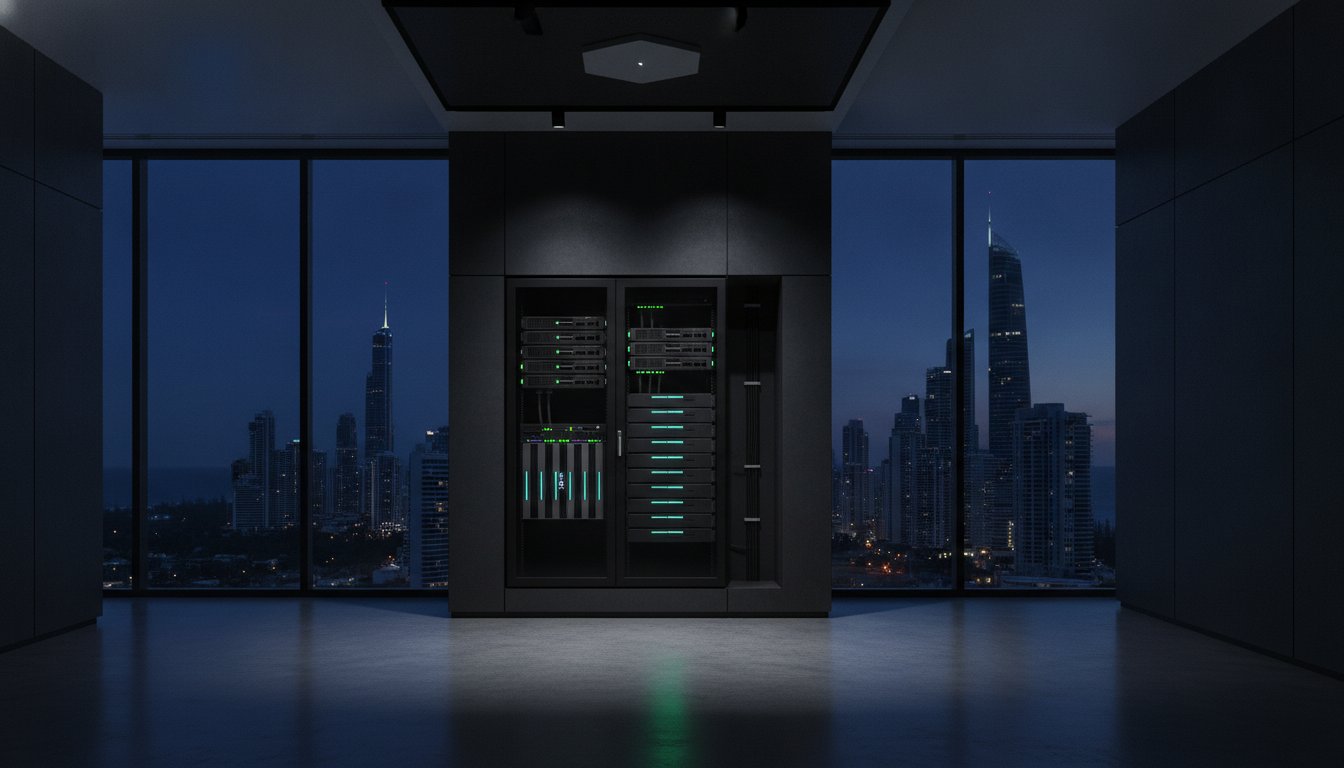
A premium NBN or Starlink connection is a wasted investment if your office WiFi is built on residential-grade shortcuts. Most QLD businesses assume a high-end router is a silver bullet. Yet, they still struggle with dead zones in the back warehouse and network crashes during the Monday morning rush. Engineering high-performance commercial wifi systems is a rigorous challenge of signal propagation and physical infrastructure, not just a hardware purchase.
It's frustrating when your digital backbone fails under pressure, especially when messy cabling and poorly positioned access points bottleneck your daily operations. You deserve a network that remains invisible because it simply works. Discover how to design a robust, commercial-grade system that supports high-density environments and provides seamless roaming across your entire premises. DJC Engineering Pty Ltd details the technical transition to WiFi 7, the necessity of ACMA-compliant structured cabling, and the methodical steps required to achieve a clean, professional finish without a single exposed wire.
Key Takeaways
- Understand why consumer-grade mesh kits fail in high-density environments and how a centralised management system ensures seamless roaming for your staff.
- Discover how professional heatmapping and RF design eliminate guesswork, allowing you to visualise signal propagation and eliminate dead zones before installation begins.
- Learn why robust structured cabling is the non-negotiable backbone for high-performance commercial wifi systems, providing the stability that wireless backhaul lacks.
- Master the integration of NBN and Starlink connectivity to ensure your South East Queensland business remains online with redundant, high-speed failovers.
- Identify the critical risks of using unlicensed labour and the long-term value of a meticulous, master-technician approach to network engineering.
What are Commercial WiFi Systems and Why Does Your Business Need One?
A high-performance office isn't built on consumer-grade hardware. While a home mesh kit might cover a three-bedroom house, it will buckle under the pressure of thirty staff members running concurrent video calls, cloud backups, and VoIP streams. True commercial wifi systems are engineered as a centralised environment where multiple Access Points (APs) work in unison under a single management controller. This setup ensures that your network isn't just a collection of independent signals, but a unified fabric that provides consistent connectivity regardless of where a staff member is standing.
High-density industrial or office settings present physical and electronic obstacles that residential kits simply can't bypass. Consumer mesh relies on wireless backhaul, where units talk to each other over the air. In a Brisbane warehouse with high-bay racking or a Gold Coast office with concrete core walls, this signal degrades instantly. A professional system uses a dedicated controller to manage traffic, security protocols, and channel interference. This level of control results in higher employee productivity and a drastic reduction in technical downtime. Understanding the fundamentals of Wi-Fi technology is the first step toward moving away from fragile, plug-and-play solutions toward a robust business infrastructure.
Access Points vs. Range Extenders: The Technical Difference
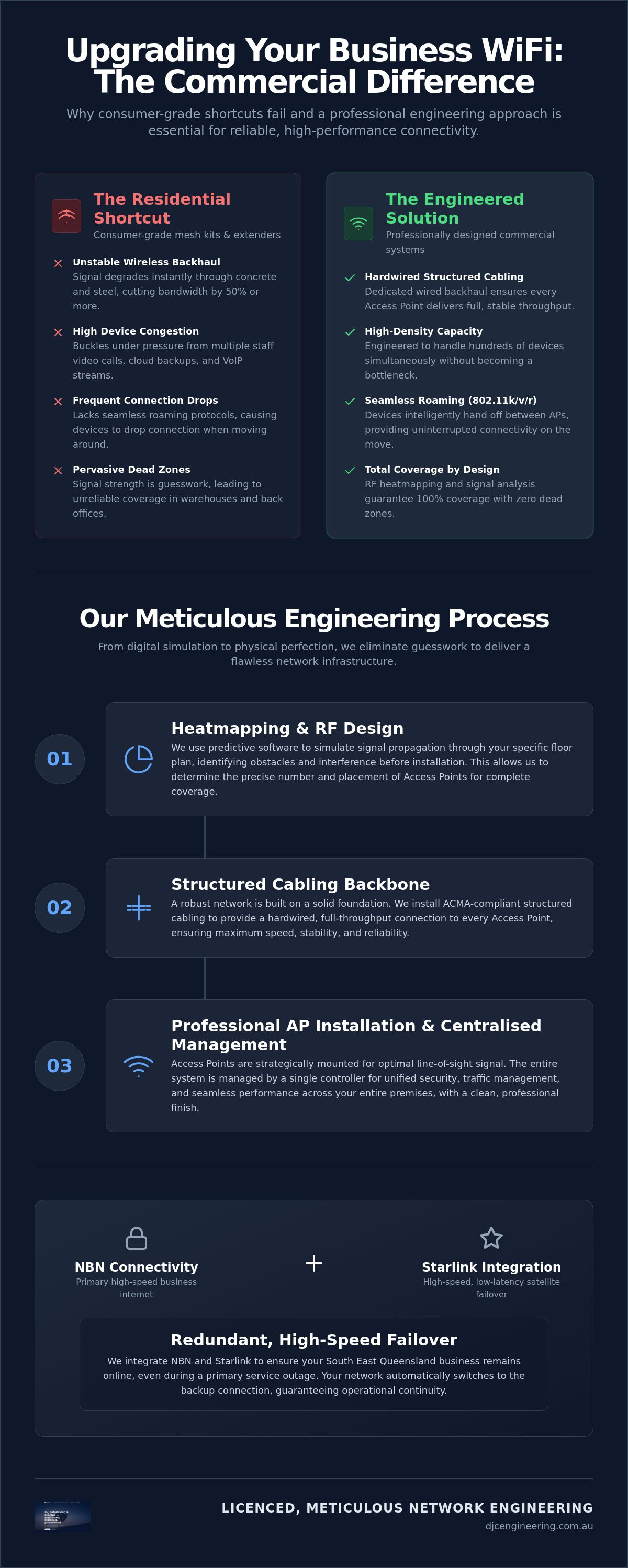
Range extenders are a compromise, not a solution. By design, an extender must receive a signal and then re-broadcast it, which effectively cuts your available bandwidth in half. It's a recipe for lag. In contrast, professional access points are hardwired back to a central switch via structured cabling. This allows them to maintain full throughput across the entire site. These systems also employ roaming standards such as 802.11k, v, and r. These protocols allow devices to hand off between APs without dropping the connection, ensuring a seamless roaming experience as you move through the building.
Capacity vs. Coverage: Designing for Device Density
Coverage is easy; capacity is the real engineering challenge. You might see full bars on your laptop, but if fifty devices are fighting for airtime on a single radio, your connection will crawl. We calculate a precise device-per-AP ratio to ensure no single point becomes a bottleneck during peak hours. Signal bars only indicate the strength of the connection to the nearest AP, not the actual quality or speed of the data flow. In high-density commercial environments, spectral efficiency is the measure of how effectively a system transmits data across a specific frequency range while minimising interference and overhead.
The Engineering Approach: Heatmapping and RF Design
High-performance commercial wifi systems aren't achieved by chance. They are the result of meticulous planning and physical verification. Before we pull a single metre of cable, we perform a comprehensive site survey to understand the unique "RF footprint" of your premises. This process involves using predictive heatmapping software to simulate how radio waves will interact with your specific floor plan. By inputting the exact dimensions and material properties of your walls and ceilings, we can determine the precise number of access points required to eliminate dead zones without over-saturating the environment.
In crowded business hubs like the Brisbane CBD or industrial estates across the Gold Coast, the airwaves are often congested. We identify external RF interference from neighbouring businesses, heavy machinery, or even high-voltage electrical panels. A critical part of our engineering phase is optimising channel selection to avoid co-channel interference. This occurs when multiple access points operate on the same frequency, leading to data collisions that slow your network to a crawl. If you are planning a new fit-out, professional network design ensures your infrastructure is calibrated for your specific location from day one.
Signal Propagation and Obstacle Analysis
Building materials significantly dictate network performance. Tilt-up concrete slabs and heavy steel beams, common in South East Queensland warehouses, act as sponges for WiFi signals. We apply the principle of Free Space Path Loss to calculate how much a signal will naturally weaken as it travels. To combat this, we prioritise ceiling-mounted access points. This placement provides a clear line of sight to client devices, avoiding the signal absorption caused by office furniture or partitions that typically happens with wall-mounted units. All our installations adhere to international structured cabling standards to ensure the physical backbone is as reliable as the wireless signal.
Frequency Coordination: 2.4GHz, 5GHz, and 6GHz
Modern networks must balance range with speed. We utilise the 2.4GHz band for low-bandwidth devices that need to connect from a distance, while reserving the 5GHz and 6GHz bands for high-speed data tasks. With the recent ACMA updates to the 6GHz spectrum, future-proofing your business with WiFi 6E or WiFi 7 is now a viable strategy for high-density offices. This new spectrum offers a "fast lane" with virtually zero interference. Additionally, we engineer separate VLANs for guest networks. This allows visitors to access the internet without ever touching your internal business servers, maintaining a strict security perimeter.
Structured Cabling: The Hardwired Backbone of Wireless Success
Wireless connectivity is only as reliable as the physical wire it's plugged into. For high-performance commercial wifi systems, every access point must have a dedicated, hardwired data connection to the core network. While consumer mesh systems often rely on "wireless backhaul" to daisy-chain units together, this approach is fundamentally flawed for business environments. Each wireless hop between units introduces latency and consumes valuable airtime, effectively halving your potential throughput. By hardwiring each AP, we ensure the wireless signal has an immediate, high-speed path to your server or internet gateway, providing the stability required for VoIP and real-time cloud applications.
We utilise Cat6 or Cat6A cabling as the baseline for all professional installations. While Cat6 is sufficient for standard Gigabit speeds, Cat6A provides the 10Gbps potential necessary to support the massive data requirements of WiFi 7 hardware. This infrastructure isn't just about raw speed; it's about power. We leverage Power over Ethernet (PoE) technology to deliver both high-speed data and electrical power through a single cable. This eliminates the need for separate power outlets at every mounting location, allowing for a cleaner installation and centralised power management from your communications room.
Data Cabling Standards for QLD Businesses
Cat6 is the minimum standard for any modern commercial fit-out. In Queensland, all telecommunications cabling must be performed by a registered cabler to ensure compliance with Australian safety and performance standards. We centralise your network "brain" within a professional communications rack, where patch panels and switches are neatly organised and ventilated. This structured approach prevents the common "spaghetti" of cables that leads to overheating and makes future network maintenance a nightmare for your IT staff.
Meticulous Installation: The DJC Engineering Pty Ltd Standard
A professional installation should be invisible to the end user. We prioritise concealing cables within wall cavities or ceiling voids to maintain a clean-finish aesthetic. Every data point we install is digitally tested for signal integrity and clearly labelled at both the wall plate and the patch panel; this meticulous documentation ensures that troubleshooting or future expansions are straightforward. Our mounting solutions are selected for durability, ensuring access points remain secure whether they are installed in a high-traffic retail centre or a vibrating industrial warehouse environment.
Local Connectivity: Integrating NBN and Starlink in South East Queensland
Reliable commercial wifi systems are only as effective as the WAN connection feeding them. In South East Queensland, businesses often face a choice between NBN Enterprise Ethernet and Starlink, or ideally, a combination of both. While NBN remains the primary fixed-line infrastructure, Starlink has evolved into a critical tool for sites in the Gold Coast hinterland or as a high-speed redundant backup for Brisbane CBD offices. Integrating these services requires more than just plugging in a cable; it demands a sophisticated gateway capable of managing multi-WAN traffic without dropping active sessions.
Load balancing is the gold standard for zero-downtime operations. By configuring a dual-WAN router, we can distribute traffic across both NBN and Starlink simultaneously. If your primary NBN fibre line is compromised during a storm or civil works, the system automatically shifts critical traffic to the satellite link. This transition is seamless, ensuring that VoIP calls and cloud-based POS systems remain online. Additionally, we account for the unique Queensland climate. Outdoor access points must be industrial-grade to withstand extreme heat and humidity, which can cause consumer hardware to thermally throttle or fail prematurely.
Starlink for Business: Beyond the Rural Myth
Many Brisbane businesses now deploy Starlink as a high-speed failover. With download speeds typically ranging from 40 to 220 Mbps, it provides a robust alternative when fixed lines fail. Bridging Starlink into a commercial network requires bypassing the standard consumer router to avoid "double NAT" issues that break VPNs and security cameras. We use professional mounting solutions, such as non-penetrating roof mounts or custom masts, to ensure a clear line of sight to the satellite constellation, even during heavy tropical downpours.
NBN Optimisation for High-Density WiFi
Symmetric NBN Fibre plans allow for equal upload and download speeds, which is vital for businesses hosting their own servers or running constant video conferencing. We configure your network's Quality of Service (QoS) settings to prioritise this sensitive traffic over background data like software updates. Having a technician who understands the South East QLD grid is an advantage, as we can calibrate your hardware to the specific hand-off requirements of local providers. If you need a resilient connection for your premises, our team can optimise your Starlink or NBN connection for maximum performance.
Choosing a Commercial WiFi Partner: Why Licenced Expertise Matters
Deploying commercial wifi systems is a high-stakes engineering task that should never be left to a general handyman or an unlicenced contractor. While a "quick fix" might restore connectivity temporarily, it often ignores the underlying issues of signal interference, cable crosstalk, and hardware thermal limits. A master technician views your network as a unified system rather than a series of isolated boxes. We prioritise the long-term stability of your infrastructure, ensuring that every component is installed to a standard that supports future scalability as your business grows and device density increases.
The difference between a generic installation and a professional one becomes clear during the handover process. We don't just walk away once the "WiFi is on." A rigorous handover includes comprehensive network maps, signal strength verification, and speed tests from every corner of your premises. This documentation is vital for your internal IT teams and ensures that any future troubleshooting is based on data, not guesswork. By building a robust foundation from day one, you avoid the compounding costs of technical debt and frequent service calls.
Licenced Technicians vs. General Contractors
In Australia, the law is clear: any person performing telecommunications cabling work must be a registered cabler. Our technicians hold the ACMA Open Cabling Registration, which is a legal requirement for installing the structured cabling that feeds your access points. General contractors often lack the specific technical authority required to integrate complex security, CCTV, and AV systems into a single managed network. As a locally owned South East Queensland business, DJC Engineering Pty Ltd takes full accountability for our work, providing the grounded reliability that national generic service providers simply cannot match.
The DJC Engineering Pty Ltd Meticulous Process
Our workflow is designed to eliminate the variables that cause network failure. We move through a disciplined progression from the initial site assessment to the final signal calibration. This methodical approach ensures that every access point is positioned for maximum throughput and every cable is routed to avoid electrical interference. We maintain a strict commitment to neatness; our philosophy is that if a rack is messy or a cable is exposed, the job isn't finished. Our Gold Coast and Brisbane clients receive a result that is as visually professional as it is technically superior.
- Physical Verification: We test every data point to ensure it meets Gigabit or 10Gbps standards.
- Aesthetic Integrity: All hardware is mounted securely and cables are concealed within building cavities.
- Local Knowledge: We understand the specific environmental challenges of the QLD climate and building styles.
- Full Documentation: You receive a complete map of your network for total transparency.
Organise a professional WiFi design for your business today and ensure your network is built to last without shortcuts.
Future-Proof Your QLD Business with High-Performance Wireless Infrastructure
Engineering a network that supports a high-density office or a sprawling warehouse requires more than just high-end hardware. It demands a meticulous approach to signal propagation and a hardwired backbone that eliminates the inherent limitations of wireless mesh. By prioritising predictive heatmapping and ACMA-compliant structured cabling, you ensure your infrastructure is ready for the demands of WiFi 7 and beyond. Whether you are integrating NBN Enterprise Ethernet in the Brisbane CBD or deploying Starlink as a redundant failover in the Gold Coast hinterland, the technical execution of your installation determines your long-term success.
Don't settle for shortcuts that lead to dead zones and technical downtime. Our team of licenced ACMA technicians specialises in the design and installation of robust commercial wifi systems across South East Queensland. We focus on clean, professional finishes and high-performance calibration to keep your operations running at peak efficiency. We take pride in seeing a project through from the initial RF assessment to the final signal verification.
Get a meticulous WiFi design and installation quote from DJC Engineering Pty Ltd
Invest in a network that works as hard as you do and enjoy the confidence of a professional, engineered solution.
Frequently Asked Questions
What is the best commercial WiFi system for a warehouse?
The best system for a warehouse environment utilises industrial-grade access points with high-gain antennas designed to penetrate high-bay racking and heavy steel inventory. Unlike standard office units, these systems are engineered to handle the "Free Space Path Loss" common in vast, open structures. We prioritise hardware with ruggedised enclosures that can withstand the dust and temperature fluctuations found in South East Queensland industrial sheds.
How many access points do I need for a 500sqm office?
A typical 500sqm office usually requires between three and five access points, but the exact number depends on your internal wall materials and device density. An open-plan layout with glass partitions has different RF requirements than an older building with brick internal walls. We use predictive heatmapping to determine the precise placement needed to ensure every desk receives a high-capacity signal without co-channel interference.
Can I use a mesh WiFi system for my business?
We don't recommend consumer mesh systems for business use because they rely on wireless backhaul, which inherently increases latency and reduces bandwidth. Professional commercial wifi systems require every access point to be hardwired via Cat6 or Cat6A cabling. This ensures each unit has a dedicated gigabit path to the network switch, providing the stability needed for high-density operations and seamless roaming.
What is the difference between WiFi 6 and WiFi 7 for commercial use?
WiFi 7 offers significantly higher throughput and lower latency than WiFi 6 by utilising 320MHz channel widths and Multi-Link Operation (MLO). While WiFi 6 is robust, WiFi 7 is the superior choice for future-proofing in 2026, especially as more devices move into the 6GHz band. Under the ACMA 2025 Class Licence, businesses can now leverage this wider spectrum to avoid the congestion found in the older 2.4GHz and 5GHz frequencies.
How much does it cost to install a commercial WiFi system in Brisbane?
Installation costs are dictated by the number of required data points, the complexity of the cabling runs, and the specific hardware standards chosen. A multi-storey office fit-out involves different labour requirements than a single-level retail space. We provide a detailed quote following a site assessment, focusing on a meticulous installation that avoids the long-term costs associated with poor coverage and technical shortcuts.
Do I need a new NBN plan to improve my business WiFi?
Your WiFi performance is capped by your incoming internet speed, so an outdated plan can certainly act as a bottleneck. With NBN wholesale price adjustments occurring in July 2026, it's a practical time to review your bandwidth. For high-density WiFi to thrive, we recommend symmetric plans like NBN Enterprise Ethernet, which provide the consistent upload speeds required for cloud-heavy business operations.
How long does a professional WiFi installation typically take?
A professional installation for a standard office typically takes one to two business days, while large-scale warehouse projects may take a week or more. This timeframe includes the physical installation of structured cabling, secure hardware mounting, and a rigorous final calibration phase. We don't consider a job finished until we've verified signal strength and data integrity across every square metre of the premises.
Is Starlink fast enough to run a commercial WiFi network?
Starlink is more than capable of supporting a commercial network, particularly the Starlink Business plans which offer download speeds between 40 and 220 Mbps. It's an excellent solution for Gold Coast hinterland sites where fixed-line NBN may be underperforming. When integrated correctly with a commercial-grade router, it provides a stable and high-speed primary or failover connection for modern business needs.
Frequently Asked Questions
Range extenders are a compromise, not a solution. By design, an extender must receive a signal and then re-broadcast it, which effectively cuts your available bandwidth in half. It's a recipe for lag. In contrast, professional access points are hardwired back to a central switch via structured cabling. This allows them to maintain full throughput across the entire site. These systems also employ roaming standards such as 802.11k, v, and r. These protocols allow devices to hand off between APs without dropping the connection, ensuring a seamless roaming experience as you move through the building.
Coverage is easy; capacity is the real engineering challenge. You might see full bars on your laptop, but if fifty devices are fighting for airtime on a single radio, your connection will crawl. We calculate a precise device-per-AP ratio to ensure no single point becomes a bottleneck during peak hours. Signal bars only indicate the strength of the connection to the nearest AP, not the actual quality or speed of the data flow. In high-density commercial environments, spectral efficiency is the measure of how effectively a system transmits data across a specific frequency range while minimising interference and overhead. High-performance commercial wifi systems aren't achieved by chance. They are the result of meticulous planning and physical verification. Before we pull a single metre of cable, we perform a comprehensive site survey to understand the unique "RF footprint" of your premises. This process involves using predictive heatmapping software to simulate how radio waves will interact with your specific floor plan. By inputting the exact dimensions and material properties of your walls and ceilings, we can determine the precise number of access points required to eliminate dead zones without over-saturating the environment. In crowded business hubs like the Brisbane CBD or industrial estates across the Gold Coast, the airwaves are often congested. We identify external RF interference from neighbouring businesses, heavy machinery, or even high-voltage electrical panels. A critical part of our engineering phase is optimising channel selection to avoid co-channel interference. This occurs when multiple access points operate on the same frequency, leading to data collisions that slow your network to a crawl. If you are planning a new fit-out, professional network design ensures your infrastructure is calibrated for your specific location from day one.
Building materials significantly dictate network performance. Tilt-up concrete slabs and heavy steel beams, common in South East Queensland warehouses, act as sponges for WiFi signals. We apply the principle of Free Space Path Loss to calculate how much a signal will naturally weaken as it travels. To combat this, we prioritise ceiling-mounted access points. This placement provides a clear line of sight to client devices, avoiding the signal absorption caused by office furniture or partitions that typically happens with wall-mounted units. All our installations adhere to international structured cabling standards to ensure the physical backbone is as reliable as the wireless signal.
Modern networks must balance range with speed. We utilise the 2.4GHz band for low-bandwidth devices that need to connect from a distance, while reserving the 5GHz and 6GHz bands for high-speed data tasks. With the recent ACMA updates to the 6GHz spectrum, future-proofing your business with WiFi 6E or WiFi 7 is now a viable strategy for high-density offices. This new spectrum offers a "fast lane" with virtually zero interference. Additionally, we engineer separate VLANs for guest networks. This allows visitors to access the internet without ever touching your internal business servers, maintaining a strict security perimeter. Wireless connectivity is only as reliable as the physical wire it's plugged into. For high-performance commercial wifi systems, every access point must have a dedicated, hardwired data connection to the core network. While consumer mesh systems often rely on "wireless backhaul" to daisy-chain units together, this approach is fundamentally flawed for business environments. Each wireless hop between units introduces latency and consumes valuable airtime, effectively halving your potential throughput. By hardwiring each AP, we ensure the wireless signal has an immediate, high-speed path to your server or internet gateway, providing the stability required for VoIP and real-time cloud applications. We utilise Cat6 or Cat6A cabling as the baseline for all professional installations. While Cat6 is sufficient for standard Gigabit speeds, Cat6A provides the 10Gbps potential necessary to support the massive data requirements of WiFi 7 hardware. This infrastructure isn't just about raw speed; it's about power. We leverage Power over Ethernet (PoE) technology to deliver both high-speed data and electrical power through a single cable. This eliminates the need for separate power outlets at every mounting location, allowing for a cleaner installation and centralised power management from your communications room.
Cat6 is the minimum standard for any modern commercial fit-out. In Queensland, all telecommunications cabling must be performed by a registered cabler to ensure compliance with Australian safety and performance standards. We centralise your network "brain" within a professional communications rack, where patch panels and switches are neatly organised and ventilated. This structured approach prevents the common "spaghetti" of cables that leads to overheating and makes future network maintenance a nightmare for your IT staff.
A professional installation should be invisible to the end user. We prioritise concealing cables within wall cavities or ceiling voids to maintain a clean-finish aesthetic. Every data point we install is digitally tested for signal integrity and clearly labelled at both the wall plate and the patch panel; this meticulous documentation ensures that troubleshooting or future expansions are straightforward. Our mounting solutions are selected for durability, ensuring access points remain secure whether they are installed in a high-traffic retail centre or a vibrating industrial warehouse environment. Reliable commercial wifi systems are only as effective as the WAN connection feeding them. In South East Queensland, businesses often face a choice between NBN Enterprise Ethernet and Starlink, or ideally, a combination of both. While NBN remains the primary fixed-line infrastructure, Starlink has evolved into a critical tool for sites in the Gold Coast hinterland or as a high-speed redundant backup for Brisbane CBD offices. Integrating these services requires more than just plugging in a cable; it demands a sophisticated gateway capable of managing multi-WAN traffic without dropping active sessions. Load balancing is the gold standard for zero-downtime operations. By configuring a dual-WAN router, we can distribute traffic across both NBN and Starlink simultaneously. If your primary NBN fibre line is compromised during a storm or civil works, the system automatically shifts critical traffic to the satellite link. This transition is seamless, ensuring that VoIP calls and cloud-based POS systems remain online. Additionally, we account for the unique Queensland climate. Outdoor access points must be industrial-grade to withstand extreme heat and humidity, which can cause consumer hardware to thermally throttle or fail prematurely.
Many Brisbane businesses now deploy Starlink as a high-speed failover. With download speeds typically ranging from 40 to 220 Mbps, it provides a robust alternative when fixed lines fail. Bridging Starlink into a commercial network requires bypassing the standard consumer router to avoid "double NAT" issues that break VPNs and security cameras. We use professional mounting solutions, such as non-penetrating roof mounts or custom masts, to ensure a clear line of sight to the satellite constellation, even during heavy tropical downpours.
Symmetric NBN Fibre plans allow for equal upload and download speeds, which is vital for businesses hosting their own servers or running constant video conferencing. We configure your network's Quality of Service (QoS) settings to prioritise this sensitive traffic over background data like software updates. Having a technician who understands the South East QLD grid is an advantage, as we can calibrate your hardware to the specific hand-off requirements of local providers. If you need a resilient connection for your premises, our team can optimise your Starlink or NBN connection for maximum performance. Deploying commercial wifi systems is a high-stakes engineering task that should never be left to a general handyman or an unlicenced contractor. While a "quick fix" might restore connectivity temporarily, it often ignores the underlying issues of signal interference, cable crosstalk, and hardware thermal limits. A master technician views your network as a unified system rather than a series of isolated boxes. We prioritise the long-term stability of your infrastructure, ensuring that every component is installed to a standard that supports future scalability as your business grows and device density increases. The difference between a generic installation and a professional one becomes clear during the handover process. We don't just walk away once the "WiFi is on." A rigorous handover includes comprehensive network maps, signal strength verification, and speed tests from every corner of your premises. This documentation is vital for your internal IT teams and ensures that any future troubleshooting is based on data, not guesswork. By building a robust foundation from day one, you avoid the compounding costs of technical debt and frequent service calls.
In Australia, the law is clear: any person performing telecommunications cabling work must be a registered cabler. Our technicians hold the ACMA Open Cabling Registration, which is a legal requirement for installing the structured cabling that feeds your access points. General contractors often lack the specific technical authority required to integrate complex security, CCTV, and AV systems into a single managed network. As a locally owned South East Queensland business, DJC Engineering Pty Ltd takes full accountability for our work, providing the grounded reliability that national generic service providers simply cannot match.
Our workflow is designed to eliminate the variables that cause network failure. We move through a disciplined progression from the initial site assessment to the final signal calibration. This methodical approach ensures that every access point is positioned for maximum throughput and every cable is routed to avoid electrical interference. We maintain a strict commitment to neatness; our philosophy is that if a rack is messy or a cable is exposed, the job isn't finished. Our Gold Coast and Brisbane clients receive a result that is as visually professional as it is technically superior. Organise a professional WiFi design for your business today and ensure your network is built to last without shortcuts. Engineering a network that supports a high-density office or a sprawling warehouse requires more than just high-end hardware. It demands a meticulous approach to signal propagation and a hardwired backbone that eliminates the inherent limitations of wireless mesh. By prioritising predictive heatmapping and ACMA-compliant structured cabling, you ensure your infrastructure is ready for the demands of WiFi 7 and beyond. Whether you are integrating NBN Enterprise Ethernet in the Brisbane CBD or deploying Starlink as a redundant failover in the Gold Coast hinterland, the technical execution of your installation determines your long-term success. Don't settle for shortcuts that lead to dead zones and technical downtime. Our team of licenced ACMA technicians specialises in the design and installation of robust commercial wifi systems across South East Queensland. We focus on clean, professional finishes and high-performance calibration to keep your operations running at peak efficiency. We take pride in seeing a project through from the initial RF assessment to the final signal verification. Get a meticulous WiFi design and installation quote from DJC Engineering Invest in a network that works as hard as you do and enjoy the confidence of a professional, engineered solution.
The best system for a warehouse environment utilises industrial-grade access points with high-gain antennas designed to penetrate high-bay racking and heavy steel inventory. Unlike standard office units, these systems are engineered to handle the "Free Space Path Loss" common in vast, open structures. We prioritise hardware with ruggedised enclosures that can withstand the dust and temperature fluctuations found in South East Queensland industrial sheds.
A typical 500sqm office usually requires between three and five access points, but the exact number depends on your internal wall materials and device density. An open-plan layout with glass partitions has different RF requirements than an older building with brick internal walls. We use predictive heatmapping to determine the precise placement needed to ensure every desk receives a high-capacity signal without co-channel interference.
We don't recommend consumer mesh systems for business use because they rely on wireless backhaul, which inherently increases latency and reduces bandwidth. Professional commercial wifi systems require every access point to be hardwired via Cat6 or Cat6A cabling. This ensures each unit has a dedicated gigabit path to the network switch, providing the stability needed for high-density operations and seamless roaming.
WiFi 7 offers significantly higher throughput and lower latency than WiFi 6 by utilising 320MHz channel widths and Multi-Link Operation (MLO). While WiFi 6 is robust, WiFi 7 is the superior choice for future-proofing in 2026, especially as more devices move into the 6GHz band. Under the ACMA 2025 Class Licence, businesses can now leverage this wider spectrum to avoid the congestion found in the older 2.4GHz and 5GHz frequencies.
Installation costs are dictated by the number of required data points, the complexity of the cabling runs, and the specific hardware standards chosen. A multi-storey office fit-out involves different labour requirements than a single-level retail space. We provide a detailed quote following a site assessment, focusing on a meticulous installation that avoids the long-term costs associated with poor coverage and technical shortcuts.
Your WiFi performance is capped by your incoming internet speed, so an outdated plan can certainly act as a bottleneck. With NBN wholesale price adjustments occurring in July 2026, it's a practical time to review your bandwidth. For high-density WiFi to thrive, we recommend symmetric plans like NBN Enterprise Ethernet, which provide the consistent upload speeds required for cloud-heavy business operations.
A professional installation for a standard office typically takes one to two business days, while large-scale warehouse projects may take a week or more. This timeframe includes the physical installation of structured cabling, secure hardware mounting, and a rigorous final calibration phase. We don't consider a job finished until we've verified signal strength and data integrity across every square metre of the premises.
Starlink is more than capable of supporting a commercial network, particularly the Starlink Business plans which offer download speeds between 40 and 220 Mbps. It's an excellent solution for Gold Coast hinterland sites where fixed-line NBN may be underperforming. When integrated correctly with a commercial-grade router, it provides a stable and high-speed primary or failover connection for modern business needs.