
Commercial CCTV Systems: The Technical Guide to High-Performance Surveillance in 2026
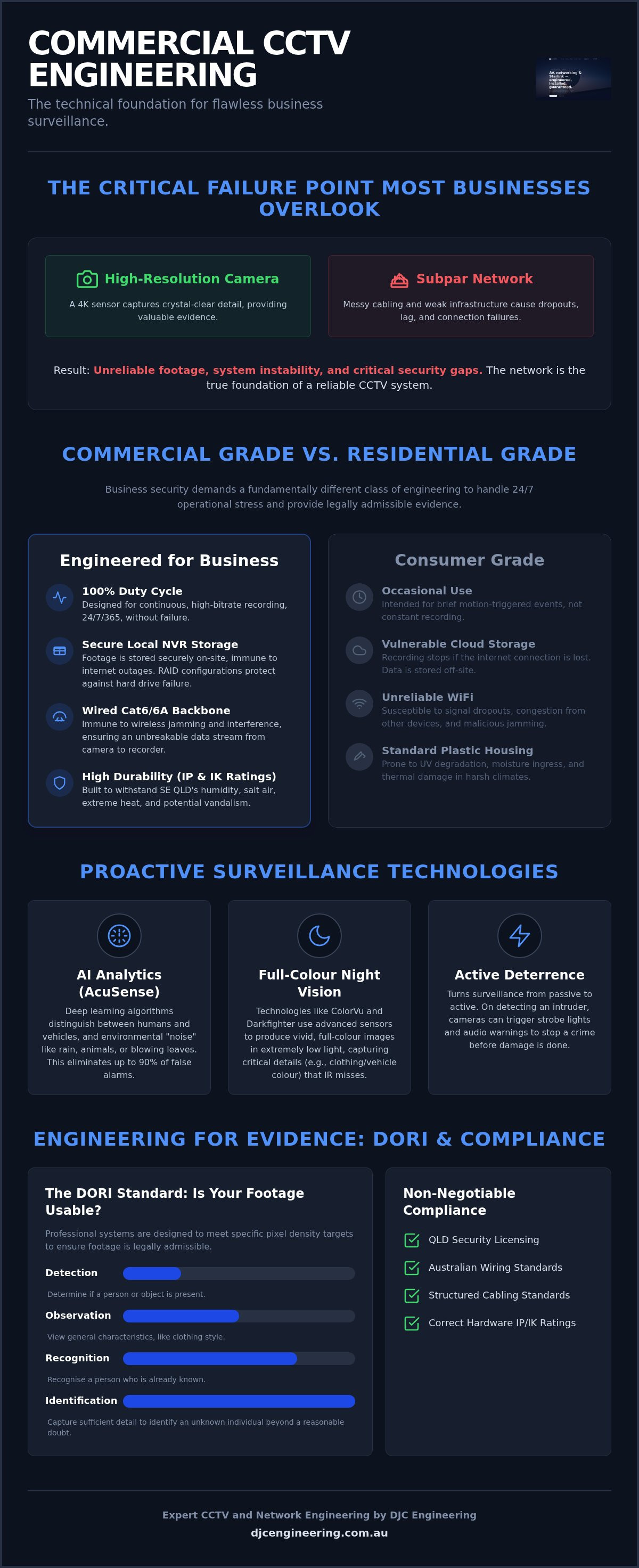
Most business owners believe the camera lens is the most critical part of their security, but the truth is that even the finest 4K sensor is useless if it's plugged into a subpar network. You've likely dealt with the frustration of grainy night-time footage, system dropouts, or a mobile app that fails to connect exactly when you need to review an incident. It's common to see commercial cctv systems undermined by messy, unorganised cabling and weak data infrastructure that simply can't handle the bandwidth of modern, high-resolution streams.
We agree that a security system shouldn't be a source of constant technical failure. This guide will help you master the technical requirements of commercial-grade surveillance, proving why engineered network infrastructure is the key to a truly reliable setup. We will examine the Australian standards for structured cabling, the role of professional WiFi design in achieving stable remote monitoring, and the specific QLD security licensing requirements you need to navigate in 2026 to ensure your business stays compliant and crystal-clear around the clock.
Key Takeaways
- High-performance commercial cctv systems require an engineered Cat6 or Cat6A cabling backbone to prevent bandwidth bottlenecks and ensure 24/7 system stability.
- Advanced AI analytics and low-light technologies allow you to filter out environmental noise and capture clear, colour evidence even in challenging night-time conditions.
- Effective surveillance relies on calculating pixel density according to DORI standards to ensure your footage is sufficient for legal identification rather than just basic detection.
- Strict adherence to QLD security licensing and Australian wiring standards is a non-negotiable requirement for a system that is both legally sound and technically robust.
Commercial vs Residential CCTV: Why Business Systems Require a Different Class of Engineering
Residential cameras are designed for the occasional notification when a courier arrives. In contrast, commercial cctv systems are engineered for a 100% duty cycle. They record high-bitrate video 24 hours a day, 365 days a year without reprieve. This relentless operational demand requires a different class of internal components. While a home camera might rely on basic cloud storage that fails during an internet outage, a professional system utilises a dedicated Network Video Recorder (NVR). These units provide the processing grunt needed to manage multiple high-resolution streams simultaneously. This ensures that critical evidence is captured locally and securely regardless of your external connection status.
Relying on consumer WiFi cameras in a business setting introduces significant vulnerabilities. Wireless signals are susceptible to interference and intentional jamming, which can lead to catastrophic gaps in your security timeline. We prioritise a closed-circuit wired approach. By using structured cabling, we create a physically secure network that is immune to signal dropouts and external wireless hacking. This provides the reliability required for liability and asset protection. Meticulous placement is also a core requirement; we don't just hang cameras where it's easy. We position them to ensure every vulnerable entry point and high-value asset is covered without blind spots.
Hardware Durability and the SE QLD Environment
Hardware longevity in South East Queensland is a specific technical challenge. The salt air in coastal Gold Coast suburbs and the high humidity of Brisbane can quickly corrode standard consumer-grade housings. We specify cameras with high Ingress Protection (IP) ratings to seal against moisture and dust. For high-traffic commercial zones, IK-rated vandal-proof housings are essential to withstand physical tampering. Professional sensors also include advanced heat dissipation features. This prevents the thermal degradation common in Queensland's extreme summer temperatures, which often causes cheaper sensors to produce noisy or distorted images.
Bandwidth and Data Management Challenges
Managing the data load of multiple 4K cameras is a complex networking task. A standard office router isn't designed to handle the sustained throughput of high-definition video. This often leads to network congestion and system crashes. We solve this by configuring dedicated subnets for commercial cctv systems traffic. This keeps your surveillance data separate from your general business operations, ensuring neither is compromised. For businesses where data loss isn't an option, we implement RAID (Redundant Array of Independent Disks) configurations. This ensures that even if a hard drive fails, your footage remains intact and accessible.
Advanced Surveillance Technologies: Moving Beyond Basic Monitoring
Modern surveillance has shifted from being a passive witness to a proactive security asset. High-performance commercial cctv systems now integrate deep-learning algorithms to classify objects in real time. Technology like AcuSense allows the system to distinguish between a human, a vehicle, and environmental noise like wind-blown foliage or animals. This precision eliminates the notification fatigue caused by false alarms. It ensures that your security team or mobile alerts only trigger when a genuine threat is detected, saving time and reducing unnecessary stress.
Visual clarity after dark is another area where engineering has surpassed basic standards. While older cameras relied on grainy infrared that lost critical detail, low-light technologies such as ColorVu or Darkfighter provide full-colour imagery in near-total darkness. For Gold Coast businesses operating in dimly lit industrial areas, this means capturing the exact colour of a getaway vehicle or a suspect's clothing. When combined with thermal imaging, which detects heat signatures from overheating machinery or intruders in zero-light environments, your perimeter becomes virtually impenetrable.
Active deterrence takes this a step further. Instead of just recording a break-in, cameras equipped with strobe lights and two-way audio can intervene. A pre-recorded or live voice warning paired with flashing lights often stops a crime before it escalates. This turns your surveillance from a recording tool into a digital security guard. If you're looking to upgrade your facility's capabilities, our team provides expert security and CCTV installations tailored to these advanced specifications.
Smart Analytics for Business Intelligence
Modern commercial cctv systems offer value far beyond security. By utilising heatmapping, retail managers can identify high-traffic zones and organise shopfloor layouts to maximise customer engagement. People counting and queue management tools allow hospitality venues to adjust staffing levels in real time, improving operational efficiency. Additionally, Licence Plate Recognition (LPR) technology automates gate access for logistics hubs, tracking vehicle movements without the need for manual logbooks or dedicated gatehouse staff.
Remote Access and Multi-Site Management
Managing security across several locations used to require a massive IT overhead. Now, centralised management software allows you to view 10 or more locations from a single Gold Coast headquarters. We prioritise secure VPN configurations over basic P2P connections to ensure your mobile monitoring doesn't compromise your business firewall. A cloud-hybrid model is often the best approach; it keeps high-resolution footage stored locally on a robust NVR while backing up critical event clips to the cloud for off-site redundancy.
The Engineering of Camera Placement: Eliminating Dead Zones
Effective commercial cctv systems rely on more than just high-resolution hardware; they require a calculated approach to optical physics. A common mistake in basic installations is using wide-angle lenses for every location. While a wide Field of View (FoV) provides a broad overview, it drastically reduces pixel density as the distance from the lens increases. This often leaves you with footage where you can see an event occurred but cannot identify the person involved. Professional engineering involves balancing this coverage with detail density, ensuring that high-traffic areas like entry points and cash-handling desks receive the specific focal attention they require for legal-grade evidence.
Lighting presents a significant hurdle for many Gold Coast offices characterised by large glass frontages. The intense Queensland sun creates harsh backlighting that can turn a subject's face into a dark silhouette against the bright exterior. We solve this by selecting hardware with high Wide Dynamic Range (WDR) capabilities and physically positioning cameras to avoid direct solar glare. By placing cameras at a lower, "eye-level" height at entry points, we capture facial features more effectively than a ceiling-mounted unit looking at the top of a person's head. This strategic positioning is the difference between a system that simply "sees" and one that provides actionable intelligence.
Focal Lengths and Sensor Selection
Perimeter monitoring often requires varifocal lenses, which allow us to manually or remotely adjust the focal length to suit long-distance views. This is paired with larger sensor sizes, such as 1/1.8" sensors, which capture significantly more light and detail than standard 1/3" sensors. The DORI standard provides a technical benchmark for surveillance effectiveness by defining the specific pixel density required to Detect, Observe, Recognise, or Identify a subject within a frame. Choosing the right sensor-lens combination ensures your system meets these compliance requirements across every zone of your property, from the back dock to the front counter.
Environmental and Structural Considerations
The physical installation must be as robust as the software supporting it. We use specialised mounting brackets tailored to the specific substrate, whether it's concrete, structural steel, or timber. A master technician’s approach means junction boxes and conduits are concealed or neatly dressed to prevent tampering and maintain the professional aesthetic of your building. We also consider environmental factors like heat-haze and insect activity. By positioning cameras away from light sources that attract spiders and ensuring they are shielded from direct afternoon heat, we maintain image clarity and reduce the need for frequent physical maintenance.
The Networking Backbone: Structured Cabling for Unfailing Surveillance
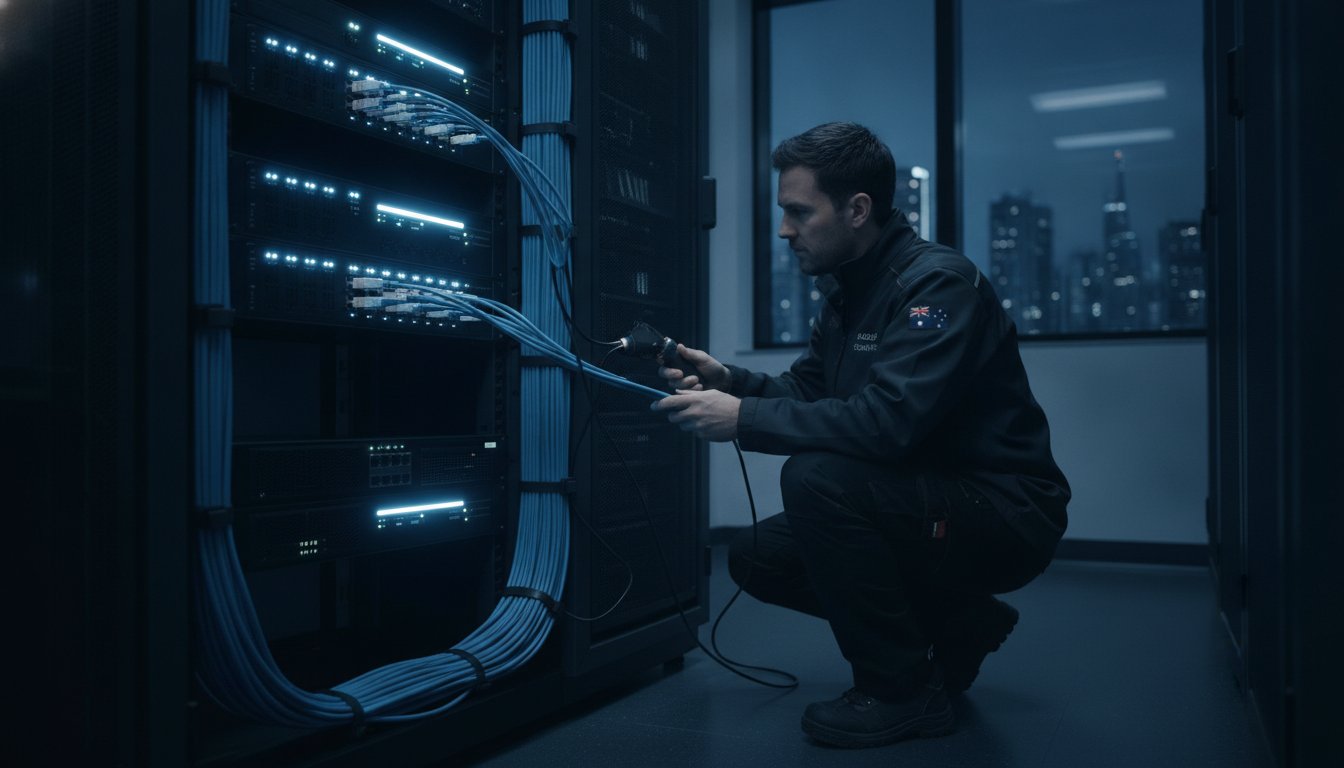
The integrity of commercial cctv systems starts in the walls and ceilings, not at the camera lens. While residential setups often rely on patchy WiFi, professional installations require a robust physical layer. Cat6 and Cat6A structured cabling have become the non-negotiable standards for 2026. These cables provide the necessary bandwidth to handle multiple 4K streams without packet loss or latency. High-quality cabling ensures that your security data reaches the NVR exactly as it was captured, preserving every frame for forensic review. Without this engineered foundation, even the most expensive cameras will suffer from dropouts and stuttering footage.
Neatness in the network rack is a hallmark of a master technician. An organised server room with labelled patch panels and managed cable runs leads to better airflow and system longevity. It also makes future troubleshooting or expansions significantly faster. Messy "spaghetti" cabling is a liability that leads to heat buildup and accidental disconnections. If you need a system built on a rock-solid foundation, our team specialises in professional networking and structured cabling designed for high-uptime environments.
Cabling Standards and Signal Integrity
Choosing between Shielded (FTP) and Unshielded (UTP) cabling is a critical technical decision. In industrial environments with heavy machinery or high-voltage lines, shielded cables are essential to prevent electromagnetic interference from degrading the video signal. We focus on commercial network cabling Gold Coast standards to ensure every installation is future-proofed against upcoming technological shifts. Every run we install undergoes rigorous testing and certification to ensure it meets gigabit performance standards and complies with the latest Australian wiring rules (AS/CA S009:2020).
PoE Switches and Power Management
Power over Ethernet (PoE) simplifies the installation process by delivering both data and electricity through a single cable. However, calculating the total PoE budget is vital. High-draw devices like Pan-Tilt-Zoom (PTZ) cameras or units with internal heaters for humidity control can easily overwhelm a standard switch. We prioritise managed switches that allow for granular control over security traffic and remote port resetting. To protect against the frequent Gold Coast storms, we integrate Uninterruptible Power Supplies (UPS) to keep the cameras rolling during power surges or temporary outages. For large industrial sites where camera runs exceed the 100-metre limit of copper, we utilise fibre optic uplinks to maintain signal integrity over kilometres.
Choosing a Commercial CCTV Partner in SE QLD: Compliance and Quality
Selecting the right installer for commercial cctv systems is a decision that impacts your business's legal standing and long-term operational security. In Queensland, the requirements are strict. Anyone installing, maintaining, or repairing security equipment for a fee must hold a valid Class 2 Security Equipment Installer Licence. A standard electrical licence is simply not enough. Using an unlicensed provider risks voiding your insurance and leaves you with a system that may not meet the evidentiary standards required by the QLD Police or the Surveillance Devices Act. We take this accountability seriously, ensuring every installation is performed by licensed specialists who understand the rigorous compliance landscape of 2026.
The "DJC Engineering Pty Ltd" difference lies in our commitment to precision during the commissioning phase. We don't just mount a camera and walk away. Every unit undergoes meticulous post-installation calibration. We fine-tune the WDR settings, motion trigger zones, and bitrate configurations to suit the specific lighting and structural environment of your site. Ongoing maintenance is equally vital to protect your investment. Dust, sea salt, and insects can quickly degrade image quality. We recommend a structured maintenance schedule involving quarterly lens cleaning and critical firmware updates to patch security vulnerabilities. This methodical approach ensures your system performs as well in year five as it did on day one.
Local Knowledge and SE QLD Support
A local partner understands that a Gold Coast beachfront property faces different environmental challenges than a Brisbane CBD office. The salt air and high humidity of South East Queensland require specific hardware selections and protective measures to prevent premature sensor failure. Our team provides fast response times across the region, ensuring that if a critical component fails, your facility isn't left vulnerable for days. We also specialise in integrating your surveillance with a broader commercial security system installation Gold Coast package, creating a unified defence that includes access control and alarm monitoring.
Your Next Steps for a Secure Facility
A professional site audit is the only way to design a system that actually works. We refuse to provide generic over-the-phone quotes because every facility has unique structural hurdles and lighting conditions that must be assessed in person. If you're currently relying on a legacy analog system, we can design a phased transition to a modern IP-based solution. This allows you to leverage your existing infrastructure where possible while significantly boosting your resolution and analytical capabilities. Contact the specialists at DJC Engineering Pty Ltd today for a meticulous assessment and a system engineered for high-performance results.
Future-Proof Your Facility with Engineered Surveillance
High-performance commercial cctv systems are defined by more than just their pixel count. As we've explored, the true value lies in the synergy between advanced AI analytics, calculated camera placement, and a robust Cat6A cabling backbone. When these technical elements are integrated with precision, your security shifts from a basic recording tool to a proactive business intelligence asset. Relying on generic hardware or unlicensed installers is a liability that no Gold Coast or Brisbane business can afford in 2026.
Achieving this level of reliability requires a master technician who prioritises quality over shortcuts. Our team of licensed QLD security technicians at DJC Engineering Pty Ltd brings master-level structured cabling expertise to every project, ensuring your infrastructure is built to withstand the specific environmental challenges of South East Queensland. Don't leave your asset protection to chance with a subpar setup. Request a Meticulous Site Assessment from DJC Engineering Pty Ltd to ensure your facility is protected by a system that actually delivers. We're ready to help you secure your premises with the precision and accountability your business deserves.
Frequently Asked Questions
Do I need a specific licence to install commercial CCTV in Queensland?
You absolutely require a Class 2 Security Equipment Installer Licence to legally install or maintain security systems in Queensland. A standard electrical licence doesn't cover security work. Engaging an unlicensed provider puts your insurance at risk and may lead to legal complications if footage is needed for evidence. We ensure every technician on our team is fully licensed and compliant with current 2026 QLD regulations to provide peace of mind.
What is the difference between IP cameras and analog CCTV systems?
IP cameras represent the modern standard for commercial cctv systems, transmitting digital data over structured network cabling. Unlike older analog systems that rely on coaxial cables and offer limited resolution, IP technology supports 4K clarity and advanced AI analytics. This digital approach allows for easier scalability and better integration with your existing IT infrastructure. It's the only viable choice for businesses that prioritise high-definition evidence and remote accessibility.
How much storage do I need for 30 days of 4K commercial footage?
Calculating storage for 30 days of 4K footage depends on your frame rate and compression settings, such as H.265+. Generally, a single 4K camera recording continuously at a medium frame rate requires approximately 2TB to 4TB of storage for a month of retention. We use high-capacity, surveillance-grade hard drives in a RAID configuration. This setup ensures your data remains intact even if a single drive fails during operation.
Can I view my commercial CCTV cameras on my phone while away from the office?
You can securely monitor your cameras from any mobile device or desktop with an internet connection. We configure professional NVR software that provides an encrypted stream to your smartphone app without leaving your business network vulnerable to hackers. This allows you to check live feeds or review historical footage while away from your Gold Coast office. Stable remote viewing depends on a well-designed network and sufficient upload bandwidth.
What is PoE, and why is it used in professional security installations?
PoE stands for Power over Ethernet, a technology that delivers both electricity and data through a single Cat6 cable. This streamlines the installation process by removing the need for separate power points at every camera location. It also allows us to centralise your power management. By connecting your PoE switches to an Uninterruptible Power Supply (UPS), your cameras will continue recording even during a sudden power outage or storm.
How many CCTV cameras does the average Gold Coast business need?
There is no one-size-fits-all number because every site has unique blind spots and structural challenges. A small retail shop might only need four cameras, while a large industrial warehouse could require twenty or more to cover all perimeters and high-value zones. We determine the exact count through a meticulous site audit. This process ensures we meet DORI standards for identification at every critical entry and exit point.
Is wireless CCTV reliable enough for a commercial warehouse or shop?
Wireless cameras are generally not reliable enough for high-stakes business environments. They are prone to signal interference from building materials and can be easily disabled by wireless jammers. For commercial cctv systems, we always recommend a hard-wired structured cabling approach. A physical connection ensures 100% uptime and prevents the bandwidth bottlenecks that often cause wireless systems to drop frames or lose connection during critical moments.
How often should a commercial security system be professionally serviced?
We recommend a professional service at least every six months, though quarterly checks are better for coastal Gold Coast properties. Regular maintenance involves cleaning camera lenses to remove salt spray and dust, checking cable connections for corrosion, and updating firmware to protect against cyber threats. This proactive approach prevents unexpected system failures and ensures your hardware lasts its full expected lifespan in the harsh Queensland climate.
Frequently Asked Questions
You absolutely require a Class 2 Security Equipment Installer Licence to legally install or maintain security systems in Queensland. A standard electrical licence doesn't cover security work. Engaging an unlicensed provider puts your insurance at risk and may lead to legal complications if footage is needed for evidence. We ensure every technician on our team is fully licensed and compliant with current 2026 QLD regulations to provide peace of mind.
IP cameras represent the modern standard for commercial cctv systems, transmitting digital data over structured network cabling. Unlike older analog systems that rely on coaxial cables and offer limited resolution, IP technology supports 4K clarity and advanced AI analytics. This digital approach allows for easier scalability and better integration with your existing IT infrastructure. It's the only viable choice for businesses that prioritise high-definition evidence and remote accessibility.
Calculating storage for 30 days of 4K footage depends on your frame rate and compression settings, such as H.265+. Generally, a single 4K camera recording continuously at a medium frame rate requires approximately 2TB to 4TB of storage for a month of retention. We use high-capacity, surveillance-grade hard drives in a RAID configuration. This setup ensures your data remains intact even if a single drive fails during operation.
You can securely monitor your cameras from any mobile device or desktop with an internet connection. We configure professional NVR software that provides an encrypted stream to your smartphone app without leaving your business network vulnerable to hackers. This allows you to check live feeds or review historical footage while away from your Gold Coast office. Stable remote viewing depends on a well-designed network and sufficient upload bandwidth.
PoE stands for Power over Ethernet, a technology that delivers both electricity and data through a single Cat6 cable. This streamlines the installation process by removing the need for separate power points at every camera location. It also allows us to centralise your power management. By connecting your PoE switches to an Uninterruptible Power Supply (UPS), your cameras will continue recording even during a sudden power outage or storm.
There is no one-size-fits-all number because every site has unique blind spots and structural challenges. A small retail shop might only need four cameras, while a large industrial warehouse could require twenty or more to cover all perimeters and high-value zones. We determine the exact count through a meticulous site audit. This process ensures we meet DORI standards for identification at every critical entry and exit point.
Wireless cameras are generally not reliable enough for high-stakes business environments. They are prone to signal interference from building materials and can be easily disabled by wireless jammers. For commercial cctv systems, we always recommend a hard-wired structured cabling approach. A physical connection ensures 100% uptime and prevents the bandwidth bottlenecks that often cause wireless systems to drop frames or lose connection during critical moments.
We recommend a professional service at least every six months, though quarterly checks are better for coastal Gold Coast properties. Regular maintenance involves cleaning camera lenses to remove salt spray and dust, checking cable connections for corrosion, and updating firmware to protect against cyber threats. This proactive approach prevents unexpected system failures and ensures your hardware lasts its full expected lifespan in the harsh Queensland climate.