Commercial Access Control Systems Gold Coast: A Technical Guide to Industrial Security
With retail theft in Australia surging by 45 percent between 2024 and 2026, relying on a standard brass key to protect your warehouse or office is no longer a viable security strategy. It's a common frustration for local managers who struggle with unreturned physical keys, a total lack of visibility over restricted zones, and security hardware that fails to integrate with the business network. You deserve a system that doesn't just lock doors; you need a digital audit trail and a technical setup that scales with your operations.
This guide explains how to engineer high-performance commercial access control systems Gold Coast premises require for genuine industrial security. We'll show you how to move beyond basic hardware to a fully integrated solution that secures your perimeter while standing up to Queensland’s harsh, salty environment. You'll learn about the technical infrastructure needed for a reliable keyless setup, the critical role of structured cabling, and how to ensure your system meets the latest 2026 cybersecurity standards for internet-connected devices.
Key Takeaways
- Transition from mechanical keys to a networked security perimeter to eliminate the security risks associated with unreturned or lost physical credentials.
- Learn how to specify commercial access control systems Gold Coast businesses require to withstand coastal salt air and humidity through robust, industrial-grade hardware.
- Evaluate the performance trade-offs between mobile credentials, biometrics, and traditional fobs to find the right balance of security and convenience for your staff.
- Discover how to integrate entry logs with CCTV and alarm systems to create a unified, high-performance technical infrastructure for your premises.
- Understand the importance of professional calibration and structured cabling in ensuring your security hardware remains reliable under heavy industrial use.
What is Commercial Access Control in a Modern Industrial Context?
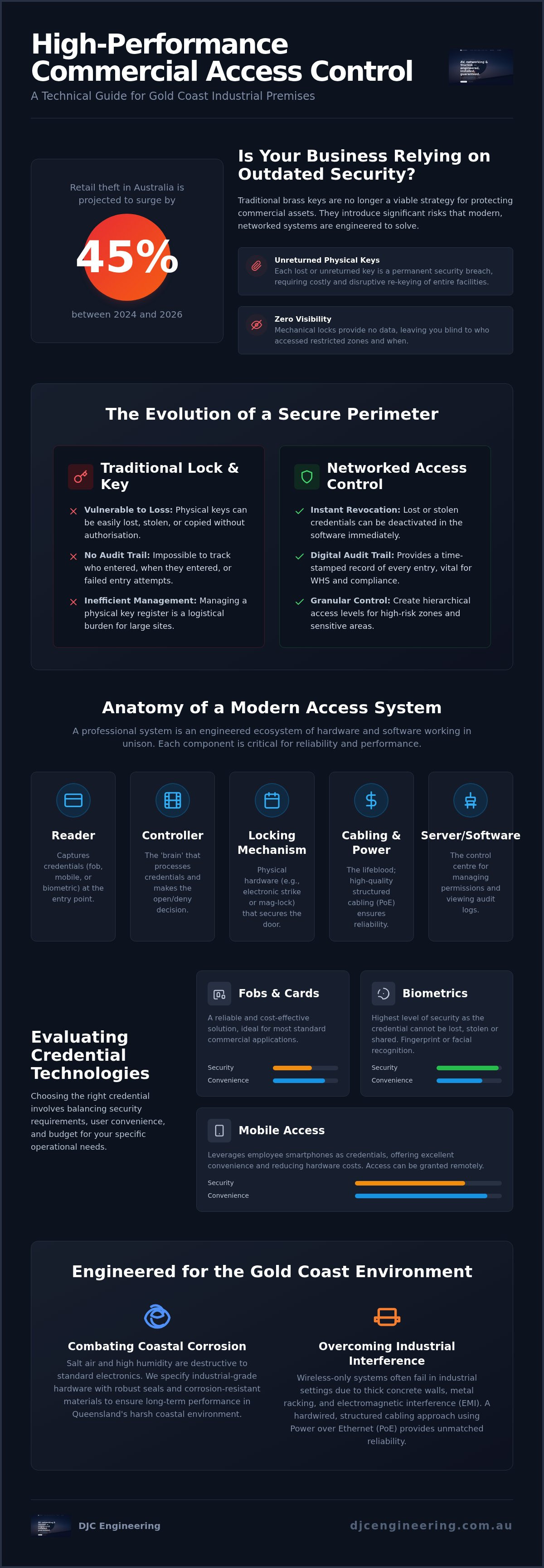
Modern commercial access control systems Gold Coast businesses are commissioning represent a fundamental shift in how we define a secure perimeter. It is no longer just about a physical barrier or a heavy-duty padlock. Instead, we view access control as a networked security perimeter where every entry point is a data node. This transition from mechanical security to digital credentialing allows for a level of precision that traditional locks simply cannot match. When asking What is Access Control? in a professional industrial sense, we are looking at the strategic, software-driven restriction of property to authorised personnel only, backed by a robust technical infrastructure.
Digital systems provide a level of accountability that is vital for workplace health and safety (WHS) and industrial compliance. In high-risk environments, you need to know exactly who is on-site at any given moment. Digital audit trails provide this visibility, offering a time-stamped record of every entry and exit. This data is essential for managing site safety, verifying contractor hours, and meeting the rigorous reporting standards required by Queensland industrial regulations. It's a move from passive security to active, intelligent management of your physical space.
Moving Beyond the Traditional Lock and Key
For large Gold Coast sites, managing a physical key register is a logistical nightmare. Every lost key is a potential security breach that can only be resolved by a costly and time-consuming re-keying of the entire premises. Engineered commercial access control systems Gold Coast technicians install eliminate this risk entirely. If a credential is lost, it's revoked in the software instantly. This is the primary difference between a basic 'smart lock' you might find at a hardware store and a professional, engineered system. A standalone lock is a silo; an engineered system is a scalable component of your broader business network, designed for reliability and long-term performance.
The Role of Access Control in Industrial Security Systems
Industrial sites in areas like Molendinar or Yatala face far more complex challenges than a standard retail shopfront. You aren't just protecting inventory; you're managing access to high-risk zones, heavy machinery areas, and sensitive technical infrastructure. A robust system allows you to create hierarchical access levels, ensuring only trained staff can enter dangerous environments. This granular control is a core component of a modern risk management strategy. Industrial access control serves as the critical first line of defence in a multi-layered security strategy, ensuring that only the right people reach the right areas at the right time.
The Technical Infrastructure: How Modern Access Systems Function
Engineering commercial access control systems Gold Coast sites can rely on requires a deep understanding of the hardware-software handshake. At its core, a professional system consists of three pillars: the reader, the controller, and the server. The reader captures the credential, the controller makes the decision, and the server hosts the central database and management software, often referred to as the 'Control Centre'. This management hub is where administrators organise permissions, view real-time audit logs, and integrate the system with other security layers. It is the central nervous system of your facility's security.
Physical security relies on the integrity of the locking mechanism. Electronic strikes are often the preferred choice for standard timber or metal doors because they allow for a mechanical override during emergencies. Magnetic locks (mag-locks) are the standard for glass entries or high-traffic industrial zones, providing a powerful hold through electromagnetic force. However, these components are only as effective as the path for data and power. This is why high-quality structured cabling is the lifeblood of the entire installation. Poorly terminated wires or low-grade cables lead to intermittent failures that compromise your perimeter at the worst possible moment.
The Importance of Structured Cabling and Power
Wireless-only access systems often fail in Gold Coast industrial environments. Thick concrete tilt-slab walls, heavy metal racking, and electromagnetic interference from machinery create "dead zones" that render wireless locks unresponsive. We advocate for a hardwired approach using Power over Ethernet (PoE). This technology allows a single data cable to provide both the network connection and the electrical power needed for the reader and lock, which simplifies the architecture and reduces potential failure points. Given the frequency of Gold Coast summer storms and subsequent power surges, a professional installation must include a robust battery backup. This ensures your security remains active and your premises stay locked even during a total grid outage.
The Controller: The Brain of the Operation
The controller is the intelligence that determines who enters and when. A deep dive into the technical characteristics of access control reveals that modern systems are moving toward edge-based controllers. These units sit near the door and can make "offline" decisions if the main server connection is lost, preventing staff from being locked out during a network glitch. Professional configuration is non-negotiable; poorly calibrated controllers cause system latency, leading to frustrating delays for staff at the entry point. If you are planning a new facility, consulting a licensed technician during the design phase ensures your network is engineered to handle the specific data load of a modern security suite.
Evaluating Credential Technologies: Fobs, Biometrics, and Mobile Access
Credentials drive the user experience. Selecting the right identification method is a balance between operational speed and the technical rigour of your security perimeter. While a simple PIN might suffice for a communal staff room, high-value industrial zones often require multi-factor authentication (MFA). This involves a "something you have", such as a card, paired with a "something you know", like a code, or "something you are", which refers to a biometric scan. Implementing MFA ensures that even if a physical credential is stolen, the perimeter remains uncompromised. For high-performance commercial access control systems Gold Coast facilities require, the choice of credential dictates the long-term scalability of the entire network.
RFID Cards and Key Fobs: The Reliable Standard
Radio Frequency Identification (RFID) remains the workhorse of industrial security. These systems function through a small chip and antenna embedded in a plastic card or fob, which transmits a unique ID to the reader via radio waves. However, not all RFID is created equal. We distinguish between low-frequency 125kHz cards, which are easily cloned, and high-frequency 13.56MHz encrypted cards like Mifare or DESFire. The latter provides a secure, encrypted handshake that is significantly harder to intercept. Managing these through a centralised interface allows you to organise permissions by department or seniority, ensuring that card issuance and deactivation happen in seconds rather than hours.
Biometrics and Mobile Access: The Future of Entry
The shift toward "contactless" and "keyless" environments has accelerated the adoption of biometrics and mobile credentials. Biometric systems, including facial recognition and fingerprint scanning, are the gold standard for reducing "buddy punching" or the unauthorised sharing of credentials among staff. These systems require a high-capacity data backbone to handle the transmission of biometric templates between the reader and the controller. Mobile credentials represent the next step in this evolution, utilising the NFC or Bluetooth Low Energy (BLE) capabilities already present in modern smartphones. A 2026 global survey indicated that 29 percent of organisations already use mobile smartphone credentials for access control, a trend that is rapidly gaining traction in Gold Coast office developments.
Mobile credentials reduce hardware touchpoints and administrative overhead. By issuing digital keys directly to a staff member's device, you eliminate the cost and waste of physical plastic cards. This technical setup requires a secure, cloud-integrated management platform to ensure that mobile keys are encrypted and cannot be duplicated. When properly calibrated by a licensed technician, mobile entry provides a seamless, high-speed experience that matches the modern aesthetic of a professional Gold Coast workspace while maintaining the robust security of an industrial-grade installation.
Engineering for the Environment: Industrial Security Challenges in SE QLD
Environmental factors are the primary cause of hardware failure for commercial access control systems Gold Coast businesses operate. South East Queensland presents a unique set of technical challenges, from high-velocity salt air along the coastal strip to extreme humidity and heat in the industrial hinterlands. Standard electronic components are not designed to survive these conditions. Without a meticulous approach to hardware selection and installation, even the most expensive system will succumb to corrosion and electrical shorts within a few seasons. We prioritise equipment with high Ingress Protection (IP) ratings, typically IP65 or higher, to ensure that internal circuitry remains shielded from moisture and fine salt particles.
Our role as local specialists involves more than just mounting hardware; it requires a deep understanding of regional logistics. We assess the specific micro-climate of your site before recommending a technical solution. This grounded approach ensures that your security infrastructure provides a high-performance result that lasts, rather than a temporary fix that requires constant maintenance. By accounting for the physical environment during the initial engineering phase, we build systems that remain reliable under the most punishing Queensland weather conditions.
Corrosion Resistance and Hardware Longevity
Selecting the right materials is critical for longevity. We specify 316-grade stainless steel for external readers and strike plates because of its superior resistance to pitting and crevice corrosion. Off-the-shelf hardware from big-box retailers often uses lower-grade alloys or plastic housings that degrade quickly under intense UV exposure. Our installation process involves meticulous sealing of all entry points and the strategic concealment of cabling within conduit. This prevents moisture from "wicking" through the wires and reaching the sensitive internal controllers, a common failure point in substandard installations.
Site Assessment: Designing for Industrial Workflows
A secure perimeter must also facilitate efficient operations. During a site assessment, we analyse the interaction between vehicle and pedestrian traffic to ensure that access points don't become bottlenecks. Integrating your system with commercial security gates allows for a unified perimeter where heavy vehicle entry is managed with the same precision as the front office door. We also factor in emergency egress and fire safety compliance. This involves a technical choice between fail-safe locks, which unlock when power is cut, and fail-secure locks, which remain locked. Balancing these requirements ensures your site is both secure and compliant with Australian safety standards. If you need a perimeter that stands up to the local climate, contact DJC Engineering to discuss a resilient, industrial-grade installation.
Integrating Access Control with Your Wider Security Ecosystem
Integrating commercial access control systems Gold Coast managers rely on with broader security layers turns a simple door lock into a proactive intelligence tool. A standalone reader provides limited value if it cannot communicate with your cameras or sirens. When we engineer a security ecosystem, we ensure that these disparate hardwares speak the same language through a unified management platform. This level of technical synergy allows for automated responses, such as a door being forced open instantly triggering a site-wide lockdown or an immediate alert to your mobile device. It's about moving from isolated hardware to a cohesive security strategy.
This high level of integration depends entirely on the underlying digital infrastructure. Without professional WiFi and network design, cloud-based management platforms suffer from dropouts and data lag, which can leave your premises vulnerable. A robust network ensures that when an employee swipes their credential, the system can simultaneously disarm commercial alarm systems in their specific zone while logging the event in the central server. This methodical approach replaces manual security checks with automated, precision-calibrated workflows that increase both safety and operational efficiency.
Video Verification: Coupling Access with CCTV
The most effective integration is the link between entry logs and video surveillance. When a staff member presents a fob, the event creates a digital 'bookmark' on the timeline of your commercial CCTV security system. This allows you to verify that the person using the credential is the authorised holder, effectively preventing card-sharing or "tailgating" where an unauthorised person follows a staff member through a door. Technically, this requires a management server capable of cross-referencing timestamps between the access controller and the Network Video Recorder (NVR). It transforms hours of manual footage review into a five-second verification task, providing a visual audit trail that is indisputable.
Remote Management and Cloud Connectivity
Modern industrial security no longer requires you to be on-site to manage user permissions. Cloud-connected systems allow you to organise access for multiple Gold Coast locations from a single interface. Whether you're managing a warehouse in Yatala or a showroom in Southport, you can revoke credentials or review audit logs from any desktop or mobile app. Maintaining this uptime requires a stable, high-speed internet connection, often involving Starlink or NBN backups to ensure the 'Control Centre' remains reachable during local outages. This setup provides a level of agility that traditional, panel-based systems can't match. For a system that works reliably and integrates perfectly with your technical infrastructure, contact DJC Engineering for a precision-engineered access control solution.
Future-Proof Your Industrial Security
Building a secure perimeter is an engineering challenge that requires a meticulous approach to both hardware and network infrastructure. We've discussed how commercial access control systems Gold Coast facilities depend on must be more than just standalone locks; they are data-driven nodes that require professional calibration and environmental protection. From selecting corrosion-resistant components to ensuring your structured cabling can handle the data load of biometric entry, every technical detail matters for long-term reliability.
Our team brings together licensed security technicians and expert network integration to deliver a result that generic providers can't match. We use our Gold Coast local knowledge to ensure your setup stands up to the salt and heat while integrating seamlessly with your CCTV and alarms. Secure your premises with a precision-engineered access system from DJC Engineering. You'll gain the peace of mind that comes from a robust, keyless perimeter designed specifically for the unique demands of South East Queensland.
Frequently Asked Questions
What is the difference between a standalone and a networked access control system?
A standalone system operates as an isolated unit at a single door, whereas a networked system connects every entry point to a central management server. Networked commercial access control systems Gold Coast businesses typically choose allow for site-wide updates, instant credential revocation, and detailed audit logs from a single interface. Standalone units are suitable for low-security individual doors; however, they lack the scalability and real-time oversight required for industrial perimeters.
Can I integrate my existing CCTV cameras with a new access control system?
Integration is usually possible if your existing CCTV cameras support standard communication protocols or have compatible software hooks. Coupling these systems allows an access event to trigger a specific camera recording or create a timestamped bookmark in your footage. This technical synergy is essential for video verification, ensuring the person swiping a fob matches the authorised user in the database without requiring hours of manual footage review.
How much does a commercial access control system cost to install on the Gold Coast?
The investment required for commercial access control systems Gold Coast sites need varies based on the number of entry points, the type of credential technology selected, and the complexity of the existing network infrastructure. Factors such as the requirement for 316-grade stainless steel hardware or extensive structured cabling will influence the final project scope. A professional site assessment is necessary to determine the specific technical requirements and hardware grades needed for your facility's environment.
What happens to my security doors if the power goes out or the internet fails?
Professional systems utilise battery backups and edge-based controllers to maintain security during power outages or internet disruptions. Edge controllers store a local copy of the user database, allowing them to make access decisions even when the connection to the central server is lost. For physical safety, locks are configured as either fail-safe or fail-secure to ensure compliance with Australian fire and emergency egress regulations, meaning doors will either unlock or remain locked based on safety requirements.
Are biometric access systems legal for Australian businesses regarding privacy?
Biometric systems are legal for Australian businesses provided they comply with the Privacy Act 1988 and the Australian Privacy Principles. You must inform employees about the collection of biometric data and ensure it is stored securely, often as encrypted mathematical templates rather than actual images. It's advisable to ensure your workplace policies and data storage methods meet current Australian standards for handling sensitive information before commissioning a biometric installation.
How many users can a typical commercial access control system handle?
Modern commercial systems are highly scalable and can typically handle anywhere from a dozen users to tens of thousands across multiple sites. The total capacity is largely determined by the management software and the memory limits of the controllers installed at each door. For industrial sites with high contractor turnover, a system with a large user capacity and easy credential management is essential for maintaining a secure and organised perimeter.
Do I need to upgrade my business's data cabling to support electronic locks?
Upgrading your data cabling is often necessary if your current infrastructure cannot support Power over Ethernet (PoE) or high-speed data transmission. Modern readers and controllers rely on stable, shielded cabling to prevent data loss and ensure reliable power delivery. Using high-quality Cat6 cabling as part of a structured cabling plan provides the robust backbone needed for a high-performance security system to function without intermittent failures or latency issues.
How often should an industrial access control system be professionally serviced?
An industrial access control system should be professionally serviced at least once or twice a year to ensure all mechanical and electronic components remain in peak condition. Regular maintenance involves checking battery health, testing emergency release triggers, and cleaning readers that are exposed to the Gold Coast's salty air. This proactive approach prevents hardware failure and ensures your security perimeter remains uncompromised by environmental wear and tear or technical glitches.
Frequently Asked Questions
A standalone system operates as an isolated unit at a single door, whereas a networked system connects every entry point to a central management server. Networked commercial access control systems Gold Coast businesses typically choose allow for site-wide updates, instant credential revocation, and detailed audit logs from a single interface. Standalone units are suitable for low-security individual doors; however, they lack the scalability and real-time oversight required for industrial perimeters.
Integration is usually possible if your existing CCTV cameras support standard communication protocols or have compatible software hooks. Coupling these systems allows an access event to trigger a specific camera recording or create a timestamped bookmark in your footage. This technical synergy is essential for video verification, ensuring the person swiping a fob matches the authorised user in the database without requiring hours of manual footage review.
The investment required for commercial access control systems Gold Coast sites need varies based on the number of entry points, the type of credential technology selected, and the complexity of the existing network infrastructure. Factors such as the requirement for 316-grade stainless steel hardware or extensive structured cabling will influence the final project scope. A professional site assessment is necessary to determine the specific technical requirements and hardware grades needed for your facility's environment.
Professional systems utilise battery backups and edge-based controllers to maintain security during power outages or internet disruptions. Edge controllers store a local copy of the user database, allowing them to make access decisions even when the connection to the central server is lost. For physical safety, locks are configured as either fail-safe or fail-secure to ensure compliance with Australian fire and emergency egress regulations, meaning doors will either unlock or remain locked based on safety requirements.
Biometric systems are legal for Australian businesses provided they comply with the Privacy Act 1988 and the Australian Privacy Principles. You must inform employees about the collection of biometric data and ensure it is stored securely, often as encrypted mathematical templates rather than actual images. It's advisable to ensure your workplace policies and data storage methods meet current Australian standards for handling sensitive information before commissioning a biometric installation.
Modern commercial systems are highly scalable and can typically handle anywhere from a dozen users to tens of thousands across multiple sites. The total capacity is largely determined by the management software and the memory limits of the controllers installed at each door. For industrial sites with high contractor turnover, a system with a large user capacity and easy credential management is essential for maintaining a secure and organised perimeter.
Upgrading your data cabling is often necessary if your current infrastructure cannot support Power over Ethernet (PoE) or high-speed data transmission. Modern readers and controllers rely on stable, shielded cabling to prevent data loss and ensure reliable power delivery. Using high-quality Cat6 cabling as part of a structured cabling plan provides the robust backbone needed for a high-performance security system to function without intermittent failures or latency issues.
An industrial access control system should be professionally serviced at least once or twice a year to ensure all mechanical and electronic components remain in peak condition. Regular maintenance involves checking battery health, testing emergency release triggers, and cleaning readers that are exposed to the Gold Coast's salty air. This proactive approach prevents hardware failure and ensures your security perimeter remains uncompromised by environmental wear and tear or technical glitches.