
Commercial Alarm Systems: A Technical Guide for Gold Coast Businesses in 2026
If your security strategy starts and ends with a hardware purchase, you aren't building a perimeter; you're just buying a false sense of security. Many Gold Coast business owners know the frustration of "alarm fatigue" caused by frequent false triggers or insecure commercial alarm systems that drop out when you need them most. You deserve a setup that works as hard as you do, without the constant digital noise of a poorly configured system.
We understand that effective security is a networking challenge, not just a box of sensors. This guide details how to engineer a robust security perimeter through technical integration and professional-grade hardware. By moving beyond basic setups, you can achieve a seamless, app-controlled environment that reduces liability through certified installation. We will explore the mechanical processes of integrating your alarms with CCTV and access control, ensuring every component talks to the next. From back-to-base monitoring to the latest 2026 firmware calibrations, you will learn how to transform your physical security into a high-performance digital asset that offers genuine, long-term protection.
Key Takeaways
- Understand how transitioning from standalone units to intelligent IP-based security nodes reduces false alerts through multi-factor verification.
- Compare industry-standard commercial alarm systems like the Bosch Solution 6000 and Inner Range Integriti to find the right balance between enterprise power and SME versatility.
- Learn the technical requirements for meticulous sensor placement and cable hardening to eliminate dead zones and protect your infrastructure from tampering.
- Identify the specific QLD security licensing requirements for 2026 to ensure your installation meets all legal and insurance obligations for commercial premises.
- Discover how to engineer a unified security perimeter where your alarm system communicates seamlessly with CCTV and access control for total site visibility.
Why Modern Commercial Security Demands Integrated Alarm Systems
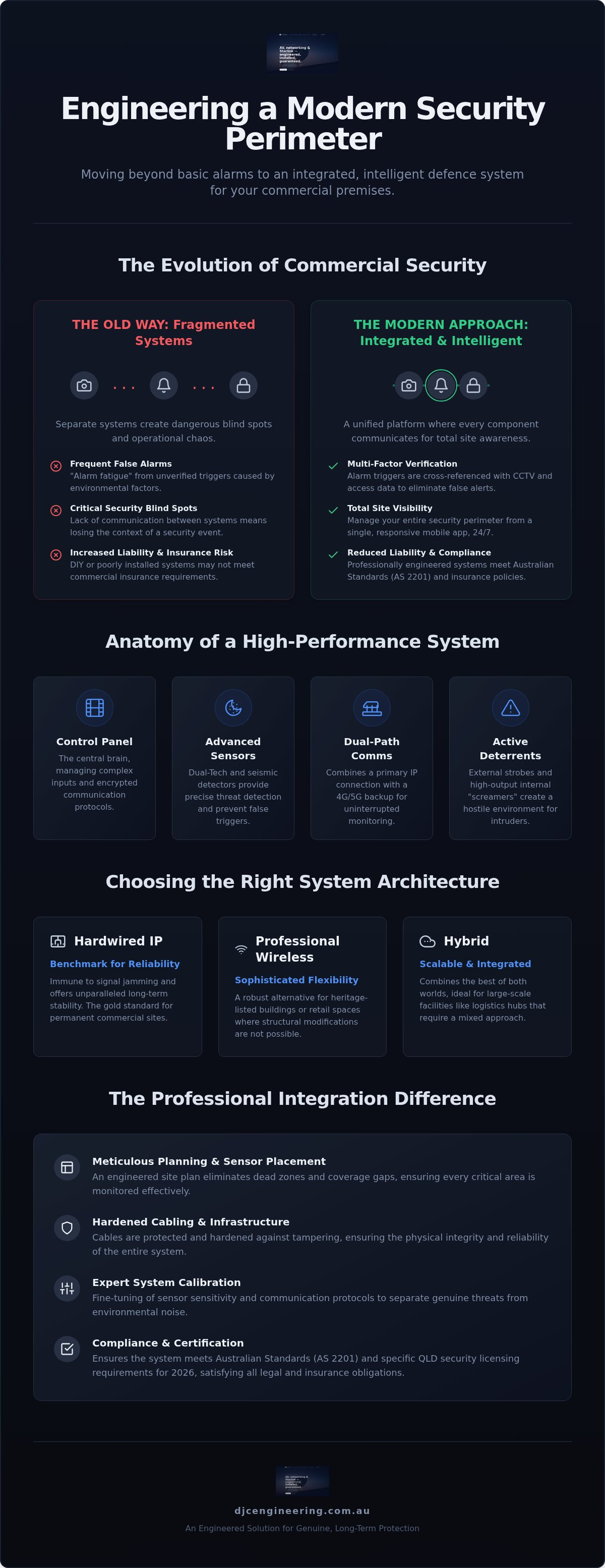
Security technology has moved beyond the era of the simple noisemaker. Historically, commercial alarm systems were standalone units designed to emit a high-decibel siren and little else. Today, these systems function as intelligent IP-based nodes within a broader digital network. This shift allows for multi-factor verification, where an alarm trigger is cross-referenced with live CCTV data or access control logs before an alert is even sent. For Gold Coast business owners, this eliminates the dreaded 2 a.m. false alarm caused by a stray moth or a shifting shadow. By integrating these sensors into a unified platform, you gain a level of site visibility that was previously reserved for high-security government facilities.
Local businesses across South East Queensland are increasingly moving toward these unified platforms to streamline operations. A modern system doesn't just protect inventory; it provides a 24/7 management tool via mobile app connectivity. You can arm the warehouse from your home in Burleigh or check if the delivery driver has arrived at your Southport storefront without leaving your desk. It's about total control over your physical perimeter through a single, responsive interface that works as hard as you do. To see how other high-performance building systems can contribute to your facility's overall efficiency, you can learn more about energy-efficient heating options for commercial and residential properties.
The Risk of Fragmented Security
Operating separate CCTV and alarm systems creates dangerous blind spots. When your hardware doesn't talk to each other, you lose the context of a security event. Cheap DIY commercial kits often promise easy setup but fail to provide the encrypted, robust connectivity required for high-stakes environments. There is also the matter of liability. While a comprehensive guide to security alarms can provide a foundational overview of hardware, it cannot replace the forensic assessment required for a complex commercial site. In a commercial setting, a system that hasn't been professionally installed and commissioned may fail to meet insurance requirements, leaving you exposed if a breach occurs.
The Master Technician Approach
Effective security requires an engineered solution, not a box-dropping service. At DJC Engineering, we focus on the mechanical precision of the install. This means ensuring your commercial alarm systems are configured with the correct communication protocols and that every cable is hardened against tampering. Professional configuration is what separates a nuisance alarm from a life-saving alert. We ensure every component meets Australian Standards, specifically AS 2201, which is often a prerequisite for commercial insurance policies. By prioritising meticulous cabling and precise sensor calibration, we build systems that remain stable and functional for years, rather than just weeks.
Key Technical Components of a High-Performance Alarm System
Engineering high-performance commercial alarm systems requires a deep understanding of component synergy. The control panel serves as the central processing unit, managing complex inputs and encrypted communication protocols. While PIR sensors are common, we often specify Dual-Tech detectors for Gold Coast warehouses to prevent false triggers caused by thermal shifts. For high-value assets like server rooms or safes, seismic sensors provide an additional layer of protection by detecting the specific vibrations of drilling or cutting. These devices must align with UL standards for commercial security to ensure they perform under extreme stress.
Dual-path communication modules are the current gold standard for uptime. By combining a primary IP connection with a 4G or 5G backup, your site remains monitored even if the local NBN infrastructure is compromised. Warning devices like external strobes and internal high-output "screamers" provide the final layer of active deterrence. These components work together to create a hostile environment for intruders while notifying authorities in real-time.
IP vs. Wireless vs. Hybrid Architectures
Hardwired IP systems remain the benchmark for security in permanent commercial sites due to their immunity to signal jamming and their long-term reliability. However, professional wireless systems like the AX Pro range offer a sophisticated alternative for heritage-listed buildings or retail spaces where structural modifications are restricted. Hybrid solutions are frequently deployed in large-scale logistics hubs. This allows us to use robust wiring for the main perimeter while maintaining flexibility for internal office partitions that may change as the business grows.
The Necessity of Structured Cabling
The reliability of commercial alarm systems in 2026 hinges on the quality of the data backbone. We exclusively use high-specification Cat6 cabling to ensure zero signal interference and maximum bandwidth for future expansions. This structured approach allows for the seamless integration of your alarm with Commercial CCTV Security, enabling instant visual verification when a sensor is tripped. Meticulous cable management and the concealment of all infrastructure prevent tampering and ensure a clean, professional finish. If you need an assessment of your current wiring, our team can provide a professional site audit to identify potential vulnerabilities before they are exploited.
Comparing Industry Standards: Bosch, Integriti, and Inner Range
Selecting the right hardware for your facility isn't just about brand recognition; it's about matching mechanical capability to your specific operational risks. The Bosch Solution 6000 remains the versatile workhorse for small-to-medium enterprises across the Gold Coast. It's a reliable, cost-effective platform that supports up to 144 zones, making it ideal for standard commercial footprints. As of July 2026, the latest IP-only firmware (V3.03.30) has further hardened these units against network vulnerabilities, ensuring your connection to the monitoring centre remains encrypted and stable.
For larger facilities requiring high-level integration, Integriti by Inner Range provides enterprise-level power. It's designed to manage hundreds of doors and thousands of users, allowing you to build a sophisticated, layered security infrastructure. Where Bosch excels in simplicity, Integriti thrives in complexity, offering deep access control integration that links your alarm states directly to user permissions. If your site requires a cable-free approach, the Hikvision AX Pro leads the market for high-performance wireless commercial alarm systems, providing a robust alternative for heritage buildings or flexible retail spaces where structural modifications are restricted.
Which System Suits Your Industry?
Your industry dictates the technical requirements of your sensors and control logic. We find that retail clients prioritising shoplifting prevention benefit most from systems that offer easy staff arming and disarming via encrypted keyfobs or mobile credentials. Warehousing operations in industrial hubs like Yatala require a different approach, focusing on long-range perimeter sensors and heavy-duty magnetic reeds for roller doors. For professional offices in Robina or Southport, the priority often shifts to integrating access control with staff time-clocks, ensuring that security and HR data exist within the same ecosystem to streamline management; for these data-sensitive environments, firms like OAD Technologies provide the necessary frameworks to ensure digital assets are just as protected as the physical premises.
Feature Face-Off: Monitoring and Apps
A security system is only as effective as its interface. Modern commercial alarm systems must offer high-speed app responsiveness for real-time site management. We compare the user experience across brands to ensure your team can arm, disarm, and isolate zones without a steep learning curve. This remote management capability relies heavily on your site's underlying network. Integrating your security nodes with professional WiFi Design & Installation ensures that your mobile alerts arrive instantly, even in large facilities with complex layouts. Finally, we ensure all systems are compatible with back-to-base monitoring protocols, providing the 24/7 professional oversight required by most Australian commercial insurance providers.
Engineering Your Perimeter: Placement and Connectivity
Designing an effective perimeter is a matter of geometry and environmental physics. We don't just "place" sensors; we engineer coverage patterns to eliminate dead zones where an intruder could potentially mask their movement. In large Gold Coast floorplans, this involves a forensic assessment of entry points and internal thoroughfares to ensure every square metre is accounted for. Your commercial alarm systems must be hardened against physical tampering, which means concealing all cabling within high-grade conduits and securing control panels behind reinforced, monitored enclosures. This physical robustness ensures the system cannot be bypassed or disabled before an alert is successfully dispatched.
Local environmental factors in South East Queensland present unique challenges for electronic security infrastructure. Salt air corrosion from the coast and high humidity levels can degrade sensitive components over time if they aren't properly protected. We specify IP-rated housings and corrosion-resistant hardware to maintain long-term reliability in our harsh coastal climate. This attention to detail extends to the integration of CCTV Installation Gold Coast protocols. When an alarm sensor is tripped, your cameras should automatically pivot to the zone of interest or trigger a high-resolution recording, providing the visual verification needed to confirm a breach in real-time.
The Technical Checklist for Installation
Gold Coast storms are notorious for causing sudden power outages and voltage spikes. We ensure every system includes high-capacity battery redundancy and surge protection to keep your site secure when the local grid fails. For businesses using wireless components, we perform rigorous signal strength testing to account for high-interference environments or thick structural concrete. Our approach to structured cabling is equally disciplined. Organised, labelled server racks aren't just for aesthetics; they prevent thermal issues and make future maintenance or system upgrades significantly more efficient. Maintaining a stable environment is equally important for hardware longevity, and for businesses considering their cooling needs, Peninsula Air Conditioning (PenAir) offers an expert comparison of central and split system air conditioning to help you make an informed choice.
Connectivity and Remote Access
A 2026 alarm system is only as good as the network it rides on. We configure secure VPNs and dedicated ports to allow for encrypted remote access without exposing your business network to external cyber threats. High-speed connectivity via Starlink or business-grade NBN is vital for maintaining the dual-path communication required for modern IP-based commercial alarm systems. This ensures a seamless handover between onsite warning devices and the instant notifications sent to your mobile device. If your current setup feels like a collection of disconnected parts, you can book a professional security assessment with our team to unify your infrastructure.
Why Professional Integration is the Only Real Protection
Security is a matter of technical accountability. While the hardware discussed in previous sections provides the foundation, the efficacy of commercial alarm systems depends entirely on the precision of the final commissioning. At DJC Engineering, we approach every project with a master technician’s eye for detail. This means we don't just "drop boxes" and move on. We ensure every sensor is calibrated for its specific environment and every communication protocol is verified before we consider the job done. We engineer solutions that stand up to forensic scrutiny and local environmental stress.
Compliance is non-negotiable for Gold Coast businesses in 2026. In Queensland, it's a criminal offence to record private conversations without consent, and it's a legal requirement for technicians to hold a specific Security Equipment Installer Licence to maintain these systems. A standard electrician's licence is generally not sufficient for high-level security work. Our team is fully accredited and deeply familiar with the local regulatory landscape, ensuring your installation meets the strict AS/CA S009:2020 wiring rules. This professional accreditation is often the difference between an insurance claim being approved or rejected after an incident.
We don't leave until the system is perfect. Our commissioning process involves stress-testing dual-path communication modules and verifying sensor sensitivity under varying heat and light conditions. This meticulous approach is vital given that nearly half of all "other theft" incidents in 2024 occurred in retail locations, as reported by the Australian Bureau of Statistics; for businesses managing high-value assets like Javda Jewelry, you need a system that triggers correctly every time, without the nuisance of false alerts.
Beyond the Installation
Beyond the initial handover, we establish regular maintenance schedules to prevent hardware degradation caused by the salty Gold Coast air. This proactive approach allows us to scale your security as your business expands, adding new zones or integrating advanced access control nodes as your operational footprint grows; for businesses with regional operations in Central Queensland, CQR Plumbing provides the same level of professional gas fitting and drainage expertise required for complex commercial sites.
Secure Your Assets Today
Choosing a unified technical partner simplifies your infrastructure. By managing your WiFi, networking, and security needs through a single specialist, you eliminate the compatibility issues that plague fragmented setups. Starting your security assessment is a straightforward process that begins with a physical site audit and a review of your digital network. If you're ready to move beyond basic protection, you can organise your commercial security assessment with DJC Engineering today. We will help you build a perimeter that is as resilient as it is intelligent.
Securing Your Business with Technical Precision
A robust security perimeter in 2026 isn't a retail product you buy off the shelf. It's a networked infrastructure that requires meticulous engineering and a no-shortcut cabling approach to remain effective. We have explored how modern commercial alarm systems now function as intelligent nodes, integrating seamlessly with CCTV and access control to eliminate false alerts and provide total site visibility. Whether you're deploying the versatile Bosch Solution 6000 or the enterprise-grade power of Integriti, the success of your setup relies on professional calibration and strict compliance with QLD security regulations.
Don't leave your assets to chance with fragmented, DIY solutions that fail when you need them most. Our team of licensed SE QLD technicians operates with a focused commitment to quality, ensuring every connection is hardened against environmental stress and tampering. As integrated security specialists, we bridge the gap between physical hardware and digital connectivity to protect your livelihood. We invite you to Contact DJC Engineering for a Meticulous Commercial Security Setup and take the first step toward a unified, high-performance perimeter. Your business deserves a security system that is engineered to last.
Frequently Asked Questions
What is the difference between a residential and a commercial alarm system?
Commercial systems differ from residential setups through their scale, integration capabilities, and strict compliance requirements. While a home system might only monitor a few entry points, commercial alarm systems manage hundreds of zones and integrate directly with access control and fire safety systems. They are engineered to meet Australian Standard AS 2201, which is a common requirement for business insurance policies seeking to reduce liability.
Do commercial alarm systems require a phone line in 2026?
No, physical phone lines have been largely superseded by IP and cellular connectivity. Modern commercial alarm systems rely on dual-path communication, using your business NBN or Starlink connection as the primary channel with a 4G or 5G cellular backup. This redundancy ensures that your site remains monitored even if the physical network cable is cut or the local exchange experiences a technical failure.
How much does a commercial alarm system cost to install on the Gold Coast?
Installation costs vary significantly based on the number of detection zones, the complexity of the structured cabling, and the level of integration required. Every commercial site on the Gold Coast has unique structural challenges that influence the labour and hardware needed for a robust setup. We recommend a professional site audit to receive an accurate assessment tailored to your specific facility and risk profile.
Can I integrate my existing CCTV with a new commercial alarm system?
Integration is usually possible if your existing cameras support standard communication protocols like ONVIF. By linking your CCTV to your alarm, you can trigger high-resolution recording or pivot cameras to specific zones the moment a sensor is tripped. This creates a unified security perimeter that allows for instant visual verification of any alarm event through your management app.
What happens to my business alarm system during a power outage?
Your system will continue to operate via an internal backup battery during a local power failure. Professional installations include high-capacity sealed lead-acid or lithium batteries designed to maintain the control panel and sensors for several hours. Once the battery reaches a critical level, the system can send a low-power alert to your mobile device or monitoring centre so you can take action before the system shuts down.
Is wireless security reliable enough for a commercial warehouse?
Modern wireless technology is highly reliable for many commercial applications, provided it uses frequency-hopping and encrypted signals. Systems like the AX Pro are designed to resist jamming and can cover large areas without the need for extensive cabling. However, in warehouses with heavy metal racking or high electrical interference, we often recommend a hybrid approach to ensure maximum signal stability across the entire floorplan.
What are the legal requirements for commercial alarm monitoring in Queensland?
Queensland law requires that any person installing or maintaining a security system for a fee must hold a current Security Equipment Installer Licence. Additionally, if your system includes audio recording, you must comply with the Surveillance Devices Act, which generally prohibits recording private conversations without consent. Most insurance providers also mandate that your monitoring centre is graded according to Australian Standards to ensure a professional response.
How often should a commercial security system be serviced?
We recommend a professional service at least once every twelve months to ensure your hardware remains in peak condition. Regular maintenance involves testing backup battery health, cleaning sensors to prevent false triggers, and updating firmware to the latest secure versions. For high-risk environments or large-scale facilities, bi-annual inspections help identify potential hardware degradation before it leads to a system failure or a gap in your security coverage.
Frequently Asked Questions
Your industry dictates the technical requirements of your sensors and control logic. We find that retail clients prioritising shoplifting prevention benefit most from systems that offer easy staff arming and disarming via encrypted keyfobs or mobile credentials. Warehousing operations in industrial hubs like Yatala require a different approach, focusing on long-range perimeter sensors and heavy-duty magnetic reeds for roller doors. For professional offices in Robina or Southport, the priority often shifts to integrating access control with staff time-clocks, ensuring that security and HR data exist within the same ecosystem to streamline management.
Commercial systems differ from residential setups through their scale, integration capabilities, and strict compliance requirements. While a home system might only monitor a few entry points, commercial alarm systems manage hundreds of zones and integrate directly with access control and fire safety systems. They are engineered to meet Australian Standard AS 2201, which is a common requirement for business insurance policies seeking to reduce liability.
No, physical phone lines have been largely superseded by IP and cellular connectivity. Modern commercial alarm systems rely on dual-path communication, using your business NBN or Starlink connection as the primary channel with a 4G or 5G cellular backup. This redundancy ensures that your site remains monitored even if the physical network cable is cut or the local exchange experiences a technical failure.
Installation costs vary significantly based on the number of detection zones, the complexity of the structured cabling, and the level of integration required. Every commercial site on the Gold Coast has unique structural challenges that influence the labour and hardware needed for a robust setup. We recommend a professional site audit to receive an accurate assessment tailored to your specific facility and risk profile.
Integration is usually possible if your existing cameras support standard communication protocols like ONVIF. By linking your CCTV to your alarm, you can trigger high-resolution recording or pivot cameras to specific zones the moment a sensor is tripped. This creates a unified security perimeter that allows for instant visual verification of any alarm event through your management app.
Your system will continue to operate via an internal backup battery during a local power failure. Professional installations include high-capacity sealed lead-acid or lithium batteries designed to maintain the control panel and sensors for several hours. Once the battery reaches a critical level, the system can send a low-power alert to your mobile device or monitoring centre so you can take action before the system shuts down.
Modern wireless technology is highly reliable for many commercial applications, provided it uses frequency-hopping and encrypted signals. Systems like the AX Pro are designed to resist jamming and can cover large areas without the need for extensive cabling. However, in warehouses with heavy metal racking or high electrical interference, we often recommend a hybrid approach to ensure maximum signal stability across the entire floorplan.
Queensland law requires that any person installing or maintaining a security system for a fee must hold a current Security Equipment Installer Licence. Additionally, if your system includes audio recording, you must comply with the Surveillance Devices Act, which generally prohibits recording private conversations without consent. Most insurance providers also mandate that your monitoring centre is graded according to Australian Standards to ensure a professional response.
We recommend a professional service at least once every twelve months to ensure your hardware remains in peak condition. Regular maintenance involves testing backup battery health, cleaning sensors to prevent false triggers, and updating firmware to the latest secure versions. For high-risk environments or large-scale facilities, bi-annual inspections help identify potential hardware degradation before it leads to a system failure or a gap in your security coverage.