
Back to Base Alarm Installation Gold Coast: High-Performance Security Engineering

A standard local siren is often little more than a noise complaint waiting to happen, rather than a genuine security strategy. You've probably felt that pang of anxiety when a neighbour's alarm rings out for hours, ignored by everyone on the street. It's a common frustration for Gold Coast property owners who worry their own system might fail during an NBN outage or become a neighbourhood nuisance because of a false trigger. This is why professional back to base alarm installation Gold Coast services have shifted from simple noise-makers to high-performance engineering.
In this guide, you'll discover how a meticulously calibrated system provides a guaranteed 24/7 response, keeping your property secure even when the power or internet drops out. We will break down the technical differences between GPRS and IP monitoring, explain how to secure insurance premium reductions, and show you why a robust, engineered backbone is the only way to ensure your security works when it matters most. By moving beyond basic hardware, you can achieve a level of protection that remains active regardless of local infrastructure failures.
Key Takeaways
- Learn why standard sirens fail to deter modern intruders and how a monitored connection provides a guaranteed response.
- Understand how to keep your security online during NBN outages by using engineered IP and GPRS communication links.
- Discover the precision involved in a professional back to base alarm installation Gold Coast to eliminate blind spots and cabling vulnerabilities.
- Explore how Starlink integration and meticulous hardware concealment protect your system from local environmental challenges.
- Identify the benefits of technical synergy, where your alarm, CCTV, and network hardware work as one unified, robust unit.
Beyond the Siren: Why Gold Coast Properties Need Back to Base Monitoring
In many modern neighbourhoods, the sound of a distant alarm siren is treated as a nuisance rather than a genuine emergency. Professional intruders are well aware of this psychological shift; they know that a noise-only system relies entirely on a bystander's willingness to intervene. On the Gold Coast, environmental factors add another layer of risk. The relentless salt air and high humidity can quickly degrade the internal components of standard external sirens, leading to corrosion on circuit boards and piezo drivers. This often results in "phantom" triggers or, worse, a complete failure to sound when a breach occurs. A professional back to base alarm installation Gold Coast moves security away from these physical vulnerabilities by establishing a digital lifeline to a secure monitoring facility.
Beyond the hardware, many Queensland insurers now mandate professional monitoring for properties with high-value assets or specific risk profiles. This isn't just about reducing premiums, though that is a common benefit. It's about ensuring a documented trail of accountability. When a system is engineered to report every event, from a low battery to a forced entry, it creates a "Good Neighbour" environment. You no longer have to worry about a malfunctioning siren bothering the street for hours while you're at work or away on holiday; the monitoring centre identifies the fault and notifies you or a technician immediately.
The Limitations of Self-Monitored Smart Alarms
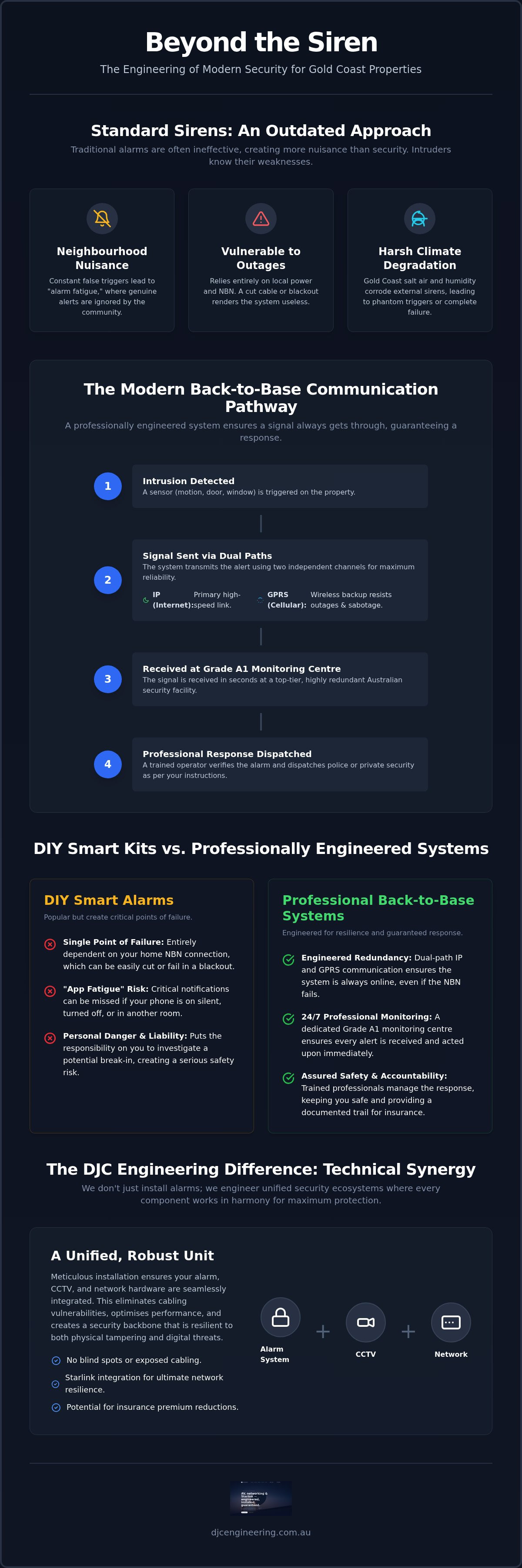
While DIY smart kits are popular, they suffer from what industry specialists call "App Fatigue." If a critical notification arrives at 3 AM while your phone is on "Do Not Disturb" or sits in a charging cradle in another room, the security chain is broken. These systems also rely heavily on your local NBN connection. If the internet goes down or an intruder cuts the external lead-in cable, your app becomes useless. Relying on a personal "ping" also creates a significant liability. Attempting to investigate a potential break-in yourself, based only on a phone alert, puts you in physical danger. A professional system avoids these gaps by using dedicated communication paths that don't depend on your home WiFi.
The Value of 24/7 Accountability
The core of a high-performance setup is the connection to a Grade A1 monitoring centre. This rating signifies the highest level of redundancy and response speed in Australia. To understand the technical foundations of these setups, you can research how modern back to base alarm systems work and interface with central stations. Once a sensor is triggered, the response is immediate. Within seconds, a trained operator verifies the signal and dispatches police or private security guards according to your pre-set instructions. For holiday home owners on the Coast, this level of technical synergy provides a guarantee that the property is being watched even when the street is quiet.
How Modern Back to Base Alarm Systems Work
The traditional era of security alarms relied on a simple copper phone line and a basic dialler. If a thief cut the line or the exchange went down, the system was effectively silenced. Modern Back to Base Monitoring is a continuous communication link between a premise and a security centre. This digital heartbeat has replaced the fragile analogue connections of the past, ensuring that an alarm signal isn't just a local noise, but a verified data packet that reaches a response team in seconds.
With the NBN rollout, old-school dialler alarms have become obsolete. Standard NBN connections often fail during power outages because the local nodes and home routers lose power, leaving your security stranded. A high-performance back to base alarm installation Gold Coast now utilises dual-path monitoring. This is the gold standard for commercial and premium residential security, using two independent communication routes to ensure a signal always gets through. If one path is blocked or fails, the system instantly switches to the secondary route without losing a second of protection.
GPRS vs. IP Communication Paths
IP (Internet Protocol) communication leverages your existing home or business network for high-speed data transmission. It's incredibly fast, but it's physically tied to your modem and cabling. GPRS (mobile data) acts as the wireless backbone of the system. Because it uses cellular networks, it's the primary defence against deliberate sabotage like wire-cutting. In a dual-path setup, these two technologies work in tandem; the IP path handles the bulk of the data, while the GPRS path provides a robust, untethered redundancy that stays live even if your internet service provider has an outage.
The "Heartbeat" Connection Explained
Modern systems don't just wait for a sensor to trigger; they actively "poll" the monitoring centre. This polling interval is a regular check-in, or heartbeat, where the panel confirms its status to the base. If the monitoring centre doesn't receive this signal, it knows immediately that the system has been tampered with or the network has failed. This is a critical defence against sophisticated intruders who use signal jamming devices to try and mask their entry.
On the Gold Coast, summer storms frequently cause local power surges and blackouts. A professional installation includes a dedicated battery backup and a communicator designed to stay online when the rest of the street is dark. This level of engineering ensures your security backbone remains uncompromised regardless of local infrastructure stability. If you're unsure if your current hardware is NBN-ready, it's a good idea to book a professional security assessment to verify your system's communication redundancy.
Professional Installation vs. DIY Security Kits
Professional security isn't just about sticking hardware to a wall; it's about eliminating vulnerabilities through precise engineering. While a DIY kit might seem cost-effective, it lacks the technical rigour of a back to base alarm installation Gold Coast property owners can actually rely on. Professional sensor placement involves calculating detection patterns to avoid the "blind spots" that intruders exploit. We don't just place a PIR sensor in the corner of a room; we assess heat sources, airflow, and entry angles to ensure the system triggers only when it should.
Hardwired reliability remains the benchmark for high-end security. Structured cabling provides a dedicated, interference-free path for every signal, whereas wireless consumer units are susceptible to local RF noise and signal jamming. A professional setup also includes built-in tamper protection. If an intruder attempts to pry a sensor off the wall or open the main control unit, the system immediately alerts the monitoring base. We also prioritise a "clean finish" standard, where all cabling is concealed within wall cavities or conduits. This isn't just for aesthetics; it prevents an intruder from simply cutting an exposed wire to disable the system.
The Risks of DIY Wireless Alarms
Wireless performance is often compromised by the heavy masonry and brickwork common in Gold Coast construction. Thick walls can degrade signals, leading to intermittent sensor failure or delayed reporting. There's also the hidden chore of battery management. A typical home might require 15 to 20 wireless sensors, each needing regular battery replacements. If a battery dies while you're away, that zone becomes a gaping hole in your defence. Poor placement by an amateur often leads to false alarm triggers, which can result in expensive monitoring call-outs and fines from local authorities.
Why Accreditation and Licensing Matter
In Queensland, security installers must hold a specific class of security provider license. A general electrician might understand power, but they aren't necessarily trained in the intricate logic of security engineering or the requirements of Australian Standard AS2201. A specialist ensures your system is configured to meet these rigorous benchmarks, providing a level of accountability that off-the-shelf products can't match. This professional certification is often the key to validating your insurance policy, as many providers require proof of a licensed installation before they'll cover high-value assets. This ensures your security backbone is robust enough to handle the specific environmental and logistical challenges of the region.
Engineering a Resilient System for Gold Coast Conditions
Gold Coast properties range from high-density coastal strips to rural acreage in the hinterland. Standard security setups often struggle in NBN-poor zones, which is why we specialise in integrating alarm panels with Starlink. This satellite-based backbone ensures your monitoring signal remains active even in isolated locations where traditional copper or fibre networks fail. A professional security camera installation Gold Coast complements a back to base alarm system by providing visual verification for every triggered event.
We take a methodical approach to sensor placement using heatmapping techniques. Instead of guessing where an intruder might move, we use technical data to determine the optimal field of view for Passive Infrared (PIR) sensors. This reduces dead zones and ensures the system captures movement immediately. Meticulous cabling is the foundation of this setup. We don't just pull wires; we engineer a path that protects the security backbone from the South East Queensland elements. This level of precision is what defines a high-performance back to base alarm installation Gold Coast.
Step-by-Step: The DJC Engineering Pty Ltd Installation Process
Our workflow is disciplined and thorough. It begins with an Initial Site Assessment to identify entry points and potential signal vulnerabilities. Once the design is finalised, we move to Infrastructure Preparation. This involves running high-grade commercial network cabling to ensure high-speed, interference-free data transmission. Hardware Commissioning follows, where the specialists at DJC Engineering Pty Ltd configure the control panel and communication modules for dual-path reporting. Finally, we conduct a Final Verification, live testing every signal path to ensure the monitoring centre receives data packets without delay.
Weatherproofing and Durability
The Gold Coast's salt air is notoriously corrosive to electronic hardware. We select professional-grade sensors and sirens with high IP ratings to survive tropical storm ingress and humidity. All external cabling is protected by UV-rated conduit, following neat, engineered paths that prevent wear and tear over time. This focus on physical robustness ensures your system doesn't just work on day one, but remains operational for years in a harsh coastal environment. If you need a system engineered for the specific challenges of your property, contact the team at DJC Engineering Pty Ltd for a technical consultation.
The DJC Engineering Pty Ltd Difference: Meticulous Security Integration
While many generic service providers prioritise speed to move onto the next job, our approach is defined by precision over pace. We refuse to take shortcuts because a security system is only as strong as its weakest connection. A high-performance back to base alarm installation Gold Coast requires more than just mounting hardware; it demands a deep understanding of how that hardware communicates across your local infrastructure. As licensed specialists rather than general electrical contractors, DJC Engineering Pty Ltd focuses on the technical rigour of the setup, ensuring every data packet is encrypted and every sensor is calibrated for maximum accuracy.
We create technical synergy by integrating your alarm system with your existing digital ecosystem. This means your security doesn't operate in a vacuum. By aligning your alarm with high-speed WiFi networks and CCTV arrays, we build a unified defence. If a sensor triggers, your network can prioritise that data stream, ensuring the monitoring centre receives the alert and high-definition footage simultaneously. This level of integration is only possible when your installer understands networking as deeply as they understand security hardware. It's this grounded, local reliability that sets a specialist engineering firm apart from a generalist tradie.
Future-Proofing Your Security
Our modular system designs allow your security to evolve alongside your needs. You might start with a core alarm setup and later decide to add sophisticated access control or additional perimeter sensors as your property or business grows. Because we use structured cabling and high-capacity communication modules, expanding your system doesn't require a total overhaul. We also provide remote management capabilities, giving you the convenience of smartphone control while maintaining the unshakeable reliability of professional 24/7 monitoring. This ensures your investment remains compliant with changing Australian Standards and the specific environmental challenges of a back to base alarm installation Gold Coast.
Get a Professional Security Assessment
A one-size-fits-all approach is a recipe for security failure. Every property on the Coast has unique signal vulnerabilities, entry points, and environmental factors like salt air that must be accounted for during the design phase. We provide a meticulous site review that goes beyond a basic quote, looking at the mechanical and digital health of your entire premises. If you are ready to move beyond basic sirens and implement a system that stays online when it matters most, Contact DJC Engineering Pty Ltd for an engineered security solution to book your technical assessment.
Protect Your Assets with Engineered Precision
A noise-only alarm is no longer a sufficient deterrent for modern intruders. True security requires a continuous heartbeat connection that stays active during power outages and network failures. By choosing a professional back to base alarm installation Gold Coast, you ensure that every sensor is meticulously placed and every cable is protected from the harsh coastal elements. Our approach relies on precision technical integration, where your security hardware works in perfect synergy with your networking infrastructure. Licensed security technicians provide the accountability that DIY kits simply can't match, giving you a robust system that stands up to the specific challenges of the SEQ region.
Don't leave your property's safety to a system that might fail when the NBN drops out. It's time to transition to a high-performance solution that offers guaranteed 24/7 accountability and technical resilience. Secure your property with a professionally engineered alarm system and enjoy the peace of mind that comes with Gold Coast local expertise. We look forward to helping you build a safer, more resilient future for your home or business.
Frequently Asked Questions
What is the difference between back to base and self-monitoring?
Back to base monitoring establishes a continuous link to a professional Grade A1 security centre, whereas self-monitoring depends entirely on your phone's ability to receive an app notification. If you're in a meeting, sleeping, or out of mobile range, a self-monitored alert goes unanswered. A professional back to base alarm installation Gold Coast ensures that trained operators are always watching the signal, ready to dispatch security guards or emergency services the moment a breach is verified.
Does a back to base alarm work if the NBN goes down?
A professionally engineered system remains operational even during a total NBN outage. We achieve this by using dual-path communicators that combine your internet connection with a GPRS mobile data link. If the NBN line is cut or the local exchange fails, the system instantly switches to the cellular network to send its signals. This redundancy is a core part of a high-performance setup, ensuring your property's digital lifeline is never severed by infrastructure issues.
How much does back to base alarm monitoring cost on the Gold Coast?
While we don't set the rates for monitoring centres, industry data shows that standard A1 monitoring on the Gold Coast typically ranges from $30 to $75 per month. The final cost depends on your requirements, such as how often the system "polls" the base and whether you opt for guard call-out services. Investing in a higher tier of monitoring usually provides faster response protocols and more frequent heartbeat checks to detect sophisticated signal jamming.
Can I use my existing alarm for back to base monitoring?
Most legacy alarm panels can be retrofitted for modern monitoring with a simple hardware upgrade. Instead of replacing the entire system, a technician can install a new IP or GPRS communication module that interfaces with your existing sensors. This is a cost-effective way to bring an older system into the NBN era. We conduct a thorough technical assessment of your current hardware to determine if the existing circuit boards support these high-speed digital upgrades.
Do I need a phone line for a back to base alarm system?
Traditional copper phone lines are no longer necessary for security monitoring. In fact, relying on a phone line is now considered a security risk because the wires are easily accessible and prone to failure during the NBN transition. Modern systems utilise either your home internet connection or dedicated mobile data networks. This transition to wireless and IP-based paths has made back to base alarm installation Gold Coast more robust and significantly harder for intruders to sabotage.
How does a back to base alarm reduce my insurance premiums?
Insurers prioritise professional monitoring because it significantly reduces the likelihood of a successful burglary. By having a system that guarantees a 24/7 response, you lower the risk profile of your property. Many Australian insurance providers offer premium reductions for homes and businesses with a certified, monitored alarm. You should check with your specific insurer to see if they require a Grade A1 monitoring certificate to activate these policy discounts and lower your annual costs.
What happens if there is a false alarm with my monitored system?
Modern monitoring protocols are designed to filter out false triggers before emergency services are involved. If a sensor is tripped, the monitoring centre immediately contacts your nominated keyholders to verify the situation. If you confirm it's a false alarm, the event is cancelled. However, if they cannot reach you or if you verify a breach, they follow your pre-determined response plan, which may include dispatching a private security patrol to the site for verification.
Can I integrate my back to base alarm with Starlink internet?
Integrating your security with Starlink internet is an excellent solution for properties in the Gold Coast hinterland or rural areas. Starlink provides the high-speed IP path required for modern alarm panels and CCTV verification. When we engineer these systems, we ensure the alarm's communication module is correctly configured to handle the satellite connection's specific latency and handoff patterns, providing a reliable link where traditional NBN services often struggle to maintain a stable connection.
Frequently Asked Questions
Back to base monitoring establishes a continuous link to a professional Grade A1 security centre, whereas self-monitoring depends entirely on your phone's ability to receive an app notification. If you're in a meeting, sleeping, or out of mobile range, a self-monitored alert goes unanswered. A professional back to base alarm installation Gold Coast ensures that trained operators are always watching the signal, ready to dispatch security guards or emergency services the moment a breach is verified.
A professionally engineered system remains operational even during a total NBN outage. We achieve this by using dual-path communicators that combine your internet connection with a GPRS mobile data link. If the NBN line is cut or the local exchange fails, the system instantly switches to the cellular network to send its signals. This redundancy is a core part of a high-performance setup, ensuring your property's digital lifeline is never severed by infrastructure issues.
While we don't set the rates for monitoring centres, industry data shows that standard A1 monitoring on the Gold Coast typically ranges from $30 to $75 per month. The final cost depends on your requirements, such as how often the system "polls" the base and whether you opt for guard call-out services. Investing in a higher tier of monitoring usually provides faster response protocols and more frequent heartbeat checks to detect sophisticated signal jamming.
Most legacy alarm panels can be retrofitted for modern monitoring with a simple hardware upgrade. Instead of replacing the entire system, a technician can install a new IP or GPRS communication module that interfaces with your existing sensors. This is a cost-effective way to bring an older system into the NBN era. We conduct a thorough technical assessment of your current hardware to determine if the existing circuit boards support these high-speed digital upgrades.
Traditional copper phone lines are no longer necessary for security monitoring. In fact, relying on a phone line is now considered a security risk because the wires are easily accessible and prone to failure during the NBN transition. Modern systems utilise either your home internet connection or dedicated mobile data networks. This transition to wireless and IP-based paths has made back to base alarm installation Gold Coast more robust and significantly harder for intruders to sabotage.
Insurers prioritise professional monitoring because it significantly reduces the likelihood of a successful burglary. By having a system that guarantees a 24/7 response, you lower the risk profile of your property. Many Australian insurance providers offer premium reductions for homes and businesses with a certified, monitored alarm. You should check with your specific insurer to see if they require a Grade A1 monitoring certificate to activate these policy discounts and lower your annual costs.
Modern monitoring protocols are designed to filter out false triggers before emergency services are involved. If a sensor is tripped, the monitoring centre immediately contacts your nominated keyholders to verify the situation. If you confirm it's a false alarm, the event is cancelled. However, if they cannot reach you or if you verify a breach, they follow your pre-determined response plan, which may include dispatching a private security patrol to the site for verification.
Integrating your security with Starlink internet is an excellent solution for properties in the Gold Coast hinterland or rural areas. Starlink provides the high-speed IP path required for modern alarm panels and CCTV verification. When we engineer these systems, we ensure the alarm's communication module is correctly configured to handle the satellite connection's specific latency and handoff patterns, providing a reliable link where traditional NBN services often struggle to maintain a stable connection.