
Video Surveillance Security Cameras: The Technical Guide to Modern Property Protection
Why do most off-the-shelf security kits fail exactly when you need them most? It's a frustrating reality for many Gold Coast property owners who find that their "smart" WiFi cameras drop out during a heavy storm or provide nothing but a grainy blur when it's time to identify a late-night intruder. You've likely spent hours trying to hide messy cables or dealing with unexpected cloud storage fees, only to end up with a setup that feels more like a hobbyist project than a robust video surveillance system installation.
We agree that true security shouldn't be a gamble. This guide explores the engineering standards behind professional-grade surveillance, moving beyond basic hardware to focus on the infrastructure that ensures 100% uptime and high-definition clarity. You'll discover the critical differences between consumer-grade bundles and engineered systems that integrate seamlessly into your existing network. We'll also cover essential Queensland licensing requirements and the technical shift toward Edge AI, giving you the knowledge to secure your property with a clean, professional finish that leaves no room for error.
Key Takeaways
- Learn how modern surveillance has shifted from passive recording to proactive, AI-driven threat detection for real-time property protection.
- Understand why IP architecture is the superior choice for a video surveillance system installation, providing the data bandwidth and scalability required for 2026 standards.
- Compare the reliability of hardwired professional engineering against consumer WiFi kits that often fail during local Gold Coast weather events.
- Identify the technical hardware specifications necessary to maintain image clarity under the intense Australian sun and within low-light coastal environments.
- Discover how to integrate surveillance with high-performance alarm systems to create a unified, meticulously calibrated security ecosystem.
Understanding Video Surveillance Security Cameras in 2026
Modern surveillance has evolved far beyond the simple "set and forget" camera setups of the past. It's now a sophisticated ecosystem where hardware and software work in unison to provide a comprehensive security shield. A professional video surveillance system installation ensures that every component, from the optical glass in the lens to the firmware in the recorder, is calibrated for peak performance. We no longer rely on passive monitoring. Instead, we deploy proactive, AI-driven threat detection that identifies risks before they escalate into incidents.
This technological leap is why we consider surveillance a core pillar of integrated protection. The primary objective is the capture of evidence-grade footage. On the Gold Coast, where lighting conditions vary from harsh midday sun to pitch-black coastal nights, your system must produce imagery that holds up under police scrutiny. It's the difference between seeing a blurry shape and identifying a specific individual or vehicle registration number with absolute certainty.
The Core Components of a Surveillance System
A high-performance system relies on three technical pillars. The lens and sensor are your first line of sight. It's a common misconception that megapixels are the only metric for clarity; in reality, a large, high-quality sensor is what allows a camera to "see" in low light without excessive noise. The recorder, typically a Network Video Recorder (NVR), acts as the central brain. It manages data streams, executes complex analytics, and provides secure storage. Finally, the transmission path determines reliability. We prioritise physical, structured cabling over wireless links to ensure footage travels from the camera to the recorder without the risk of dropouts or interference.
The Evolution of Surveillance Technology
The history of video surveillance has seen a dramatic shift from grainy, analogue CCTV tapes to ultra-high-definition 4K and 8K digital streams. One of the most significant advancements in 2026 is the rise of Edge Computing. Modern cameras now process data locally on the device itself. By analysing movement and patterns at the "edge," the system can distinguish between harmless environmental factors and genuine security threats. This efficiency in a professional video surveillance system installation enables seamless integration with mobile devices. You receive verified, real-time alerts on your smartphone, allowing for remote viewing and immediate response from anywhere, ensuring your property is never truly unmonitored.
IP vs. Analog Systems: Which Architecture Wins?
Choosing the right backbone for your video surveillance system installation determines more than just image quality. It dictates how your security infrastructure will scale over the next decade. While analog systems were the industry standard for years, the shift to Internet Protocol (IP) architecture has fundamentally changed how data moves across a property. Analog relies on a point-to-point connection where each camera requires a dedicated cable back to the recorder. In contrast, IP systems treat each camera as a networked device, allowing for a more flexible, decentralised approach to security.
IP Cameras and NVRs: High-Performance Digital Security
The technical superiority of IP systems begins with Power over Ethernet (PoE). Instead of the bulky, twin-strand Siamese cables used in older setups, PoE allows a single Category 6 (Cat6) cable to provide both high-speed data transmission and electrical power. This results in a much neater finish with fewer visible components. Professional engineering also leverages ONVIF standards, specifically Profile T for modern H.265 streaming, which remains the industry benchmark in 2026. This compliance ensures that your NVR can communicate with various camera brands, preventing vendor lock-in. Because the data is digital from the source, IP cameras support advanced Edge AI and facial recognition that analog simply cannot match.
Analog (HD-TVI/CVI) and DVRs: The Legacy Contender
Analog systems, often using HD-TVI or CVI technology, still exist primarily as a retrofit solution. If a building already has extensive coaxial cabling embedded in the walls, an analog recorder (DVR) can sometimes save on initial labour costs. However, these systems face significant technical bottlenecks. Resolution is often capped, and signal interference becomes a major issue over long distances or near electrical mains. While the initial hardware might be cheaper, the long-term value of a professional video surveillance system installation lies in its digital flexibility. The lack of remote management capabilities and poor scalability means that most property owners eventually find themselves paying twice when they inevitably need to upgrade to a digital platform.
For those prioritising longevity and precision, a networked approach is the only logical path forward. Scalability is effortless; you can add cameras to the network without running individual cables back to a central hub for every single unit. This level of technical foresight is a hallmark of professional security engineering. By focusing on the network backbone first, we ensure your system remains robust and responsive as your security needs evolve.
DIY Security Kits vs. Professional Engineering
Convenience often masks critical vulnerabilities. While retail stores push "plug-and-play" kits as a simple solution, these products are generally consumer gadgets rather than security-grade infrastructure. A professional video surveillance system installation prioritises hardwired reliability over the flimsy connectivity of battery-powered alternatives. When a security event occurs, you don't want to find that a camera was offline for a firmware update or that its battery died during a critical window. Relying on a system that requires regular charging or battery swaps creates a gap in protection that professional engineering simply doesn't allow.
The Reliability Gap: Why WiFi Often Fails
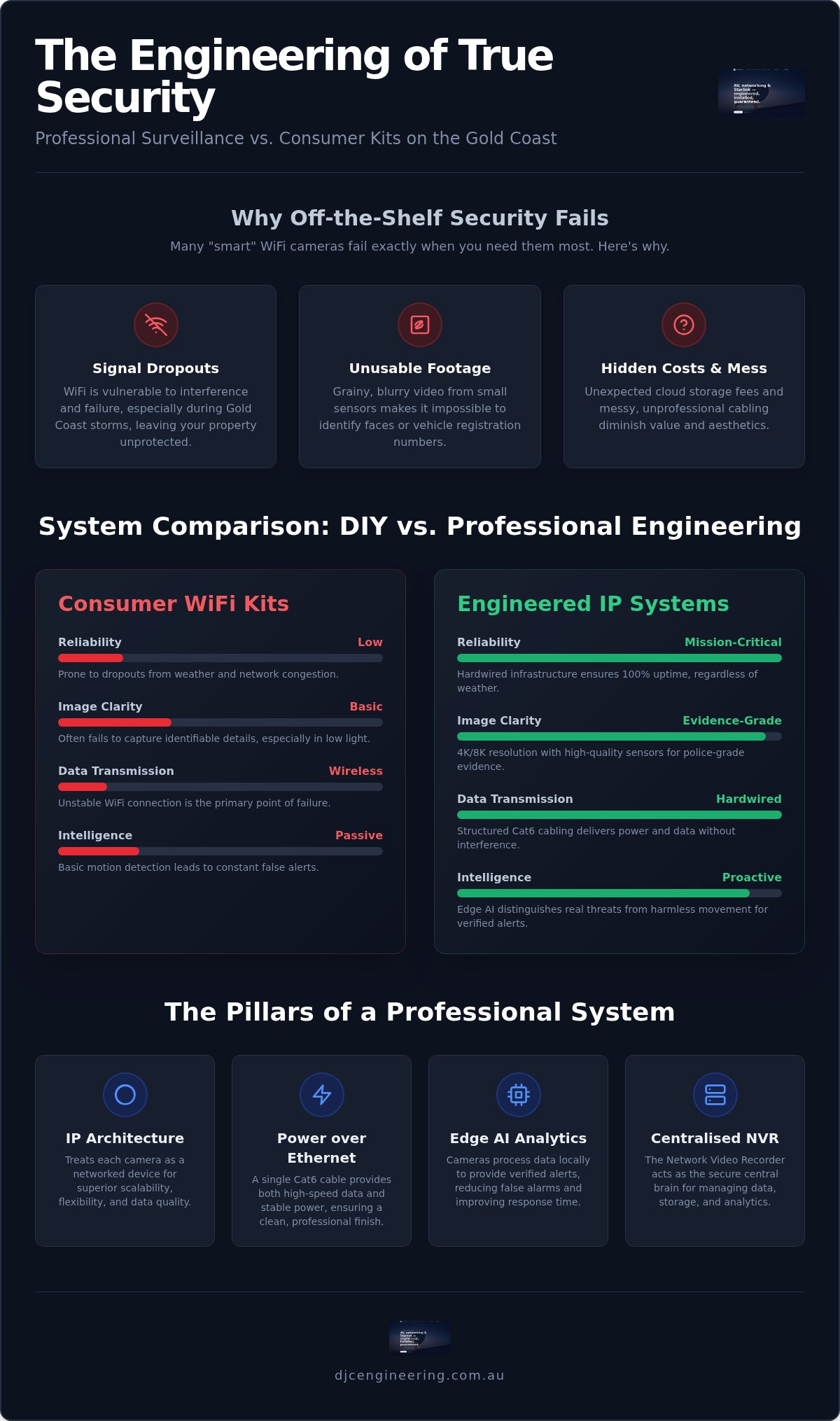
Wireless cameras are notoriously susceptible to environmental factors. In modern Gold Coast homes with thick masonry or multiple levels, mesh WiFi systems often struggle to maintain the high-bandwidth streams required for consistent 4K video. This leads to dropped frames and pixelation exactly when clarity is needed. Beyond signal strength, wireless signals are vulnerable to network congestion and even intentional jamming. If your security relies on a hybrid setup, professional WiFi design is a non-negotiable requirement to ensure your network can handle the continuous data load without compromising other connected devices.
Engineering Standards: Meticulous Placement and Cabling
Professional engineering focuses on the physical integrity of the setup. We don't just stick cameras to the eaves; we use structured cabling to provide a dedicated, interference-free path for every data stream. This approach ensures 100% uptime regardless of weather conditions or local network traffic. Neatness is a matter of security, not just aesthetics. By concealing cables within wall cavities or protective conduit, we prevent tampering and shield the infrastructure from the corrosive coastal air. A visible cable is a vulnerability that any intruder can exploit with a pair of snips.
Meticulous planning also goes into calculating fields of view. A DIYer might aim a camera at a door, but a technician calculates the specific focal length to ensure "identification" grade footage rather than mere "detection." This process includes a final commissioning stage where we calibrate motion zones and verify that every pixel is sharp. You also avoid the trap of hidden costs. While DIY brands often lock your footage behind monthly cloud subscriptions, a professional video surveillance system installation uses local NVR storage. This gives you full ownership of your data with zero recurring fees and instant, high-speed access to your recordings, even if the internet goes down.
Essential Features for Gold Coast Security Systems
Hardware selection is never a universal process. A professional video surveillance system installation on the Gold Coast must account for environmental stressors that would compromise standard retail gear within months. Between the corrosive salt air of the coastal strip and the intense UV radiation of the hinterland, durability is a technical requirement rather than an optional extra. We select components based on their ability to maintain evidence-grade clarity while withstanding the unique climate of South East Queensland.
Weatherproofing and Durability in SE QLD
Protection ratings are the first metric we evaluate. An IP66 rating indicates the camera is dust-tight and protected against high-pressure water jets, which is essential for surviving a standard Gold Coast summer storm. For more exposed locations, we often specify IP67-rated housings that can withstand temporary immersion. However, water resistance is only part of the equation. Salt-air corrosion is a silent killer of outdoor electronics. We prioritise camera bodies with high-grade aluminium or treated polycarbonate housings that won't pit or degrade when exposed to coastal winds. This attention to detail extends to the infrastructure; we use UV-rated, outdoor-grade cabling and sealed junction boxes to prevent the sun from turning your data lines brittle and prone to failure.
Night Vision and Low-Light Performance
Effective surveillance requires clarity 24 hours a day. Traditional Infrared (IR) night vision is the standard for stealthy monitoring, providing a monochrome image in total darkness. However, for properties where colour identification of vehicles or clothing is critical, we deploy high-sensitivity sensors capable of full-colour night vision. These sensors capture usable colour data with minimal ambient light, providing a significant advantage during police investigations.
Lighting challenges aren't limited to the night. The intense glare of the Queensland sun can "blind" a standard camera, resulting in washed-out images or deep, unreadable shadows. We mitigate this using Wide Dynamic Range (WDR) technology. A camera with true 120dB WDR can balance the exposure of a bright driveway against a shaded porch, ensuring every detail remains visible. To round out the system, we calibrate smart AI analytics to filter out false alarms. By distinguishing between the movement of a palm frond in the wind and a person entering your perimeter, the system ensures that the alerts you receive on your phone are genuine threats that require your attention.
Selecting the right hardware for our local conditions is a specialised task that requires experience and technical foresight. If you're ready to secure your property with an engineered solution built for the Gold Coast environment, contact our licensed technicians to discuss a tailored system design.
The Professional Approach to Surveillance Installation
Executing a high-calibre video surveillance system installation is a disciplined process that separates a secure property from a vulnerable one. A professional security integrator doesn't simply mount hardware to a wall; they engineer a solution where every camera angle, data packet, and power source is accounted for. This methodical approach ensures that the system remains easy for you to manage while being virtually impossible for an intruder to defeat. By choosing a specialist who prioritises technical standards over speed, you're investing in a system that delivers consistent results for years to come.
True property protection is achieved through synergy. We integrate visual surveillance with high-performance alarm systems to create a multi-layered defence. While cameras provide visual verification and evidence, a calibrated alarm system provides the immediate active response needed during a breach. In Queensland, the law is clear: any person installing security equipment for a fee must hold a Class 2B "security equipment installer" licence under the Security Providers Act. Working with a licensed local technician provides a level of accountability and expertise that a retail product simply cannot match.
The Step-by-Step Commissioning Process
Our workflow begins with a comprehensive site assessment. We identify blind spots, analyse light transitions throughout the day, and determine the most effective placement for evidence-grade capture. Once the strategy is set, we move to infrastructure preparation. This involves running high-bandwidth structured cabling that complies with AS/CA S009:2020 "Wiring Rules." We never take shortcuts with exposed wires; every cable is concealed or protected to maintain system integrity. The final stage is commissioning, where we verify every motion trigger, calibrate storage overwrite cycles, and test remote access to ensure the system is perfectly tuned before handover.
Integration with Your Digital Lifestyle
A professional video surveillance system installation must feel like a natural extension of your daily life. We configure your network to allow seamless viewing on smartphones, tablets, and dedicated monitors, providing real-time oversight of your Gold Coast property from anywhere in the world. This integration often extends to your broader digital ecosystem, linking surveillance with access control and audio-visual systems for a unified experience. Choosing a local partner means you aren't reliant on a generic overseas helpdesk if you need a system update or a technical adjustment. You have a master technician who understands the local environment and stands behind the quality of the work, ensuring your security infrastructure remains robust and responsive.
Precision Engineering for Lasting Security
Effective property protection is no longer about simply buying a camera; it's about building a robust digital backbone. We've explored why IP architecture and structured cabling are the only ways to ensure total reliability in the face of Gold Coast storms and corrosive salt air. You now understand that evidence-grade footage depends on more than just megapixels. It requires meticulous calibration, Edge AI, and local storage to bypass the pitfalls of recurring cloud fees and unreliable WiFi connections.
A professional video surveillance system installation is an investment in your property's long-term integrity. By partnering with our licensed security technicians, you gain the expertise in structured cabling and networking needed to create a system that is hard to defeat but easy to use. Our commitment to Gold Coast local reliability means we don't take shortcuts, ensuring every component is concealed, protected, and performing at its peak.
Ready to move beyond consumer-grade gadgets? Secure your property with a professional surveillance assessment from DJC Engineering Pty Ltd. We look forward to helping you achieve a clean, high-performance finish that provides genuine peace of mind.
Frequently Asked Questions
Do I need a professional to install my security cameras on the Gold Coast?
Yes, if you are paying for the service, Queensland law requires the installer to hold a Class 2B security equipment installer licence. Beyond legalities, a professional video surveillance system installation ensures your cameras are correctly positioned for evidence-grade capture and that all cabling is concealed. This prevents tampering and protects the infrastructure from the harsh Gold Coast salt air, which often causes DIY setups to fail prematurely.
Can I view my video surveillance cameras on my phone while I'm away?
Absolutely, modern IP systems provide seamless remote access via dedicated smartphone apps. Once your system is networked, you can view live streams and playback recorded footage from anywhere in the world with an internet connection. We configure secure, encrypted pathways to ensure your private data remains protected while giving you real-time alerts if a motion trigger is activated on your property, allowing for an immediate response.
What is the difference between an NVR and a DVR?
The primary difference lies in how the video data is processed. A DVR (Digital Video Recorder) processes data at the recorder and is used with older analog cameras. An NVR (Network Video Recorder) encodes and processes data at the camera level before sending it digitally. NVRs are the standard for high-performance video surveillance system installation because they support higher resolutions, advanced AI analytics, and simpler PoE cabling.
How long does security camera footage stay stored?
Most professional systems are configured to store between 14 and 30 days of footage, though this depends on your hard drive capacity and recording settings. We use high-efficiency H.265 compression to maximise storage space without sacrificing image quality. You can choose between continuous recording or motion-triggered events. Once the drive is full, the system automatically overwrites the oldest data to ensure you always have the most recent footage available.
Do security cameras work if the power or internet goes out?
Your cameras will continue to record locally to the NVR even if your internet connection drops out, provided the system has power. This is a major advantage over cloud-only DIY kits. If the mains power fails, the system will shut down unless a Uninterruptible Power Supply (UPS) is installed. We recommend a UPS for critical security setups to maintain protection during local Gold Coast storm-related power outages.
Are wireless security cameras as good as wired ones?
Wired cameras are significantly more reliable than wireless alternatives. While wireless cameras offer easier placement, they are prone to signal interference from building materials and other electronics. They also require regular battery charging or nearby power outlets. Hardwired PoE systems provide 100% uptime and the high bandwidth needed for 4K video streams, ensuring you never lose frames due to a weak WiFi signal or network congestion.
What is PoE and why is it used in professional CCTV?
PoE stands for Power over Ethernet. It is a technology that allows a single Cat6 cable to transmit both high-speed data and electrical power to your cameras. This simplifies the installation process and results in a much cleaner finish with fewer cables. It also improves reliability, as the cameras receive stable power directly from the NVR or a PoE switch rather than relying on individual, external power adapters.
Is it legal to record video and audio on my own property in Queensland?
It is legal to record video on your own property and public areas visible from it, provided you respect your neighbours' reasonable expectation of privacy. However, recording audio is strictly regulated under the Invasion of Privacy Act 1971. It is generally an offence to record a private conversation without consent. We typically recommend disabling audio recording features to ensure your system remains fully compliant with Queensland's strict privacy regulations.
Frequently Asked Questions
Yes, if you are paying for the service, Queensland law requires the installer to hold a Class 2B security equipment installer licence. Beyond legalities, a professional video surveillance system installation ensures your cameras are correctly positioned for evidence-grade capture and that all cabling is concealed. This prevents tampering and protects the infrastructure from the harsh Gold Coast salt air, which often causes DIY setups to fail prematurely.
Absolutely, modern IP systems provide seamless remote access via dedicated smartphone apps. Once your system is networked, you can view live streams and playback recorded footage from anywhere in the world with an internet connection. We configure secure, encrypted pathways to ensure your private data remains protected while giving you real-time alerts if a motion trigger is activated on your property, allowing for an immediate response.
The primary difference lies in how the video data is processed. A DVR (Digital Video Recorder) processes data at the recorder and is used with older analog cameras. An NVR (Network Video Recorder) encodes and processes data at the camera level before sending it digitally. NVRs are the standard for high-performance video surveillance system installation because they support higher resolutions, advanced AI analytics, and simpler PoE cabling.
Most professional systems are configured to store between 14 and 30 days of footage, though this depends on your hard drive capacity and recording settings. We use high-efficiency H.265 compression to maximise storage space without sacrificing image quality. You can choose between continuous recording or motion-triggered events. Once the drive is full, the system automatically overwrites the oldest data to ensure you always have the most recent footage available.
Your cameras will continue to record locally to the NVR even if your internet connection drops out, provided the system has power. This is a major advantage over cloud-only DIY kits. If the mains power fails, the system will shut down unless a Uninterruptible Power Supply (UPS) is installed. We recommend a UPS for critical security setups to maintain protection during local Gold Coast storm-related power outages.
Wired cameras are significantly more reliable than wireless alternatives. While wireless cameras offer easier placement, they are prone to signal interference from building materials and other electronics. They also require regular battery charging or nearby power outlets. Hardwired PoE systems provide 100% uptime and the high bandwidth needed for 4K video streams, ensuring you never lose frames due to a weak WiFi signal or network congestion.
PoE stands for Power over Ethernet. It is a technology that allows a single Cat6 cable to transmit both high-speed data and electrical power to your cameras. This simplifies the installation process and results in a much cleaner finish with fewer cables. It also improves reliability, as the cameras receive stable power directly from the NVR or a PoE switch rather than relying on individual, external power adapters.
It is legal to record video on your own property and public areas visible from it, provided you respect your neighbours' reasonable expectation of privacy. However, recording audio is strictly regulated under the Invasion of Privacy Act 1971. It is generally an offence to record a private conversation without consent. We typically recommend disabling audio recording features to ensure your system remains fully compliant with Queensland's strict privacy regulations.