
Surveillance Cameras & Security: The Technical Guide to Professional Protection
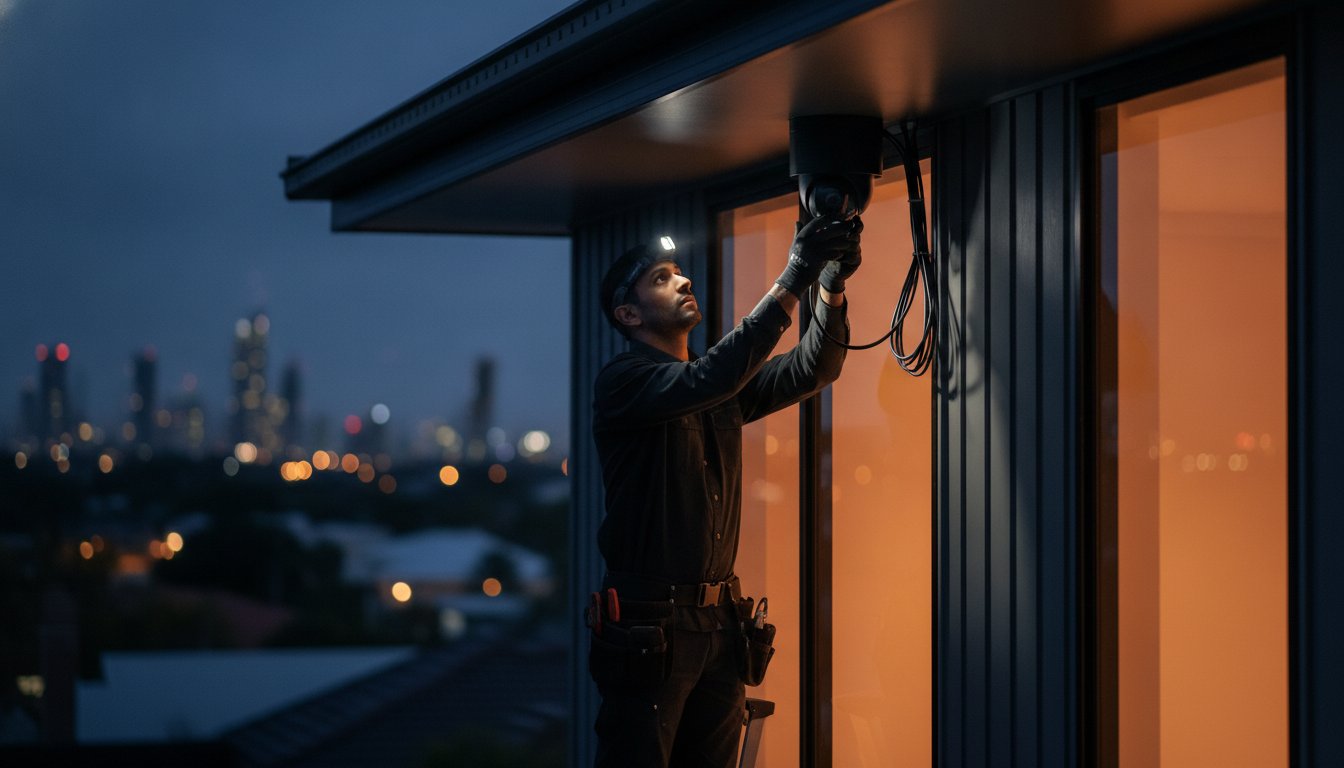
Why does a high-resolution camera still produce a blurry, unrecognisable face when it actually matters? Most property owners invest in surveillance cameras security expecting total peace of mind, only to be met with grainy night footage and a tangled mess of unreliable WiFi connections. It is a common frustration that stems from treating security as a simple retail purchase rather than a rigorous technical engineering project.
We understand that a security system is only as strong as its weakest link, whether that is substandard cabling or a laggy mobile app that fails when you are away from home. This guide will help you master the technical requirements of modern surveillance systems and explain why professional engineering is the key to reliable property protection. We will examine how structured cabling, adherence to Australian wiring standards, and precise sensor calibration deliver crystal clear 4K footage and seamless network integration for your property.
Key Takeaways
- Understand why modern IP surveillance and AI-driven human detection have made traditional analog systems obsolete for high-performance property protection.
- Discover how structured cabling acts as the vital backbone for your network, ensuring your surveillance cameras security system delivers reliable, high-definition 4K footage without lag.
- Learn to avoid the common battery trap of DIY units by integrating professional WiFi design and robust hardware that won't fail when you need it most.
- Identify the specific environmental challenges in South East Queensland, such as salt spray and heat, that dictate where and how you should install your equipment.
- See how professional engineering links your security hardware directly to your NBN or Starlink connection for seamless, crystal-clear remote viewing from any location.
Beyond the Lens: Understanding Modern Surveillance Camera Security
Analog systems are a relic of the past. Modern IP surveillance has fundamentally changed how we secure properties in South East Queensland. While older systems relied on grainy coax cables and low-resolution sensors, today's surveillance cameras security infrastructure is built on high-speed digital networks. For a comprehensive overview of Closed-circuit television (CCTV), it's clear that the industry has shifted from simple recording to intelligent, active protection.
In 2026, the standard is AI-driven analytics. We don't just record footage; we deploy systems that distinguish between a stray cat and a person at your gate. Active deterrence features, such as strobe lights and sirens triggered by vehicle detection, turn a passive observer into a proactive guard. True security requires 100% uptime. If the network drops or the storage fails, your protection vanishes. This is why professional engineering focuses on the entire ecosystem, not just the camera on the wall.
The Components of a High-Performance System
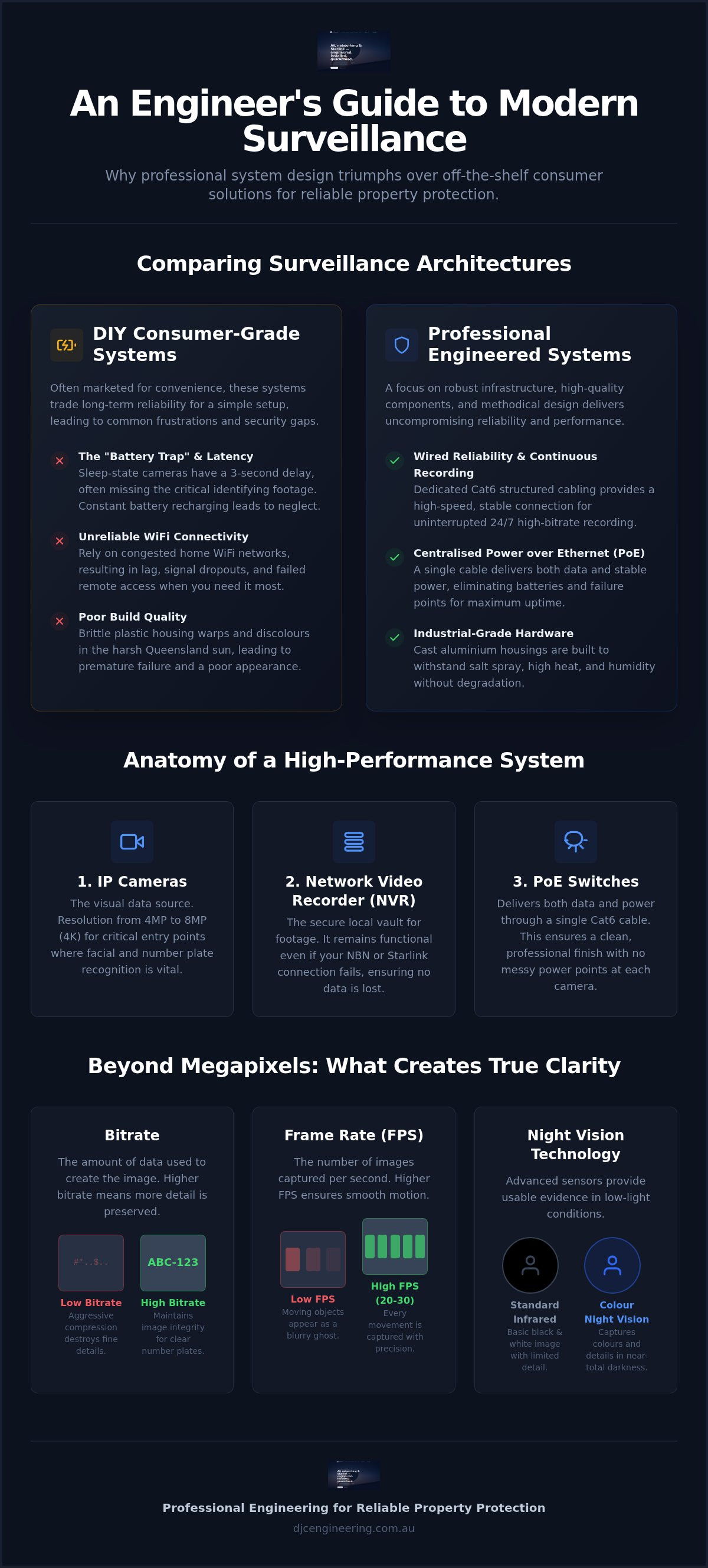
A professional setup relies on three core pillars. First, IP cameras provide the visual data, with resolutions ranging from 4MP for general areas to 8MP (4K) for critical entry points where facial recognition is vital. Second, the Network Video Recorder (NVR) acts as the secure local vault. Local storage is superior to cloud-only options because it remains functional even if your NBN or Starlink connection fails. Finally, Power over Ethernet (PoE) switches deliver both data and electricity through a single Cat6 cable. This eliminates the need for messy power points at every camera location and ensures a clean, professional finish.
Why Resolution Isn’t the Only Metric That Matters
High megapixels don't always equal high quality. A cheap 8MP camera often uses aggressive compression that destroys fine details like number plates. Bitrate is the secret to clarity. We prioritise high-bitrate sensors that maintain image integrity even during complex scenes. For night vision, technologies like Darkfighter or ColorVu are essential. These allow cameras to see in near-total darkness or provide full-colour images at midnight, capturing details that standard infrared would miss. Frame rate is equally vital. A low frame rate makes a running intruder look like a series of blurry ghosts. A consistent 20 to 30 frames per second ensures every movement is captured with precision, providing the evidence you need when it counts.
Comparing Surveillance Architectures: DIY vs. Professional Engineering
Retail stores often push "easy-install" kits as the ultimate solution, but these products frequently lead to the "Battery Trap". When you rely on consumer-grade surveillance cameras security, you're trading long-term reliability for a simple weekend DIY project. A professional installation prioritises permanent infrastructure over temporary convenience. This ensures that your system remains functional for years, not just until the first battery drain or WiFi glitch. True protection isn't found in a box on a shelf; it's built through methodical network design and high-quality hardware selection.
The Limitations of Consumer-Grade Battery Cameras
Battery-powered units are designed to stay in a low-power sleep state until they detect motion. This creates a significant latency gap. It's common to see a 3-second delay between a person entering the frame and the recording starting. By then, the critical identifying shot is often gone. Most homeowners also experience recharge fatigue. After the third or fourth time climbing a ladder to swap batteries, the task gets ignored. This leaves your property vulnerable with nothing but a plastic ornament on the wall. These units usually only record short, low-bitrate clips, meaning you lose the vital context of what happened before and after an event occurred.
The Professional Advantage: Wired Reliability
Wired systems using Cat6 cabling provide a dedicated, high-speed highway for your data. This eliminates the lag and dropouts associated with congested home WiFi networks. We use industrial-grade housing made of cast aluminium rather than the brittle plastic found in retail stores. This hardware is built to withstand the harsh Queensland sun without warping or discolouring over time. If you're tired of unreliable notifications and grainy footage, a professionally configured security network provides the stability needed for instant remote access and high-bitrate recording.
A major technical benefit of this approach is centralised power. By connecting your NVR and PoE switches to a UPS, your cameras keep recording even if an intruder cuts the mains power. Professional configuration also addresses modern cybersecurity. New Australian rules introduced in early 2026 mandate that smart devices must not use universal default passwords. We implement secure network protocols and define clear software update paths to protect your private footage from external threats. This technical rigour ensures your setup meets the required legal standards for video surveillance while delivering the high-performance results you expect.
The Engineered Backbone: Cabling and Network Integration
A high-performance camera is essentially useless without a robust data highway to carry its signal. For surveillance cameras security to be truly effective, the underlying network must be engineered to handle constant, high-bitrate data streams. This is where many DIY setups fail. They rely on over-congested home WiFi, leading to dropped frames and pixelated footage when you need clarity the most. A professional installation treats your security as a critical piece of infrastructure, starting with the physical cabling and ending with a calibrated network rack.
Structured Cabling for CCTV
We utilise Cat6 structured cabling as the gold standard for every installation. Unlike wireless alternatives, a physical copper link provides zero-latency transmission and delivers Power over Ethernet (PoE) directly to the device. This future-proofs your property for upcoming 8K technologies while ensuring your current 4K streams never falter. We prioritise meticulous cable management, concealing wires within wall cavities and conduits to prevent tampering and maintain a clean aesthetic. Every link we install undergoes rigorous testing to ensure it is 100% reliable before we even mount a lens.
Integrating Surveillance with Starlink and WiFi
Remote viewing is the most demanding part of any modern system. Your NBN or Starlink upload speed determines whether your mobile app loads a crisp live feed or a frustrating loading spinner. For rural properties, we specialise in optimising Starlink connections to handle the heavy upload requirements of high-definition video. To prevent your cameras from slowing down your Netflix or work-from-home setup, we implement bandwidth management through VLAN configuration. By isolating your security traffic on its own virtual network, we improve the security of modern IP-based surveillance systems and ensure your home network remains fast.
Organising the "brain" of your system into a neat server rack is not just about pride in workmanship. It provides the necessary airflow to prevent NVR overheating and makes future troubleshooting a simple process. When combined with Professional WiFi Design, this integrated approach creates a seamless security ecosystem that works every time you open the app. We don't take shortcuts with your connectivity because a reliable backbone is what separates a professional grade system from a domestic toy.
Planning Your Gold Coast Security: Local Factors and Laws
Designing a system for the Gold Coast requires more than just picking a spot on a wall. Our local climate is notoriously harsh on electronics. Salt spray from the Pacific and high humidity levels in South East Queensland can corrode standard hardware in months. Beyond the environment, you must navigate strict Queensland legislation. In QLD, the installation of surveillance cameras security equipment must be performed by a licensed security installer. A standard electrician's licence is not sufficient for this specialised technical work.
Privacy laws are equally critical. While you have the right to protect your property, you cannot legally record your neighbour's private spaces. Additionally, under the Surveillance Devices Acts, recording audio without consent is generally a criminal offence. We usually recommend disabling microphones unless you have specific legal advice and clear signage. New 2026 standards also require visible signage at every entrance. These signs must now include a contact method for the designated Data Controller to ensure compliance with updated transparency rules.
Surviving the Coastal Environment
Canal-front and beachfront properties require IP67-rated hardware as a minimum standard. This rating ensures the camera housing is completely dust-tight and protected against powerful water jets or temporary immersion. We avoid cheap plastic mounts that become brittle in the QLD sun. Instead, we use high-quality aluminium brackets and stainless steel fixings to prevent rust streaks and structural failure. Regular maintenance is also vital. A quick wipe of the lens every few months keeps salt crust and spiderwebs from triggering false AI alerts or blurring your 4K evidence.
Strategic Camera Placement
We follow the "Choke Point" principle to maximise identification. This involves placing cameras at narrow entry points, such as gates or front doors, where an intruder's path is predictable. Height is a major factor here. While high mounting prevents tampering, placing a camera at 2.4 metres is usually the sweet spot for capturing a clear facial ID. We also match the lens to the specific task. A wide-angle lens is perfect for a broad driveway, but a telephoto lens is required for a long gate approach to ensure the pixel density is high enough to read a number plate.
Lighting is the final piece of your property audit. Even with advanced low-light sensors, identifying shadows and light flare from street lamps is essential for a clean image. We assess your property's ambient light to ensure the sensors aren't blinded by glare at 2:00 am. For a system that meets these rigorous environmental and legal standards, contact DJC Engineering for a professional security assessment today.
The DJC Engineering Approach: Professional Security Installation
Professional installation is the bridge between high-quality hardware and a high-performance outcome. We don't just bolt cameras to your eaves. Our process begins with a rigorous site assessment to identify the specific technical requirements of your property. By following a methodical workflow of assessment, execution, and final calibration, we ensure your surveillance cameras security system operates at its peak potential. This structured approach eliminates the common failures of DIY setups and generic installations, such as poor cable management or misconfigured network settings.
Neatness is a core pillar of our technical authority. We prioritise the concealment of all components, using professional-grade conduits and wall cavities to protect your infrastructure from both the elements and tampering. Our licensed technicians take full accountability for every link in the chain, from the structured cabling in your ceiling to the final configuration of your NVR. We specialise in comprehensive integration, ensuring your surveillance works in harmony with your existing alarms, access control, and networking infrastructure for a unified security ecosystem.
Commissioning and Handover
The final stage of our installation is the commissioning process. We don't leave site until every sensor is calibrated and your smartphone is configured for instant, accurate alerts. We provide thorough user training to ensure you are confident in navigating the interface and, most importantly, know exactly how to pull high-definition footage for police if an incident occurs. For more details on our specific local expertise, view our Security Camera Installation Gold Coast pillar. We ensure your remote access loads instantly, providing the reliable property protection you expect from a premium engineered solution.
Ongoing Support and Scalability
A professional system should evolve with your needs. We design every project with future-proofing in mind, allowing you to add more cameras or upgrade to 8K technology as your requirements change. Cybersecurity remains a top priority. Following the Australian standards introduced in March 2026, we manage critical firmware updates to keep your system secure from digital threats. This commitment to longevity is the DJC guarantee. You aren't just buying a kit; you're investing in a relationship with a master technician who prioritises precision, robustness, and a clean finish in every project we undertake across SE QLD.
Engineering Your Peace of Mind: The Path to Robust Protection
Effective property protection goes far beyond buying a box of cameras from a retail shelf. It requires a deep understanding of network stability, structured cabling, and the specific environmental demands of South East Queensland. By moving away from the limitations of battery-powered DIY units and embracing a professionally engineered system, you ensure that your surveillance cameras security setup delivers clear, unshakeable evidence when it matters most. Reliable protection is built on a foundation of industrial-grade hardware and meticulous technical calibration.
We believe in a no-shortcuts approach to every installation. Our licensed SE QLD technicians are specialists in high-performance networking, ensuring your system integrates seamlessly with your NBN or Starlink connection. We take full accountability for the neatness and robustness of our work, from the first cable pull to the final smartphone handover. Take the first step toward a system that actually works and Request a Professional Security Assessment from DJC Engineering. Your property deserves the precision of a master technician.
Frequently Asked Questions
Do I need a security licence to install cameras in Queensland?
Yes, you absolutely need a specific security provider licence to install surveillance cameras security systems in Queensland. While many people assume a standard electrician can do the job, QLD law requires a Class 2 security equipment installer licence for anyone fitting, repairing, or maintaining these systems. We ensure all our technicians are fully licensed, protecting you from the legal risks and insurance complications that arise from using unlicensed installers for your property.
Can I see my security cameras on my phone when I am not at home?
You can certainly view your footage remotely using a dedicated smartphone app. We configure your Network Video Recorder (NVR) to link securely with your home internet, whether you use NBN or Starlink. This setup allows for instant live viewing and accurate push notifications from anywhere in the world. We calibrate the system to ensure the stream is fluid and high-resolution, avoiding the lag often found in poorly configured or retail-grade DIY setups.
How much storage do I need for 30 days of 4K footage?
Storage requirements depend on the number of cameras and the chosen bitrate, but a standard four-camera 4K setup typically requires between 8TB and 12TB of hard drive space for 30 days of continuous recording. Using modern H.265+ compression helps reduce the data footprint without sacrificing image quality. We calculate the specific capacity needed during our assessment to ensure your footage isn't overwritten before you have a chance to review it properly.
Will security cameras work if the power goes out or the NBN fails?
Your cameras will continue to record locally to the NVR if you have a Uninterruptible Power Supply (UPS) installed, even during a total blackout. However, remote viewing on your phone will fail if the NBN or Starlink connection goes down. A professionally engineered system prioritises local storage precisely for this reason, ensuring that your property remains protected and evidence is captured even when your external network connection is temporarily unavailable or compromised.
What is the difference between a bullet camera and a turret camera?
Bullet cameras are highly visible, protruding units that act as a strong visual deterrent, while turret cameras feature a "ball and socket" design that is more discreet and harder for vandals to reposition. We often recommend turrets for residential areas because they don't have a glass dome that causes IR glare, resulting in clearer night vision. Both types provide high-definition surveillance cameras security, but the choice depends on the specific mounting location and your aesthetic preference.
Can security cameras be integrated with my existing alarm system?
Integration is a standard part of our high-performance setups. We can link your surveillance with existing alarms and access control systems using physical I/O ports or unified software platforms. This allows for advanced triggers, such as your cameras automatically displaying on a monitor when a perimeter sensor is tripped. This integrated approach creates a more robust security ecosystem, moving your property from simple recording to an active, responsive defence network that works together.
How many cameras do I need for a standard four-bedroom home?
Most standard four-bedroom homes in SE QLD require between four and six cameras for comprehensive coverage. This typically includes a dedicated unit for the front entry, the driveway, side paths, and the rear alfresco area. We focus on eliminating blind spots while ensuring that every "choke point" is covered with enough resolution to identify faces. During our initial assessment, we map out the exact placements to provide total property protection with maximum efficiency.
Is it better to have wired or wireless security cameras?
Wired systems using Cat6 cabling are the superior choice for any permanent installation. While wireless options seem convenient, they are prone to signal interference, network congestion, and the "battery trap" of constant recharging. A wired PoE connection provides a dedicated data highway and consistent power, ensuring 100% reliability. We specialise in structured cabling to deliver a robust backbone that supports high-bitrate 4K footage without the dropouts common in domestic WiFi-based products.
Frequently Asked Questions
Yes, you absolutely need a specific security provider licence to install surveillance cameras security systems in Queensland. While many people assume a standard electrician can do the job, QLD law requires a Class 2 security equipment installer licence for anyone fitting, repairing, or maintaining these systems. We ensure all our technicians are fully licensed, protecting you from the legal risks and insurance complications that arise from using unlicensed installers for your property.
You can certainly view your footage remotely using a dedicated smartphone app. We configure your Network Video Recorder (NVR) to link securely with your home internet, whether you use NBN or Starlink. This setup allows for instant live viewing and accurate push notifications from anywhere in the world. We calibrate the system to ensure the stream is fluid and high-resolution, avoiding the lag often found in poorly configured or retail-grade DIY setups.
Storage requirements depend on the number of cameras and the chosen bitrate, but a standard four-camera 4K setup typically requires between 8TB and 12TB of hard drive space for 30 days of continuous recording. Using modern H.265+ compression helps reduce the data footprint without sacrificing image quality. We calculate the specific capacity needed during our assessment to ensure your footage isn't overwritten before you have a chance to review it properly.
Your cameras will continue to record locally to the NVR if you have a Uninterruptible Power Supply (UPS) installed, even during a total blackout. However, remote viewing on your phone will fail if the NBN or Starlink connection goes down. A professionally engineered system prioritises local storage precisely for this reason, ensuring that your property remains protected and evidence is captured even when your external network connection is temporarily unavailable or compromised.
Bullet cameras are highly visible, protruding units that act as a strong visual deterrent, while turret cameras feature a "ball and socket" design that is more discreet and harder for vandals to reposition. We often recommend turrets for residential areas because they don't have a glass dome that causes IR glare, resulting in clearer night vision. Both types provide high-definition surveillance cameras security, but the choice depends on the specific mounting location and your aesthetic preference.
Integration is a standard part of our high-performance setups. We can link your surveillance with existing alarms and access control systems using physical I/O ports or unified software platforms. This allows for advanced triggers, such as your cameras automatically displaying on a monitor when a perimeter sensor is tripped. This integrated approach creates a more robust security ecosystem, moving your property from simple recording to an active, responsive defence network that works together.
Most standard four-bedroom homes in SE QLD require between four and six cameras for comprehensive coverage. This typically includes a dedicated unit for the front entry, the driveway, side paths, and the rear alfresco area. We focus on eliminating blind spots while ensuring that every "choke point" is covered with enough resolution to identify faces. During our initial assessment, we map out the exact placements to provide total property protection with maximum efficiency.
Wired systems using Cat6 cabling are the superior choice for any permanent installation. While wireless options seem convenient, they are prone to signal interference, network congestion, and the "battery trap" of constant recharging. A wired PoE connection provides a dedicated data highway and consistent power, ensuring 100% reliability. We specialise in structured cabling to deliver a robust backbone that supports high-bitrate 4K footage without the dropouts common in domestic WiFi-based products.