
Starlink Brisbane: Overcoming Urban Connectivity Gaps with Professional Engineering
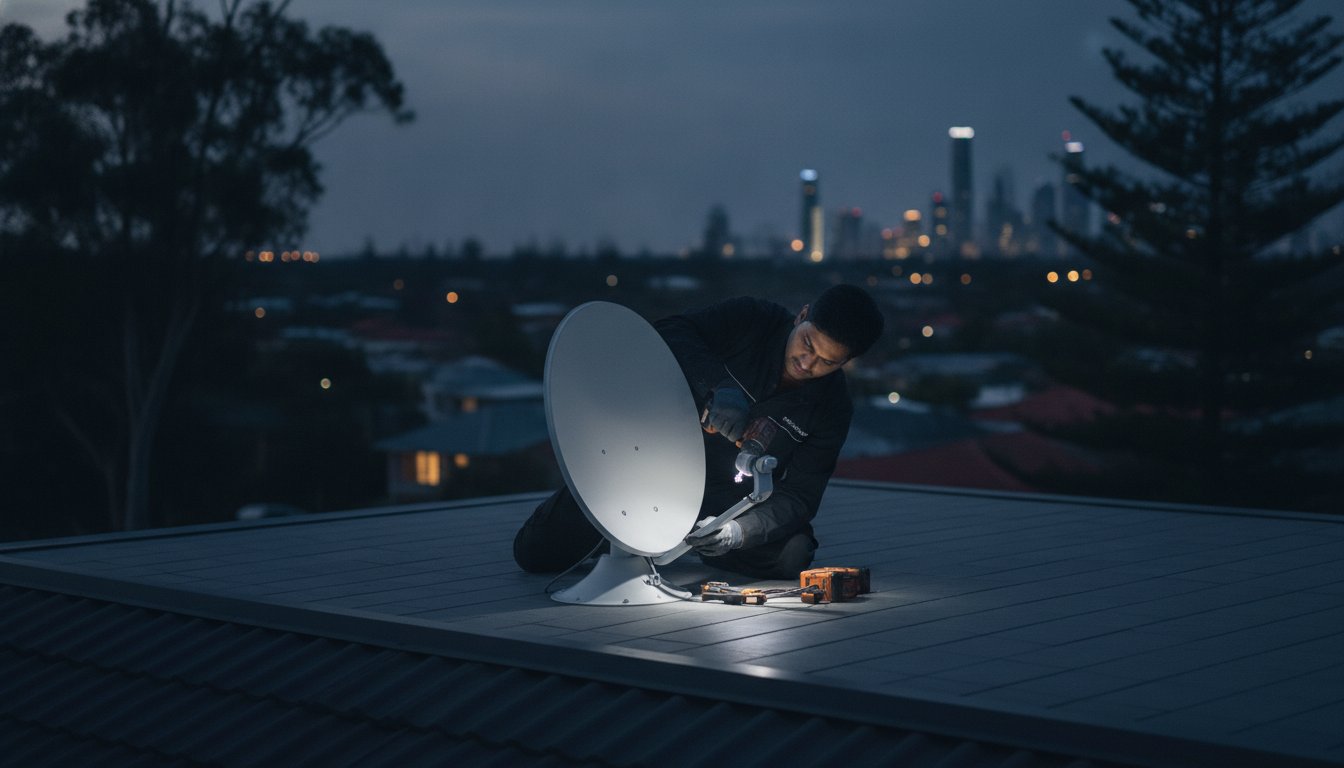
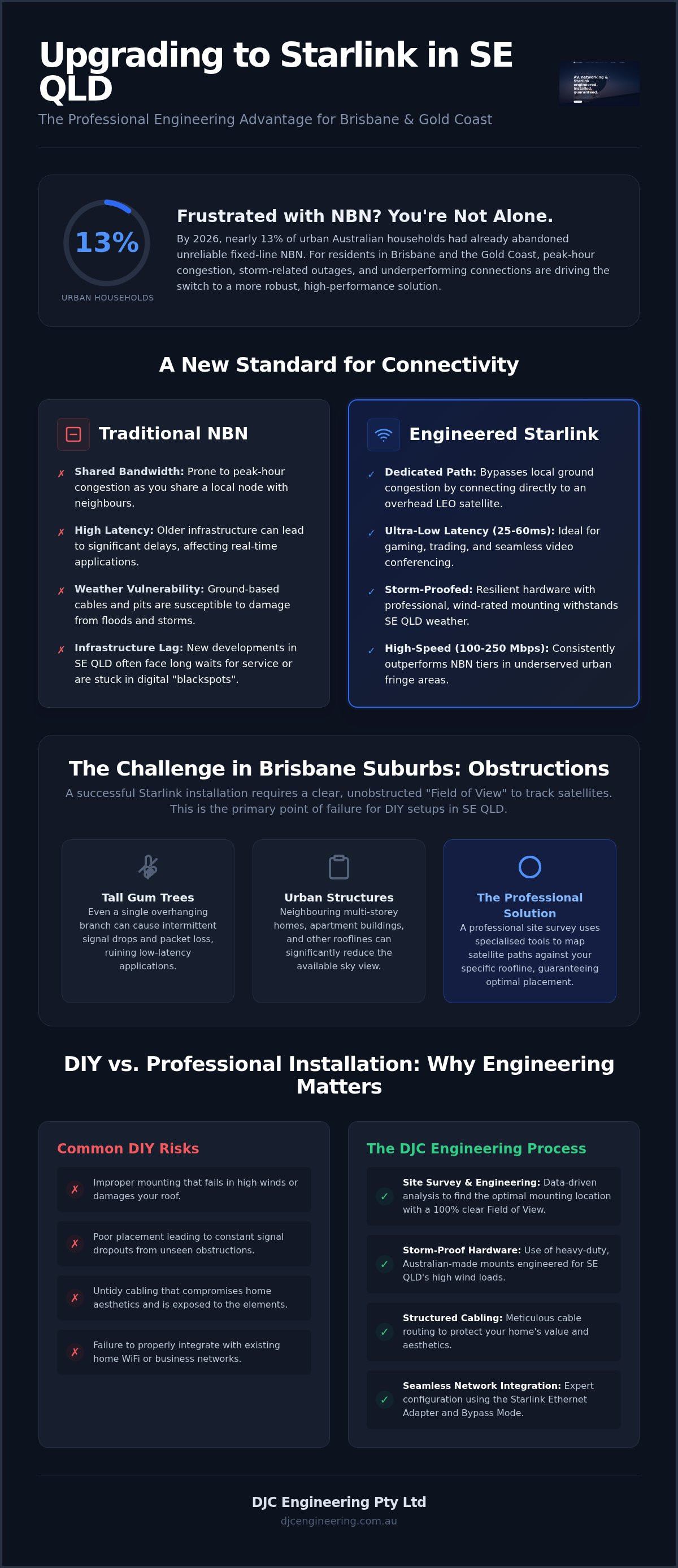
By the start of 2026, nearly 13% of urban Australian households had already abandoned traditional fixed-line connections in favour of satellite technology. It's a shift driven by a simple, frustrating reality: for many residents looking into starlink brisbane options, the NBN simply isn't delivering the stability or speed it promised. You've likely felt the sting of peak-hour congestion in Gold Coast's urban areas or watched your connection vanish the moment a summer storm hits the coast. Settling for "good enough" internet shouldn't be the standard when you're trying to run a home office or manage a modern household.
Securing a truly high-performance connection involves more than just unboxing a kit and bolting it to a gutter. With **DJC Engineering Pty Ltd**, you'll learn how a professionally engineered Starlink installation bypasses urban dead zones and overcomes the signal obstructions common in Gold Coast's diverse suburbs. This guide details how to achieve low-latency performance through meticulous mounting and structured cabling that protects your home's aesthetics and property value. We'll walk through the technical process of integrating Starlink with your existing WiFi and security systems to ensure your digital infrastructure is as robust as the hardware itself.
Key Takeaways
- Identify why Starlink’s low-latency LEO technology offers a more reliable alternative to the peak-hour congestion found in traditional Brisbane NBN connections.
- Learn how to mitigate signal dropouts caused by SE QLD’s tall gum trees and urban obstructions through precise "Field of View" engineering and site assessments.
- Discover the risks of basic DIY setups and why a professional starlink brisbane installation using heavy-duty, Australian-made hardware is vital for storm-proofing your connection.
- Explore the technical process of using the Starlink Ethernet Adapter and Bypass Mode to integrate satellite internet with your high-performance home or business network.
Why Starlink Brisbane is the Solution for SE QLD Connectivity Gaps
Starlink represents a fundamental shift in how we access the digital world, moving away from the physical constraints of copper and fibre. It is a high-speed, low-latency internet service powered by the Starlink satellite constellation, which operates in Low Earth Orbit (LEO). Because these satellites are roughly 60 times closer to Earth than traditional geostationary models, the delay in data transmission is drastically reduced. For those investigating starlink brisbane options in 2026, this technical proximity translates to real-world performance, with latency often sitting between 25 and 60 ms. This makes it the first satellite technology capable of supporting high-stakes activities like live trading, competitive gaming, and seamless video conferencing.
In SE QLD’s rapidly growing fringe developments, the infrastructure often fails to keep pace with the population. New estates across the Moreton Bay and Logan regions frequently find themselves in digital "blackspots" where legacy NBN connections are either unavailable or restricted to slow, unreliable speeds. Recent data from July 2026 shows that Starlink’s Australian residential plans now offer speeds ranging from 100 Mbps to 250 Mbps. These metrics consistently outperform standard NBN tiers in areas where the local exchange is oversubscribed or the physical cabling has degraded. It has become a primary choice for residents who refuse to wait years for planned infrastructure upgrades that may never meet their current bandwidth requirements.
Bypassing Brisbane NBN Congestion
Peak-hour congestion is a persistent issue in high-density Brisbane suburbs. When the local NBN node becomes saturated during the evening rush, speeds drop and jitter increases because you are sharing a finite amount of bandwidth with your neighbours. Choosing starlink brisbane allows you to bypass this local bottleneck entirely. By connecting directly to a satellite overhead, you secure a dedicated path to the global internet that doesn't rely on the "last mile" of congested local copper or fibre. This provides a level of consistency that is essential for home offices and businesses that cannot afford the performance dips common in urban residential areas.
Reliability During Queensland Weather Events
Our local storm season is notorious for disrupting ground-based infrastructure. Flooded pits and lightning strikes on power poles can knock out NBN services for days. Starlink hardware is built to be resilient, featuring an internal heating element originally designed for snow melt, which we use in Queensland to help shed heavy tropical rainfall from the dish surface. This ensures the signal maintains its integrity even during intense downpours. A professional installation is critical here; we use robust, heavy-duty mounting systems that are engineered to withstand the high wind loads of a SE QLD summer, ensuring your connection stays online when local ground systems fail.
The Technical Challenges of Starlink in Brisbane Suburbs
The success of a starlink brisbane installation depends entirely on the local geography and architectural landscape. Unlike rural areas with wide-open horizons, Brisbane suburbs present a dense mix of established tall gums and multi-storey structures. These physical barriers frequently disrupt the "Field of View" required by the phased-array antenna to track satellites across the sky. Even a single overhanging branch from a Spotted Gum can cause intermittent packet loss. This isn't just a minor annoyance; it ruins the experience of low-latency applications like video conferencing or competitive gaming where every millisecond of connectivity matters.
Identifying these obstructions before drilling is a critical part of our engineering process. We've seen many DIY attempts fail because the user underestimated how much of the sky the dish needs to "see" to maintain a handoff between satellites. A professional site survey uses specialised tools to map the orbital path of the constellation against your specific roofline. This data-driven approach ensures that the hardware is positioned for maximum uptime, rather than just convenience or ease of access.
Navigating Urban Obstructions
Finding the "sweet spot" on a Brisbane roof requires more than a quick glance at the sky. We use advanced signal analysis and heatmapping to identify the precise coordinates where the antenna has an unobstructed path. In fringe suburbs like Paddington or Milton, tall buildings can cast "signal shadows" that aren't immediately obvious from the ground. We solve this by using custom mounting solutions that elevate the dish above the tree line or roof peak. This ensures a stable connection without compromising the structural integrity or the watertight seal of your home.
The intense SE QLD sun is another factor that DIYers often overlook. Prolonged exposure to 35-degree days can stress hardware if it's placed in a stagnant air pocket or a poorly ventilated area. Beyond the physical environment, integrating this tech requires an understanding of the broader digital landscape. Some Australian users have even raised concerns regarding national security and privacy challenges associated with satellite data, making a secure, professionally configured network even more vital for peace of mind.
Cable Management and Property Value
A messy DIY cable run across a tile roof isn't just an eyesore; it's a long-term liability. UV exposure in Queensland quickly degrades standard cables, and improper entry points lead to roof leaks during our heavy summer downpours. We prioritise structured cabling that is concealed within wall cavities or protected by high-grade, UV-stabilised conduits. This meticulous approach protects your property’s envelope and maintains the aesthetic value of your home. If you want a result that looks as good as it performs, a professional site assessment is the first step toward a permanent, high-performance solution.
DIY Setup vs. Professional Starlink Installation: Why Engineering Matters
The "setup in minutes" marketing promise is fine for a camping trip, but it doesn't hold up for a permanent starlink brisbane residential installation. DIY attempts often ignore the mechanical stresses placed on a roof. A loose mount or a poorly sealed penetration can lead to structural damage that far outweighs the cost of professional labour. Engineering a solution means looking at the long-term viability of the hardware in our specific climate. We move beyond the basic "plug and play" mentality to ensure the installation is a permanent, high-performance asset to your property.
Using licensed technicians isn't just about having the right ladder; it's about accountability and precision. Professional installation ensures your work complies with Australian standards, which is vital for protecting your manufacturer warranty and home insurance policy. We calibrate every system for maximum throughput, looking deeper into the diagnostic data than the basic mobile app allows to ensure your hardware is performing at its absolute limit from day one.
The Limitations of the "Out of the Box" Kit
The "Dishy" tripod included in the standard kit is designed for temporary ground use, not for permanent roof mounting in SE QLD. Brisbane falls within wind Region B, where gusts can reach significant speeds during the summer storm season. Using a standard tripod or a generic bracket on a steep roof is a recipe for wind damage and signal oscillation. We utilise heavy-duty, Australian-standard mounts specifically engineered for tin, tile, or flat roof profiles to ensure the dish remains stationary. Additionally, Starlink proprietary cables are not rated for indefinite exposure to the harsh Australian sun. Without UV-stabilised conduit and meticulous concealment, the outer jacket degrades, leading to signal failure and water ingress into your wall cavities.
Network Integration and WiFi Design
The basic router provided by Starlink is often the weakest link in the digital chain. For a modern Brisbane home, a single access point is rarely sufficient to deliver high-speed, low-latency internet to every room. Achieving a result that actually works requires Professional WiFi Design that integrates the satellite feed into a robust Ethernet backbone. We frequently configure systems in "Bypass Mode" to work with high-performance third-party routers and mesh networks. This technical step ensures that the low latency provided by the LEO satellites isn't lost to poor WiFi coverage or local network interference, providing a seamless experience for every connected device in the house.
Maximising Performance: The SE QLD Starlink Installation Checklist
Executing a high-performance starlink brisbane installation requires a disciplined, step-by-step technical workflow. We treat every site as a unique engineering challenge rather than a generic hardware swap. This methodical approach ensures that the theoretical speeds promised by LEO technology translate into actual, sustained throughput for your home or business. Our commissioning process follows five critical milestones:
- Step 1: Comprehensive site assessment. We use precision signal analysis to map the orbital path against local obstructions, ensuring a 100% clear "Field of View."
- Step 2: Hardware selection. We choose mounting systems specifically rated for Australian Wind Region B to ensure the dish remains perfectly stationary during intense gusts.
- Step 3: Precision cable routing. Cables are concealed within wall cavities and terminated at professional internal wall plates, maintaining the aesthetic integrity of your interior.
- Step 4: Network commissioning. We "Stress Test" the connection under load to verify that latency and jitter remain within professional tolerances.
- Step 5: Documentation. You receive a final handover report detailing the signal quality and network configuration for your records.
Selecting the Right Mount for Brisbane Roofs
The standard hardware provided in the box is rarely suitable for a permanent urban setup. Depending on your roofline, we may deploy ridge mounts, gutter mounts, or custom pole extensions to clear the tree line. In Brisbane’s high-humidity environment, material choice is paramount. We prioritise stainless steel or heavy-duty galvanised hardware to prevent the "tea staining" and structural corrosion common with cheaper, generic alternatives. Every mount is meticulously centred and balanced. This precision reduces vibration and mechanical stress, which is essential for the sensitive tracking motors inside the Starlink Gen 3 hardware.
Surge Protection and Electrical Safety
Queensland’s storm season presents a significant risk to roof-mounted communications equipment. A lightning strike or a nearby power surge can instantly fry the sensitive electronics in your dish and router. We implement proper grounding techniques and surge protection protocols that are often overlooked in DIY setups. Because we are licensed technicians, we handle structured cabling penetrations with a focus on both electrical safety and weatherproofing. This ensures your home’s thermal envelope remains intact and your expensive hardware is protected from the elements. To secure a setup that is engineered for longevity, contact our specialist team for a technical assessment of your property.
Integrating Starlink into Your Brisbane Home or Business Network
The final stage of a professional starlink brisbane project involves transforming a satellite signal into a high-performance internal network. While the dish captures the data, the distribution of that bandwidth determines the quality of your digital experience. We move beyond the basic wireless setup by utilising the Starlink Ethernet Adapter to establish a robust, hardwired backbone for the property. This allows us to configure the system in "Bypass Mode," effectively turning the Starlink router into a simple bridge. By doing so, we can deploy commercial-grade third-party routers that offer superior firewall controls, advanced traffic prioritisation, and the stability required for modern home offices.
For Brisbane businesses, this technical configuration is essential for maintaining secure remote access and stable VPN tunnels. Standard satellite setups often struggle with the "double NAT" issues that break secure connections, but our engineering approach resolves these conflicts at the commissioning stage. This level of precision is also what allows for a seamless Security Camera Installation. High-definition surveillance requires consistent upload streams and low latency to ensure remote viewing and cloud backups function without lag or pixelation, even during peak usage periods.
Whole-Home Connectivity Solutions
Large Brisbane Queenslanders and multi-storey homes present unique challenges for WiFi propagation. The thick timber walls and sprawling layouts of these traditional builds often create significant dead zones that a single satellite router cannot penetrate. We solve this by installing structured data cabling that connects multiple access points back to the central Starlink feed. This hardwired backhaul ensures that your 4K streaming in the lounge doesn't compete with a high-bandwidth video call in the upstairs study. Every metre of cabling is concealed and tested to ensure it meets Australian gigabit standards, providing a future-proof foundation for your home’s connectivity.
Commissioning and Final Calibration
Our work isn't finished until we've verified the performance of the entire ecosystem. We conduct comprehensive speed testing and latency verification at every data point on the property, ensuring the 25 to 60 ms response times are consistent across the network. During the final handover, we provide a thorough walkthrough of the monitoring tools, showing you how to use the Starlink app to track satellite health and network statistics. The DJC Engineering commitment extends beyond the initial setup. We provide ongoing support for our SE QLD clients, ensuring that as the satellite constellation evolves, your local network remains calibrated for peak performance.
Secure Your Digital Future with Precision Engineering
Securing a high-performance connection in an urban environment requires more than just a clear view of the sky. It demands a disciplined approach to site assessment, mounting, and network calibration. You've seen how Brisbane’s specific challenges, from heavy foliage to storm-rated wind zones, can compromise a basic DIY setup. By choosing a professionally engineered starlink brisbane installation, you're investing in a system that delivers consistent, low-latency results without sacrificing your property’s aesthetics or structural integrity.
Our licensed SE QLD technicians focus on meticulous cable management and a custom engineering approach to ensure your internet actually works when you need it most. We're here to see the project through from the initial signal heatmap to the final speed verification across your entire property. Book Your Professional Starlink Installation in Brisbane Today and take the first step toward a digital infrastructure that finally keeps pace with your needs. You're just one technical calibration away from a seamless online experience.
Frequently Asked Questions
Is Starlink available in all Brisbane suburbs?
Yes, Starlink provides full coverage across every Brisbane suburb and the wider SE QLD region. Unlike the NBN, which depends on local ground infrastructure and cable quality, this satellite service is accessible wherever there is a clear view of the sky. It's particularly effective for residents in newer estates or fringe developments where traditional fixed-line connections haven't yet reached modern speed standards.
Does Starlink work better than NBN in SE QLD?
Starlink often outperforms NBN in areas suffering from peak-hour congestion or degraded copper wiring. While NBN fibre-to-the-premises can be very fast, starlink brisbane users frequently report more consistent speeds in suburbs where the local NBN node is oversubscribed. It serves as a high-performance alternative for those currently restricted to slow FTTN or unreliable fixed wireless connections.
How much does a professional Starlink installation cost in Brisbane?
The cost of a professional installation depends on your roof type, the height required to clear obstructions, and the complexity of the internal cabling. Industry data from July 2026 indicates that standard residential installations in the local area typically start from $480. This investment covers the technical assessment, heavy-duty mounting hardware, and the precision commissioning of your home network.
Can Starlink withstand Brisbane’s heavy storms and high winds?
Yes, a professionally engineered installation is designed to handle the intense weather patterns of South East Queensland. We use mounting systems rated for Wind Region B to ensure the dish remains stationary during severe summer gusts. The hardware itself features internal heating elements that help shed heavy tropical rainfall, maintaining signal integrity when local ground-based infrastructure might be compromised.
Do I need a special mount for my Brisbane roof?
Most permanent Brisbane installations require specialised Australian-standard mounts rather than the basic tripod provided in the kit. We select hardware specifically engineered for your roof profile, whether it's corrugated tin, terracotta tile, or a flat concrete deck. This ensures a watertight seal and long-term structural stability, preventing the vibration and mechanical wear that can lead to roof leaks or signal loss.
Can I use my own router with Starlink?
You can certainly use your own high-performance router by enabling "Bypass Mode" within the Starlink settings. This requires a Starlink Ethernet Adapter to bridge the connection to your preferred hardware. Using your own router allows for more sophisticated WiFi design, improved security protocols, and better coverage in large multi-storey homes or traditional Queenslanders with thick timber walls.
Is Starlink good for gaming and Zoom calls in Brisbane?
Starlink is excellent for low-latency tasks like competitive gaming and professional video conferencing. Because the satellites are in Low Earth Orbit, latency in Brisbane typically sits between 25 and 60 ms. This is a significant improvement over legacy satellite technology and provides the responsive experience necessary for home offices and real-time digital communication without the frustration of lag.
What happens if there are trees blocking my Starlink signal?
Trees are a common obstacle in leafy Brisbane suburbs and will cause intermittent signal dropouts if they enter the dish's field of view. We solve this by conducting a precision site survey to identify the orbital paths of the satellites. If foliage is an issue, we often deploy custom roof-mounted masts or ridge extensions to elevate the dish above the tree line for a 100% clear connection.
Frequently Asked Questions
Yes, Starlink provides full coverage across every Brisbane suburb and the wider SE QLD region. Unlike the NBN, which depends on local ground infrastructure and cable quality, this satellite service is accessible wherever there is a clear view of the sky. It's particularly effective for residents in newer estates or fringe developments where traditional fixed-line connections haven't yet reached modern speed standards.
Starlink often outperforms NBN in areas suffering from peak-hour congestion or degraded copper wiring. While NBN fibre-to-the-premises can be very fast, starlink brisbane users frequently report more consistent speeds in suburbs where the local NBN node is oversubscribed. It serves as a high-performance alternative for those currently restricted to slow FTTN or unreliable fixed wireless connections.
The cost of a professional installation depends on your roof type, the height required to clear obstructions, and the complexity of the internal cabling. Industry data from July 2026 indicates that standard residential installations in the local area typically start from $480. This investment covers the technical assessment, heavy-duty mounting hardware, and the precision commissioning of your home network.
Yes, a professionally engineered installation is designed to handle the intense weather patterns of South East Queensland. We use mounting systems rated for Wind Region B to ensure the dish remains stationary during severe summer gusts. The hardware itself features internal heating elements that help shed heavy tropical rainfall, maintaining signal integrity when local ground-based infrastructure might be compromised.
Most permanent Brisbane installations require specialised Australian-standard mounts rather than the basic tripod provided in the kit. We select hardware specifically engineered for your roof profile, whether it's corrugated tin, terracotta tile, or a flat concrete deck. This ensures a watertight seal and long-term structural stability, preventing the vibration and mechanical wear that can lead to roof leaks or signal loss.
You can certainly use your own high-performance router by enabling "Bypass Mode" within the Starlink settings. This requires a Starlink Ethernet Adapter to bridge the connection to your preferred hardware. Using your own router allows for more sophisticated WiFi design, improved security protocols, and better coverage in large multi-storey homes or traditional Queenslanders with thick timber walls.
Starlink is excellent for low-latency tasks like competitive gaming and professional video conferencing. Because the satellites are in Low Earth Orbit, latency in Brisbane typically sits between 25 and 60 ms. This is a significant improvement over legacy satellite technology and provides the responsive experience necessary for home offices and real-time digital communication without the frustration of lag.
Trees are a common obstacle in leafy Brisbane suburbs and will cause intermittent signal dropouts if they enter the dish's field of view. We solve this by conducting a precision site survey to identify the orbital paths of the satellites. If foliage is an issue, we often deploy custom roof-mounted masts or ridge extensions to elevate the dish above the tree line for a 100% clear connection.