
Commercial Network Cabling Brisbane: The Engineered Backbone of Modern Business in 2026

Your network infrastructure is the only part of your office fit-out that should outlast three generations of hardware. While it is easy to treat data points as a basic utility, your commercial network cabling Brisbane is actually a high-performance engineered asset that dictates whether your team thrives or stalls in a 10Gbps environment. Most local business owners have felt the sting of intermittent signal dropouts during video calls or the headache of a messy server rack that makes even simple troubleshooting impossible.
We understand that you want a "set and forget" foundation that seamlessly integrates Starlink, NBN, and 4K CCTV while boosting your property's value. This guide details why a professionally designed structured cabling system is the most critical investment for your Brisbane business's long-term digital performance. We will examine the shift to Cat6A as the 2026 standard, the importance of ACMA-compliant precision, and how a methodical installation prevents your infrastructure from becoming obsolete within the next 24 months.
Key Takeaways
- Understand why a planned, standardised architecture is superior to ad-hoc wiring for maintaining long-term network stability.
- Evaluate the shift to Cat6A and fibre standards to ensure your commercial network cabling Brisbane supports the 10Gbps demands of 2026.
- Identify the six critical subsystems of a professional network, from the entrance facility to the meticulously organised equipment room.
- Discover engineered strategies for protecting your data infrastructure from South East Queensland’s humidity and challenging building materials.
- Learn why precision termination and Fluke certification are non-negotiable for verifying the performance of your digital backbone.
Beyond the Patch Lead: What Is Commercial Structured Cabling?
Modern business doesn't run on luck; it runs on infrastructure. For many Brisbane offices, the difference between a high-performance workspace and a tech nightmare lies hidden behind the plaster. While it's easy to view data points as simple outlets, professional commercial network cabling Brisbane is actually a meticulously planned, standardised architecture. We've moved far beyond the era of basic telephone lines. Today, we engineer integrated data highways designed to handle massive throughput without breaking a sweat.
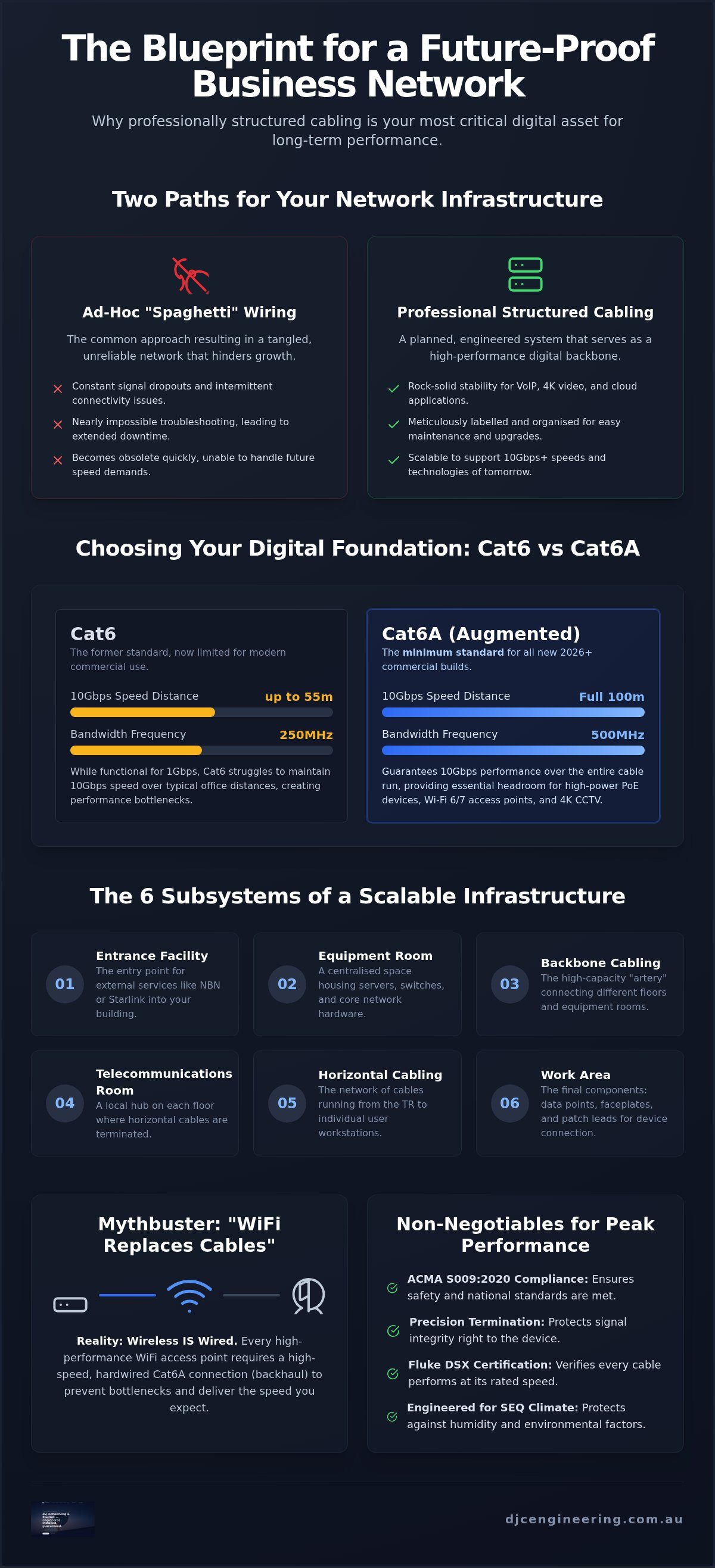
Too many businesses rely on ad-hoc, point-to-point wiring. This usually results in a "spaghetti mess" of tangled leads in the server room, making troubleshooting nearly impossible and causing unnecessary downtime during simple upgrades. A comprehensive structured cabling system is the universal telecommunications infrastructure that supports all digital business functions including data, voice, and security signals. It's a disciplined approach that ensures every cable is labelled, tested, and routed to maximise efficiency and airflow.
The Core Components of an Engineered System
A professional installation isn't just about pulling wire; it's about following a rigid hierarchy of subsystems. Horizontal cabling forms the critical link between your team's desks and the telecommunications room, typically running through ceiling voids or floor ducts. Backbone cabling acts as the high-capacity artery, connecting different floors or separate wings of a facility to the central core. Finally, work area components, including precision-installed faceplates and high-quality patch leads, ensure signal integrity is maintained right to the user's device. When these elements are installed with technical precision, the network remains robust for years.
Why WiFi Isn’t a Replacement for Quality Copper
There's a common misconception that wireless technology has made physical cables redundant. In reality, wireless is wired. Every high-performance Access Point requires a high-speed hardwired backhaul to function at its peak. Without a solid commercial network cabling Brisbane foundation, your WiFi will suffer from bottlenecking and interference. Latency remains a critical factor for VoIP calls, 4K video conferencing, and heavy server access, all of which still demand the stability of physical Cat6A ports. Beyond performance, a hardwired backbone offers inherent security benefits, providing a physical layer of protection that purely wireless environments simply can't match. We treat the copper as the bedrock, ensuring your wireless layer has the strength it needs to perform.
Cat6 vs Cat6A vs Fibre: Comparing Standards for Brisbane Businesses
Choosing the right cable grade is the most significant decision you'll make for your office fit-out. In 2026, Cat5e is effectively obsolete for new commercial installations. It simply can't keep up with the bandwidth requirements of modern cloud applications or high-definition surveillance. To ensure your commercial network cabling Brisbane project complies with the latest Australian cabling standards, specifically the AS/CA S009:2020 "Wiring Rules," we focus exclusively on high-performance copper and optical fibre solutions.
Cat6 vs Cat6A: Finding the Commercial 'Sweet Spot'
Cat6 has been a reliable workhorse, but it has a major limitation in a modern enterprise environment. While it supports 10Gbps speeds, it can only maintain that performance over distances of approximately 37 to 55 metres. In a typical Brisbane office layout, cable runs often exceed this, causing speeds to drop back to 1Gbps. Cat6A (Category 6 Augmented) operates at a higher frequency of 500MHz, doubling the 250MHz capacity of standard Cat6. This allows for full 10Gbps performance over the entire 100-metre run. We recommend Cat6A as the minimum standard for all new 2026 commercial builds. It provides the thermal stability and headroom required for high-power Power over Ethernet (PoE) applications, such as advanced WiFi access points and smart lighting.
When we assess commercial network cabling Brisbane sites, we look for potential EMI sources. In industrial pockets where electrical noise from heavy machinery is a constant factor, we often deploy Shielded Twisted Pair (STP) cabling. This prevents electromagnetic interference from degrading your data throughput. For most standard office environments, Unshielded Twisted Pair (UTP) remains the professional choice, provided it is installed with meticulous attention to separation from electrical circuits.
When to Introduce Fibre Optic Cabling
Copper has physical limits that even the best engineering cannot overcome. When connecting separate office wings, warehouses, or different floors in a multi-storey facility, fibre optics are the only viable solution. We utilise OM3 or OM4 multi-mode fibre for backbones because it is completely immune to electrical noise and carries data over vast distances without signal loss. This is vital for Brisbane industrial zones like Eagle Farm where EMI is prevalent. Fibre prepares your infrastructure for 40Gbps and 100Gbps future-standard hardware. If you are planning a large-scale project, professional networking and cabling ensures your backbone is ready for the next decade of hardware evolution.
The Six Subsystems of a Scalable Network Infrastructure
A high-performance network is never the result of guesswork. It is a structured hierarchy. For commercial network cabling Brisbane, we follow a modular design that ensures your infrastructure is easy to manage, simple to troubleshoot, and ready to scale as your team grows. This architecture is divided into six distinct subsystems, each performing a specific role in the delivery of high-speed data across your facility.
The process begins at the Entrance Facilities. This is the demarcation point where external services, such as NBN fibre or Starlink satellite feeds, meet your internal network. From here, data flows into the Equipment Room. This is the "brain" of your business, housing server racks, core switches, and patch panels. We organise these spaces with surgical precision. Adhering to secure cabling infrastructure guidelines during this phase ensures your hardware is protected from physical interference while maintaining optimal airflow for cooling. Backbone cabling then acts as the primary data artery, providing high-capacity transit between the equipment room and various telecommunications enclosures distributed across larger Brisbane commercial sites.
Horizontal Cabling and the Work Area
Horizontal cabling is the "last mile" of your internal network. It connects the telecommunications room to the individual wall plates at each workstation. We prioritise precision termination at both ends to prevent packet loss. Standardisation is vital here. Whether using T568A or T568B wiring schemes, consistency across the entire site is non-negotiable to avoid cross-over errors. The work area itself is where the user interacts with the system. We ensure that every faceplate is securely mounted and that only high-quality, certified patch leads are used. A single inferior lead can bottleneck a 10Gbps link, rendering your entire investment in high-end commercial network cabling Brisbane effectively useless at the desk level.
Administration, Labelling, and Documentation
The standard set by DJC Engineering Pty Ltd dictates that if a cable isn't labelled, the job isn't finished. We tag every single run at both ends with clear, durable identifiers that match a central administration log. This methodical approach eliminates the "spaghetti mess" found in many older Brisbane server rooms. We provide our clients with a comprehensive network map and testing documentation for every link. This transparency is essential for future upgrades or rapid troubleshooting. Without proper documentation, you are forced to pay for hours of diagnostic time just to identify a single faulty port. We replace that chaos with a structured, documented system that allows your IT team to work with total confidence.
Future-Proofing Brisbane Properties: Environmental and Tech Integration
Brisbane's subtropical climate is a silent killer of poorly installed data infrastructure. High humidity and salt air in SE QLD coastal zones lead to rapid oxidation and corrosion of copper conductors if they aren't properly terminated and sealed. We prioritise the use of premium, moisture-resistant components and meticulous termination techniques to ensure your commercial network cabling Brisbane remains reliable for decades. It's not just about the cable itself; it's about how the system is protected from the unique environmental stresses of our region.
Navigating the physical layout of a Brisbane office often involves engineered strategies for running data through thick concrete slabs or double-brick architecture. We don't take shortcuts like running loose cables over ceiling tiles or leaving them exposed to physical damage. Instead, we use core drilling and heavy-duty conduits to maintain the physical integrity of the link. This robust approach is essential for Power over Ethernet (PoE) applications. High-grade Cat6A cabling is mandatory to handle the heat dissipation requirements of powering high-definition CCTV, advanced Access Points, and VoIP systems. This physical foundation is a core component of our Professional WiFi Design, ensuring your wireless network has a stable, high-speed backhaul.
Starlink and NBN Commercial Integration
Modern head-end design must accommodate diverse internet sources, including Starlink Gen 3 satellite feeds and NBN Enterprise Ethernet. We engineer external transitions that protect cable entry points from intense SE QLD storms and UV exposure, using UV-rated jackets for any outdoor runs. Our structured systems allow for sophisticated load balancing. By using high-quality commercial network cabling Brisbane to manage redundant internet sources, we provide your business with a zero-downtime operation. If one source fails, your internal architecture ensures the handover is seamless and undetected by your team.
Security and AV Convergence
The days of separate wiring for security and media are over. Bandwidth-hungry 4K CCTV cameras require dedicated, high-grade lines to prevent frame drops and latency. We use HDBaseT technology to transmit uncompressed 4K video over standard data cables, simplifying your boardroom setups while maintaining professional-grade signal quality. This convergence extends to access control, where we integrate intercoms and smart gate controllers into the centralised structured system. If you are upgrading your facility, our licensed cabling specialists can design a system that handles these environmental and technical loads with precision.
The DJC Engineering Pty Ltd Standard: Why Precision Installation Beats the 'Cheap Fix'
A professional network is a work of technical art. At DJC Engineering Pty Ltd, we adopt a master technician approach where precision termination and meticulous cable management are the baseline, not the exception. We don't just pull wires through a ceiling; we engineer a system that looks as good as it performs. Every commercial network cabling Brisbane project we undertake is subjected to rigorous verification using professional Fluke testers. This ensures every link meets international standards for speed and signal-to-noise ratios, providing you with a certified "pass" report rather than a vague promise of performance.
Avoiding the "cheap fix" is critical for long-term reliability. DJC Engineering Pty Ltd refuses to take shortcuts with inferior materials like Copper Clad Aluminium (CCA) cables. While CCA is often found in budget-tier products, it is brittle, prone to oxidation, and has significantly higher electrical resistance than solid copper. This makes it a fire hazard for high-power PoE applications and a primary cause of intermittent network drops. Our commitment to high-grade materials and local accountability means you are working with a Brisbane and Gold Coast team that understands our regional environmental challenges and stands by every connection we terminate.
The Danger of Unlicensed 'Handyman' Cabling
Data cabling is a regulated trade. In Australia, it is a legal mandate that any person performing telecommunications work must hold an ACMA Open Cabler Registration. Hiring an unlicensed handyman or a general contractor without this specific accreditation puts your business at risk. Beyond the legal implications, poor installation techniques like excessive cable bends or improper untwisting of pairs during termination can cripple a 10Gbps network. Non-compliant work can also void your commercial insurance policies if a fault leads to property damage. We eliminate these risks by deploying only licensed technicians who follow the strict AS/CA S009:2020 rules.
Organising the Chaos: Server Rack Management
The server rack is the heart of your digital operation. We specialise in a finish that transforms a chaotic "spaghetti mess" of tangled patch leads into a colour-coded, air-flow-optimised technical centre. Meticulous rack management isn't just about aesthetics; it is about hardware protection. Proper spacing and cable routing ensure that your expensive servers and switches receive adequate cooling, preventing thermal throttling and hardware failure. A clean rack also makes future troubleshooting or hardware swaps a five-minute task rather than a multi-hour ordeal. Ready to build a foundation that lasts? Contact DJC Engineering Pty Ltd for a commercial network cabling consultation.
Build a Digital Foundation That Outlasts the Competition
Your network is only as strong as its physical layer. By prioritising a structured approach over ad-hoc wiring, you ensure your business is ready for the 10Gbps demands of 2026 and beyond. We've explored how the shift to Cat6A and fibre optics, combined with a meticulous six-subsystem architecture, creates a "set and forget" foundation that boosts both property value and team productivity. Investing in high-performance commercial network cabling Brisbane isn't just about connectivity; it's about protecting your hardware from environmental stress and technical obsolescence.
Don't let a "cheap fix" or unlicensed work become a bottleneck for your growth. The technicians at DJC Engineering Pty Ltd are ACMA Accredited specialists who provide expert Starlink and WiFi integration across Brisbane and the Gold Coast. We replace the chaos of unlabelled racks with engineered precision that performs under pressure. Organise your technical infrastructure with DJC Engineering Pty Ltd today to secure your digital future. Your business deserves a backbone built to last.
Frequently Asked Questions
Is Cat6 cabling still sufficient for a Brisbane office in 2026?
While Cat6 supports 1Gbps, it's increasingly considered a legacy choice for new 2026 fit-outs. Cat6A is the recommended standard because it handles 10Gbps speeds over the full 100-metre distance and manages the higher heat levels produced by modern Power over Ethernet (PoE) devices. If you want to avoid a refit within the next few years, Cat6A provides the necessary headroom for future hardware upgrades.
How much does commercial structured cabling cost per point in Brisbane?
Investment levels vary based on the cable category, the complexity of the building architecture, and whether the work occurs in a new build or a retrofit environment. Factors such as access to ceiling voids, the need for core drilling through concrete, and the total volume of data points will influence the final cost. We recommend a site assessment to determine the specific requirements for your commercial network cabling Brisbane project.
Can I use structured cabling for my security cameras and intercom system?
Yes, modern security and intercom systems are almost entirely IP-based and rely on the same structured foundation as your workstation computers. By integrating your CCTV and access control into a centralised cabling system, you simplify management and ensure your security hardware has the dedicated bandwidth required for 4K video streams. This convergence reduces the need for separate, proprietary wiring systems.
What is the difference between simple data cabling and a structured cabling system?
Simple data cabling often involves ad-hoc, point-to-point runs that eventually lead to a "spaghetti mess" in the server room. A structured cabling system is an engineered architecture divided into specific subsystems, including backbone and horizontal cabling. This planned approach ensures every link is tested, labelled, and easy to troubleshoot or scale as your business grows.
Do I need a special licence to install data cables in Queensland?
Yes, all telecommunications cabling work in Australia must be performed by a technician holding an ACMA Open Cabler Registration. This is a legal mandate enforced by the Australian Communications and Media Authority. Unlicensed work is not only illegal but can also void your commercial insurance and lead to significant performance bottlenecks due to poor installation techniques.
Can structured cabling improve my Starlink or NBN speeds?
Structured cabling ensures that the high-speed signal from your NBN or Starlink feed reaches your devices without interference or signal degradation. While it doesn't change the raw speed provided by your ISP, it eliminates internal bottlenecks caused by poor-quality cables or electrical noise. This allows your internal commercial network cabling Brisbane to operate at its maximum theoretical capacity.
What happens if a data cable is damaged inside a concrete wall?
Repairing a cable embedded in a concrete slab is often impossible without significant structural work. This is why we prioritise the use of heavy-duty conduits and engineered routing during the initial installation phase to protect the copper. If damage occurs, the most common solution is to bypass the faulty link with a new, professionally routed run that maintains the integrity of the network.
How long does a typical commercial structured cabling installation take?
A standard office fit-out with 20 to 50 data points typically takes between three to five days to complete, including final testing and certification. Larger projects involving multi-storey backbones or expansive industrial warehouses require a more extensive timeline. We follow a methodical workflow of assessment, execution, and final calibration to ensure the project stays on schedule while maintaining our rigorous standards.
Frequently Asked Questions
While Cat6 supports 1Gbps, it's increasingly considered a legacy choice for new 2026 fit-outs. Cat6A is the recommended standard because it handles 10Gbps speeds over the full 100-metre distance and manages the higher heat levels produced by modern Power over Ethernet (PoE) devices. If you want to avoid a refit within the next few years, Cat6A provides the necessary headroom for future hardware upgrades.
Investment levels vary based on the cable category, the complexity of the building architecture, and whether the work occurs in a new build or a retrofit environment. Factors such as access to ceiling voids, the need for core drilling through concrete, and the total volume of data points will influence the final cost. We recommend a site assessment to determine the specific requirements for your commercial network cabling Brisbane project.
Yes, modern security and intercom systems are almost entirely IP-based and rely on the same structured foundation as your workstation computers. By integrating your CCTV and access control into a centralised cabling system, you simplify management and ensure your security hardware has the dedicated bandwidth required for 4K video streams. This convergence reduces the need for separate, proprietary wiring systems.
Simple data cabling often involves ad-hoc, point-to-point runs that eventually lead to a "spaghetti mess" in the server room. A structured cabling system is an engineered architecture divided into specific subsystems, including backbone and horizontal cabling. This planned approach ensures every link is tested, labelled, and easy to troubleshoot or scale as your business grows.
Yes, all telecommunications cabling work in Australia must be performed by a technician holding an ACMA Open Cabler Registration. This is a legal mandate enforced by the Australian Communications and Media Authority. Unlicensed work is not only illegal but can also void your commercial insurance and lead to significant performance bottlenecks due to poor installation techniques.
Structured cabling ensures that the high-speed signal from your NBN or Starlink feed reaches your devices without interference or signal degradation. While it doesn't change the raw speed provided by your ISP, it eliminates internal bottlenecks caused by poor-quality cables or electrical noise. This allows your internal commercial network cabling Brisbane to operate at its maximum theoretical capacity.
Repairing a cable embedded in a concrete slab is often impossible without significant structural work. This is why we prioritise the use of heavy-duty conduits and engineered routing during the initial installation phase to protect the copper. If damage occurs, the most common solution is to bypass the faulty link with a new, professionally routed run that maintains the integrity of the network.
A standard office fit-out with 20 to 50 data points typically takes between three to five days to complete, including final testing and certification. Larger projects involving multi-storey backbones or expansive industrial warehouses require a more extensive timeline. We follow a methodical workflow of assessment, execution, and final calibration to ensure the project stays on schedule while maintaining our rigorous standards.