
Commercial Network Cabling Brisbane: The Engineered Backbone of Modern Business in 2026

The hardware sitting in your server rack will likely be obsolete within thirty-six months, yet the copper and fibre running through your walls is expected to anchor your operations for the next decade. Most Brisbane business owners treat data points like an afterthought, only to be met with stuttering video calls and a "spaghetti" mess of cables that makes troubleshooting a nightmare. It's frustrating to pay for high-speed NBN or Starlink only to have a sub-par local network bottleneck your productivity.
Investing in high-calibre commercial network cabling Brisbane wide isn't just about connecting desks to a switch; it's about engineering a resilient foundation that handles the data loads of 2026 and beyond. As DJC Engineering Pty Ltd, we understand this critical need. In this guide, you'll learn why a professionally designed structured cabling system is the most critical investment for your business’s long-term digital performance. We'll examine the technical standards, such as AS/CA S009:2020, that safeguard your infrastructure and detail how a "set and forget" backbone supports everything from 4K CCTV to high-performance Wi-Fi 7.
Key Takeaways
- Understand why moving from ad-hoc wiring to a standardised structured cabling system is the only way to eliminate network bottlenecks and messy server racks.
- Identify why Cat6A has become the new baseline for commercial network cabling Brisbane projects, providing the 10Gbps speeds required for modern Wi-Fi 7 and 4K security integration.
- Learn the six critical subsystems of a scalable network to ensure your NBN or Starlink feeds are distributed efficiently across your entire office floorplate.
- Discover engineered strategies to protect your infrastructure against Brisbane’s high humidity and the specific challenges of installing data through local double-brick and concrete architecture.
- Realise the importance of professional Fluke testing and ACMA-accredited precision to guarantee every data point performs to its rated capacity without intermittent signal dropouts.
Beyond the Patch Lead: What Is Commercial Structured Cabling?
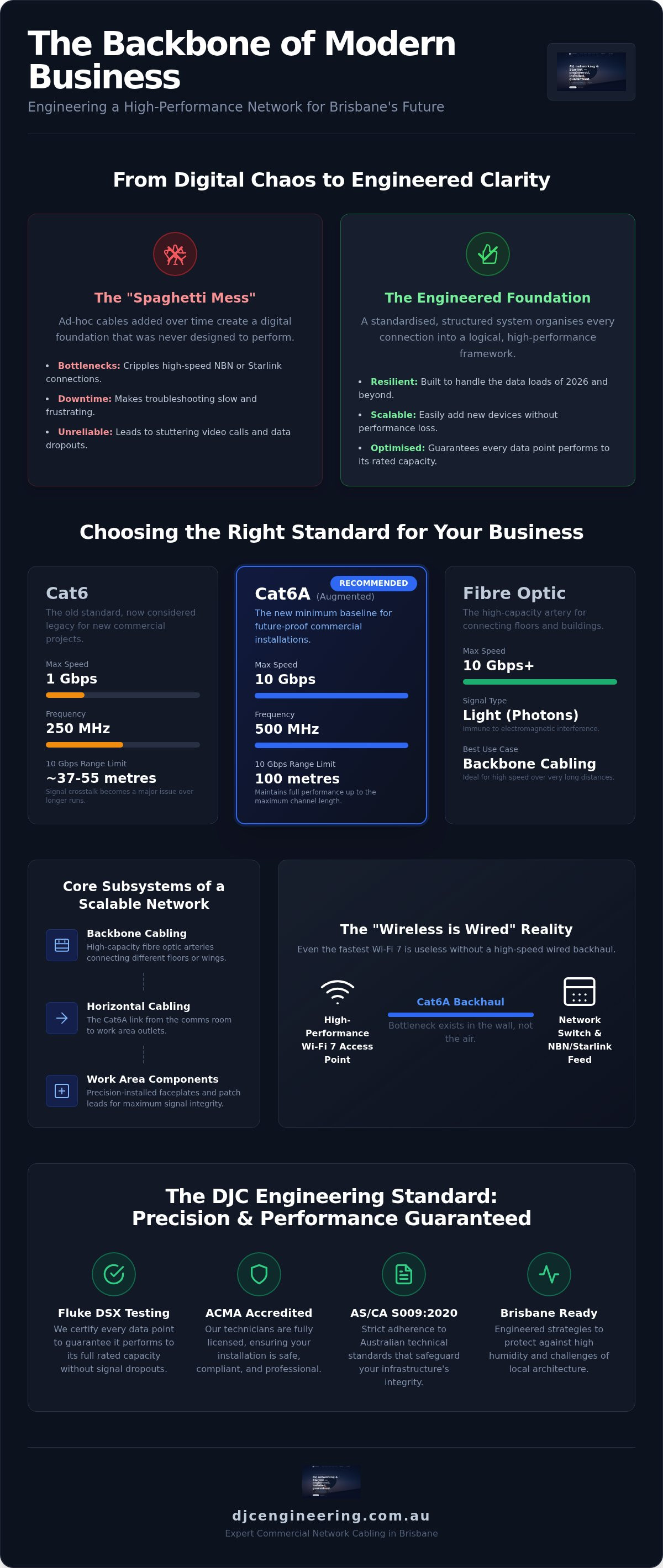
Many Brisbane businesses operate on a digital foundation that was never actually designed. It's often a collection of patch leads and point-to-point runs added whenever a new desk or printer appeared. This ad-hoc approach creates a "spaghetti mess" in the server room that makes troubleshooting nearly impossible; it's the primary cause of intermittent downtime and signal degradation. True commercial network cabling Brisbane professionals don't just pull wire. They engineer a standardised architecture that organises every connection into a logical, manageable framework. This shift represents a move from the basic telephone lines of the past to integrated data highways capable of handling massive throughput. A Structured cabling system is the universal telecommunications infrastructure that supports all digital business functions.
The Core Components of an Engineered System
An engineered system isn't a single cable. It's a hierarchy of components working in unison to provide a "set and forget" experience. We focus on three primary areas during a commercial fit-out:
- Horizontal cabling: This is the critical link between work area outlets and the telecommunications room. It's the most common type of run, usually tucked neatly into ceiling cavities or wall voids using high-grade Cat6 or Cat6A copper.
- Backbone cabling: These are the high-capacity arteries. They connect different floors or separate wings of a commercial facility, often utilising fibre optics to maintain 10Gbps speeds over longer distances.
- Work area components: Precision-installed faceplates and patch leads ensure signal integrity remains high right up to the user's device. We refuse to use inferior connectors that cause packet loss at the final stage.
Why WiFi Isn’t a Replacement for Quality Copper
It’s a common misconception that wireless technology has made cables obsolete. In reality, every high-performance Access Point requires a high-speed hardwired backhaul. We call this the "Wireless is Wired" reality. If your backhaul is weak, your Wi-Fi 7 or 6E speeds will never reach their potential because the bottleneck exists in the wall, not the air. Physical ports are still mandatory for low-latency tasks. VoIP calls, 4K video conferencing, and direct server access demand the stability of a physical Cat6A port to avoid jitter and lag.
Beyond performance, a hardwired backbone offers inherent security benefits. Unlike wireless signals that can be intercepted from a car park or adjacent office, physical ports provide a controlled, tangible environment for your business data. A master technician ensures these runs are concealed and secured, making the network foundation as robust as the building's own electrical or plumbing systems. This meticulous approach to commercial network cabling Brisbane ensures your infrastructure outlasts several generations of active hardware.
Cat6 vs Cat6A vs Fibre: Comparing Standards for Brisbane Businesses
Selecting the right cable grade is the single most important decision in any commercial network cabling Brisbane project. While older standards like Cat5e were sufficient for basic internet and voice, they are effectively obsolete for commercial fit-outs in 2026. Modern businesses demand infrastructure that adheres to the latest industry standards to support high-density Wi-Fi 7 access points and massive file transfers. Using outdated copper today is a guarantee of a costly retrofit tomorrow. It's about building for the bandwidth you'll need in three years, not just what you use today.
Cat6 vs Cat6A: Finding the Commercial 'Sweet Spot'
The technical gap between Cat6 and Cat6A is significant. Cat6 operates at a frequency of 250MHz, which is fine for standard 1Gbps speeds. However, its ability to support 10-Gigabit Ethernet is limited by distance. Once a run exceeds 37 to 55 metres, signal crosstalk becomes a major issue. Cat6A (Augmented) doubles that frequency to 500MHz. It maintains full 10Gbps performance up to the maximum 100-metre channel length. For any new Brisbane build in 2026, DJC Engineering Pty Ltd recommends Cat6A as the absolute minimum baseline to ensure your network isn't throttled by its own wiring.
Shielding also plays a vital role in local installations. In high-interference zones like Eagle Farm or Rocklea industrial estates, electrical noise from heavy machinery can disrupt data packets. We deploy Shielded Twisted Pair (STP) in these environments to block electromagnetic interference (EMI). For standard office spaces, Unshielded Twisted Pair (UTP) remains the reliable choice, provided the installation is handled with the meticulous precision a master technician brings to the job.
When to Introduce Fibre Optic Cabling
Copper has its limits, especially when connecting separate wings of a warehouse or linking floors in a CBD high-rise. This is where fibre optics become essential. Fibre is entirely immune to EMI, making it perfect for runs alongside high-voltage electrical lines or through areas with significant power draw. It also provides a clear path to future hardware upgrades, comfortably supporting 40Gbps and 100Gbps speeds as they become standard. If you're unsure which standard fits your facility, a specialist assessment from the team at DJC Engineering Pty Ltd can clarify your requirements before the first cable is pulled.
Every standard has a specific application. A master technician doesn't just pick the cheapest option; they select the grade that balances your current budget with a ten-year performance horizon. This methodical approach to commercial network cabling Brisbane ensures your hardware always operates at its theoretical peak, regardless of how much data your business scales to handle.
The Six Subsystems of a Scalable Network Infrastructure
A professional commercial network cabling Brisbane installation isn't just a bundle of wires hidden in a ceiling. It's a modular architecture designed to international standards. By breaking the network into six distinct subsystems, we ensure that a fault in one area doesn't bring down the entire business. This logical structure also allows for easy scaling as your team grows. It starts at the Entrance Facilities, the point where your NBN or Starlink satellite feeds meet your internal infrastructure. This area must be kept clean and clear to ensure service providers can maintain the external link without disrupting your internal operations.
The Equipment Room acts as the central brain of the facility. This is where core switches and server racks are meticulously organised. We prioritise airflow and cable neatness to prevent hardware overheating. Connecting this brain to the rest of the building is the Backbone (Vertical) Cabling. These are the primary arteries that carry the bulk of your data between floors or wings. For larger Brisbane sites, we use Telecommunications Enclosures as local distribution nodes. These strategically placed cabinets ensure that horizontal runs stay within the 100-metre limit required to maintain signal integrity.
Horizontal Cabling and the Work Area
The "last mile" of your network is the Horizontal Cabling. This is the run from the rack to the user’s wall plate. We insist on precision termination using the T568A or T568B standards, though we never mix the two in a single facility. Consistency prevents signal phase issues and ensures the network remains predictable. The Work Area components, including faceplates and high-quality patch leads, are the final links in the chain. Using inferior patch leads is the most common way businesses accidentally throttle their expensive 10Gbps infrastructure. High-quality components are essential for Future-Proofing Brisbane Properties against the data demands of next-generation software and high-definition video conferencing.
Administration, Labelling, and Documentation
The difference between a master technician and a generic contractor is often found in the documentation. The DJC Standard requires every single cable to be clearly labelled at both ends with durable, printed tags. Hand-written tape isn't acceptable. This precision allows for rapid troubleshooting; a technician can identify a faulty port in seconds rather than hours. We provide every client with a comprehensive network map. This documentation is a valuable asset that reduces the "cost of chaos" during future upgrades or office reconfigurations. Without a map, you're paying for expensive diagnostic time every time a change is needed. This methodical approach to commercial network cabling Brisbane ensures your foundation remains transparent and manageable for the life of the building.
Future-Proofing Brisbane Properties: Environmental and Tech Integration
Brisbane’s sub-tropical climate presents unique challenges for commercial network cabling Brisbane infrastructure. High humidity and salt air, particularly in coastal corridors and the CBD, accelerate cable corrosion and oxidation. Using inferior, non-certified cable jackets leads to premature jacket cracking and signal interference. We also engineer specific pathways for Brisbane’s traditional architecture. Penetrating concrete slabs and double-brick walls requires specialised drilling and conduit solutions to ensure the physical integrity of the cable remains intact for its ten-year lifespan. A master technician understands that a cable's environment is just as important as its category rating.
The modern data cable is now a power delivery tool. Power over Ethernet (PoE) allows a single Cat6A line to drive high-definition CCTV cameras, VoIP handsets, and wireless nodes. This eliminates the need for separate electrical outlets at every device location, reducing installation costs and clutter. To achieve total site coverage, this backbone must work in tandem with a Professional WiFi Design. Without a robust wired foundation, even the most advanced wireless system will struggle with latency and dropouts during peak usage. It's about creating a unified digital environment where the wired and wireless layers support one another.
Starlink and NBN Commercial Integration
Brisbane businesses are increasingly adopting redundant internet sources to protect against downtime. We design head-end systems that accommodate Starlink Gen 3 satellite feeds alongside NBN Enterprise Ethernet within the same structured rack. A critical part of this is the external transition. We use UV-rated conduits and weatherproof entry points to protect against intense SE QLD storms and sun exposure. This setup allows for automated load balancing. If your primary NBN link fails, the structured backbone carries the Starlink signal to every desk instantly, ensuring zero-downtime operations.
Security and AV Convergence
The days of separate wiring for security and data are over. Modern 4K CCTV systems are bandwidth-hungry and require dedicated, high-grade Cat6 lines to avoid packet loss. We also use HDBaseT technology to transmit uncompressed 4K video over standard data cables, which simplifies boardroom AV setups and removes the need for expensive, proprietary HDMI extenders. By integrating intercoms and smart gate controllers into the centralised structured system, we create a unified platform that is easier to manage. If your current infrastructure is struggling with the heat or failing to support new hardware, it's time to consult with a master technician at DJC Engineering for a comprehensive site audit.
The DJC Engineering Standard: Why Precision Installation Beats the 'Cheap Fix'
Technical precision is the difference between a network that merely functions and one that performs at its theoretical limit. At DJC Engineering Pty Ltd, we approach every commercial network cabling Brisbane project with a master technician's mindset. This means we prioritise the mechanical integrity of every termination and the meticulous management of every run. We refuse to take the shortcuts common among generic contractors because we understand that a single poorly crimped connector can introduce packet loss that ripples across your entire business. Our work isn't finished until the installation looks as professional as it performs.
Verification is the core of our accountability. While many installers rely on basic "link lights" to check connectivity, we use professional Fluke testers to certify every link against international performance standards. This process generates a technical report for every data point, proving that the cable can actually sustain its rated speed without errors. If a run doesn't meet the strict decibel requirements for crosstalk and return loss, we rectify it immediately. This rigorous testing ensures your 10Gbps backbone is a reality, not just a label on a box.
Avoiding the "cheap fix" also means being vigilant about material quality. We've seen an influx of inferior Copper Clad Aluminium (CCA) cables in the Brisbane market. These cables are brittle, prone to oxidation, and physically incapable of supporting high-wattage Power over Ethernet (PoE) demands over time. We exclusively use high-purity solid copper. It’s a choice that guarantees the robustness of your infrastructure and protects your investment from the performance degradation inherent in cut-price materials.
The Danger of Unlicensed 'Handyman' Cabling
Data cabling in Australia is a regulated trade, not a DIY task. It's a legal mandate that any person performing telecommunications work must hold an ACMA Open Cabler Registration. Using an unlicensed handyman or a general builder for your commercial network cabling Brisbane needs carries significant risks. Beyond the performance bottlenecks caused by excessive cable bends or poor termination, there are serious insurance implications. Non-compliant work can void building insurance and leave your business liable for network-related failures. We provide the peace of mind that comes with a licensed, locally accountable team that stands by every connection.
Organising the Chaos: Server Rack Management
The "DJC Finish" is most visible in the equipment room. We specialise in transforming a "spaghetti mess" of tangled leads into a colour-coded, air-flow-optimised technical centre. Proper cable management isn't just about aesthetics; it’s essential for hardware protection. Meticulous spacing and neat bundling ensure that your core switches and servers have the ventilation they need to prevent overheating. This organised approach makes future troubleshooting and hardware swaps efficient, reducing the diagnostic time required by your IT staff. Ready to build a foundation that lasts? Contact DJC Engineering Pty Ltd for a commercial network cabling consultation.
Engineering Your Business for a Decade of Digital Growth
Your network infrastructure is the only part of your office fit-out that should outlast three generations of hardware. By prioritising a high-calibre commercial network cabling Brisbane system, you're investing in a foundation that handles the massive data throughput of Wi-Fi 7 and 4K security without breaking a sweat. We've seen how precision termination, Cat6A standards, and meticulous subsystem documentation eliminate the "spaghetti mess" that causes so much unnecessary downtime. It's about moving away from reactive fixes toward an engineered asset that supports your operations for the long term.
Don't leave your digital future to chance or unlicensed contractors. Our ACMA-accredited technicians specialise in expert Starlink and Wi-Fi integration, ensuring every connection is verified with professional Fluke testing for total reliability. We provide a meticulous local service across Brisbane and the Gold Coast that turns chaotic server rooms into organised, high-performance technical centres. Organise your technical infrastructure with DJC Engineering today. It’s time to build a foundation that gives you the confidence to grow.
Frequently Asked Questions
Is Cat6 cabling still sufficient for a Brisbane office in 2026?
Cat6 remains functional for basic gigabit tasks, but it lacks the headroom required for the 2026 digital landscape. Cat6A has become the new baseline because it supports 10Gbps speeds over the full 100-metre channel length. If you're installing Wi-Fi 7 access points or handling large cloud-based backups, Cat6A is mandatory to prevent your internal wiring from becoming a permanent bottleneck.
How much does commercial structured cabling cost per point in Brisbane?
Industry averages for commercial network cabling Brisbane wide typically range from $150 to $275 per drop for Cat6, while Cat6A often sits between $200 and $350. These figures vary based on building accessibility, the volume of points, and whether the installation occurs in a new build or a heritage retrofit. Investing in higher-grade copper now prevents the much higher cost of a full network replacement in three years.
Can I use structured cabling for my security cameras and intercom system?
Yes, modern security and intercom systems are designed to run over structured cabling using Power over Ethernet (PoE). This allows a single high-grade Cat6 line to provide both 10Gbps data and power to 4K CCTV cameras and smart gate controllers. It centralises your security infrastructure and removes the need for expensive, separate electrical outlets at every device location across your facility.
What is the difference between simple data cabling and a structured cabling system?
Simple data cabling is usually an ad-hoc collection of point-to-point runs that results in a "spaghetti mess" in the server room. A structured system is an engineered architecture consisting of six standardised subsystems. It follows strict international standards to ensure every connection is logically organised, clearly labelled, and documented. This methodical approach makes future troubleshooting and hardware upgrades significantly faster and cheaper.
Do I need a special licence to install data cables in Queensland?
All data cabling work in Australia must be performed by a technician holding an ACMA Open Cabler Registration. This is a legal mandate under the Telecommunications Act. Using an unlicensed handyman or general builder for commercial network cabling Brisbane projects carries significant risk. Non-compliant work can void your building insurance and often results in poor termination that cripples your network's actual performance.
Can structured cabling improve my Starlink or NBN speeds?
Structured cabling won't increase the speed entering your building, but it ensures that the full bandwidth reaches your devices without being throttled. Internal bottlenecks caused by poor-quality wiring are the most common reason for "slow" internet. A high-performance backbone allows you to distribute Starlink or NBN Enterprise Ethernet feeds across multiple floors or office wings with zero signal degradation or packet loss.
What happens if a data cable is damaged inside a concrete wall?
Repairing a cable buried directly in a wall is rarely possible; this is why we install data through dedicated conduits and engineered pathways. Proper planning during the initial fit-out ensures that cables can be pulled through and replaced if they are ever damaged. If a cable was installed without a conduit and fails, a technician will typically have to run a new, external link to restore connectivity.
How long does a typical commercial structured cabling installation take?
A standard installation for a medium Brisbane office with 20 to 50 data points typically takes between two and four days. Larger industrial sites or multi-storey CBD fit-outs require a more extensive timeline based on the complexity of the cable routes. We follow a structured workflow that moves from initial site assessment to final Fluke verification, ensuring your business experiences minimal disruption during the transition.
Frequently Asked Questions
Cat6 remains functional for basic gigabit tasks, but it lacks the headroom required for the 2026 digital landscape. Cat6A has become the new baseline because it supports 10Gbps speeds over the full 100-metre channel length. If you're installing Wi-Fi 7 access points or handling large cloud-based backups, Cat6A is mandatory to prevent your internal wiring from becoming a permanent bottleneck.
Industry averages for commercial network cabling Brisbane wide typically range from $150 to $275 per drop for Cat6, while Cat6A often sits between $200 and $350. These figures vary based on building accessibility, the volume of points, and whether the installation occurs in a new build or a heritage retrofit. Investing in higher-grade copper now prevents the much higher cost of a full network replacement in three years.
Yes, modern security and intercom systems are designed to run over structured cabling using Power over Ethernet (PoE). This allows a single high-grade Cat6 line to provide both 10Gbps data and power to 4K CCTV cameras and smart gate controllers. It centralises your security infrastructure and removes the need for expensive, separate electrical outlets at every device location across your facility.
Simple data cabling is usually an ad-hoc collection of point-to-point runs that results in a "spaghetti mess" in the server room. A structured system is an engineered architecture consisting of six standardised subsystems. It follows strict international standards to ensure every connection is logically organised, clearly labelled, and documented. This methodical approach makes future troubleshooting and hardware upgrades significantly faster and cheaper.
All data cabling work in Australia must be performed by a technician holding an ACMA Open Cabler Registration. This is a legal mandate under the Telecommunications Act. Using an unlicensed handyman or general builder for commercial network cabling Brisbane projects carries significant risk. Non-compliant work can void your building insurance and often results in poor termination that cripples your network's actual performance.
Structured cabling won't increase the speed entering your building, but it ensures that the full bandwidth reaches your devices without being throttled. Internal bottlenecks caused by poor-quality wiring are the most common reason for "slow" internet. A high-performance backbone allows you to distribute Starlink or NBN Enterprise Ethernet feeds across multiple floors or office wings with zero signal degradation or packet loss.
Repairing a cable buried directly in a wall is rarely possible; this is why we install data through dedicated conduits and engineered pathways. Proper planning during the initial fit-out ensures that cables can be pulled through and replaced if they are ever damaged. If a cable was installed without a conduit and fails, a technician will typically have to run a new, external link to restore connectivity.
A standard installation for a medium Brisbane office with 20 to 50 data points typically takes between two and four days. Larger industrial sites or multi-storey CBD fit-outs require a more extensive timeline based on the complexity of the cable routes. We follow a structured workflow that moves from initial site assessment to final Fluke verification, ensuring your business experiences minimal disruption during the transition.