
Brisbane Home Alarm Installation: Back-to-Base Guide
A standard siren does little more than alert an intruder that they've been spotted. On the Gold Coast, where property-related offences account for a significant portion of reported crime, relying on a basic noise-maker and a shaky smartphone app is a gamble most homeowners can't afford to take. You've likely seen the headlines about rising crime across South East Queensland and felt sceptical about DIY kits that drop offline during a power outage or an NBN glitch. This is why professional home alarm installation Gold Coast has become the essential standard for those who refuse to take shortcuts with their family's safety.
We understand that a security system is only as good as its weakest connection. This guide explains how back-to-base monitoring transforms a simple alarm into a managed communication link with a Grade A1 monitoring centre. We'll detail the technical precision required for a truly reliable shield, from power redundancy to NBN-compatible hardware. You'll discover how a licensed, professional setup, such as the comprehensive solutions offered by DJC Engineering Pty Ltd, provides a 24/7 response and can even reduce your insurance premiums by up to 20% by meeting rigorous Australian Standards for residential security.
Key Takeaways
- Understand the critical difference between a simple local siren and a back-to-base system linked to a professional Grade A1 monitoring centre.
- Learn why professional home alarm installation Brisbane is the only way to ensure your security link remains active during NBN outages or power failures.
- Identify the common failure points of DIY app alerts, such as 'Do Not Disturb' settings and mobile dead zones, that professional monitoring bypasses.
- Discover how meeting Australian Standard AS/NZS 2201.1:2007 can lower your home insurance premiums by up to 20% while securing a verified police response.
- See how a technical, engineering-led approach to cabling and sensor placement eliminates the blind spots and false triggers found in generic setups.
What is a Back-to-Base Alarm System? The Professional Standard for Brisbane Homes
A back-to-base alarm system is far more than a simple deterrent. It's a robust, managed communication link that connects your property directly to a central monitoring station. While a standard alarm relies on a siren to scare off intruders, a back-to-base system ensures that every trigger is received and actioned by trained professionals. This shift toward managed security is why professional home alarm installation Brisbane is now focused on technical infrastructure rather than just hardware placement.
The core difference lies in accountability. A local alarm makes noise and hopes for the best. A monitored system provides a verifiable path for data transmission, ensuring that even if your NBN connection fails or your power is cut, the signal reaches the operators. In 2026, this level of redundancy isn't a luxury; it's the baseline for protecting high-value Brisbane assets. It transforms a reactive piece of hardware into an active security shield that operates 24 hours a day.
Grade A1 Monitoring Centres: What the Rating Means
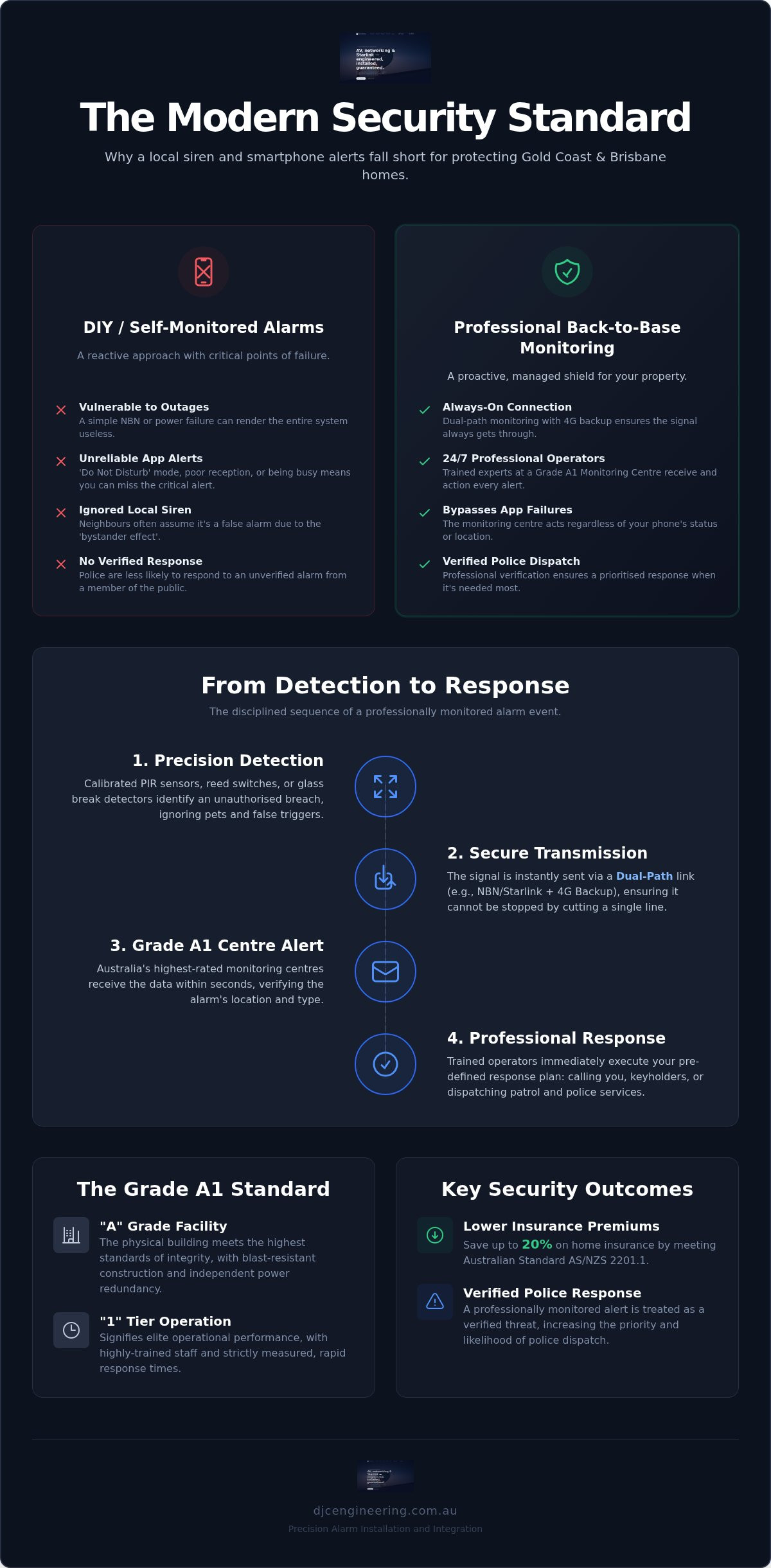
The quality of your monitoring is governed by Australian Standard AS 2201.2. When we talk about Grade A1, we're referring to the highest possible tier of security facility. The 'A' refers to the physical building's integrity, including blast-resistant walls and independent power redundancy. The '1' signifies the operational performance, meaning staff are highly trained and response times are strictly measured. Choosing a system backed by an A1 centre means your security never goes offline, providing a level of reliability that a smartphone app simply cannot match. It's the difference between a best-effort notification and a guaranteed professional response.
Why a Siren Alone Isn't Enough in 2026
Suburban Brisbane has changed. The 'bystander effect' is a real phenomenon where neighbours often ignore a ringing alarm, assuming it's a false trigger or someone else's problem. Professional thieves are well aware of this. They often exploit unmonitored systems by waiting out the siren or physically disabling the external strobe before proceeding with the theft. They know that in most cases, no one is coming to check.
A siren is a 20th-century solution to a 21st-century problem. Professional home alarm installation Brisbane must account for the fact that intruders are more sophisticated now. They use signal jammers and look for shortcuts in cabling to bypass basic setups. Without human verification from a monitoring centre, your alarm is just background noise. A back-to-base setup ensures that as soon as a PIR sensor or reed switch is tripped, a professional is already coordinating the response, whether that's contacting you or dispatching a patrol to the site immediately.
How 24/7 Monitoring Works: From Detection to Response
Professional security is a disciplined sequence of technical events. It begins with precision detection, where PIR (Passive Infrared) sensors, magnetic reed switches, and acoustic glass break detectors act as the nervous system of your property. Unlike generic DIY kits, a professional home alarm installation Brisbane ensures these sensors are calibrated to ignore pets while capturing even the slightest unauthorised movement. Once a breach is detected, the control panel processes the data and transmits a signal through secure GPRS, 4G, or IP networks to the monitoring centre software.
Dual-Path Monitoring is the industry gold standard for 2026, utilising two independent communication channels to ensure a signal always reaches the base even if one path is compromised. This redundancy is critical. Without it, a simple internet outage or a deliberate cut to a fibre line could leave your home vulnerable. This methodical flow ensures that within seconds of an event, an operator is reviewing your pre-set 'Response Plan' to determine the next course of action. It's this level of detail that separates a basic setup from a professional home alarm installation Brisbane.
Signal Transmission: NBN, Starlink, and 4G Backup
The transition to the NBN and Starlink has changed the landscape of alarm communication. Old-school copper phone lines are obsolete, and modern systems must rely on digital connectivity. However, relying solely on a home router is a mistake. Power outages or network congestion can delay or block alarm signals. We prioritise GPRS or 4G wireless backups that operate independently of your home internet. For residents in rural South East Queensland using Starlink, we integrate specialised networking hardware to maintain a stable, low-latency link to the monitoring centre. Just as Queensland's smoke alarm legislation mandates interconnected systems for fire safety, we apply the same rigorous standards to your security data paths. A technical assessment of your home's infrastructure is the first step toward a robust security design.
The Human Element: What Happens When an Alarm Triggers?
Technology provides the signal, but the human response provides the protection. When an alarm triggers, operators follow strict verification protocols. This usually involves calling the premises to confirm if the trigger was accidental. If there is no answer or a 'Duress Code' is entered, the response plan escalates. This may involve notifying your list of keyholders or dispatching a private security patrol to the site. Under the Police Powers and Responsibilities Regulation 2026, the Queensland Police Service generally requires verification of an actual crime in progress before attending. A professional monitoring centre bridges this gap, providing the evidence and verification needed to prompt a swift response from authorities or private patrols.
Professional Monitoring vs. Self-Monitoring: Why App Alerts Aren’t Enough
The appeal of zero monthly fees makes DIY self-monitoring an attractive prospect for many. However, this model shifts 100% of the responsibility onto the property owner. In a self-monitored setup, you are the dispatcher, the investigator, and the first responder. If an alert hits your phone at 3:00 AM while you are in a deep sleep or in a mobile dead zone, the system has effectively failed. A professional home alarm installation Brisbane is designed to remove this single point of failure by handing the burden of vigilance to a dedicated, 24/7 team.
Relying on app alerts also introduces significant personal liability. Attempting to manage a high-stress security event yourself is inherently dangerous. There is a documented risk of homeowners, spurred by a camera notification, rushing home to confront intruders, which can lead to physical harm or complex legal situations. Beyond the physical risk, insurance companies in Queensland often mandate professional monitoring for high-value properties. Without a certificate of monitoring from a licensed provider, you may find your claim for theft or damage significantly reduced or even denied because the system didn't meet professional response standards.
The 'Dead Phone' Scenario: A Critical Security Gap
Mobile notifications are 'best-effort' transmissions. They rely on your phone being charged, turned on, and connected to a stable network. The likelihood of missing a critical notification during the night is high, especially with 'Do Not Disturb' settings that silence non-priority alerts. A professional monitoring centre operates as a redundant fail-safe. While a push notification is a simple data packet that can be delayed by server traffic, a Grade A1 signal is a supervised link. If the centre doesn't receive a regular 'heartbeat' from your panel, they know immediately, whereas a self-monitored user might not realise their system is offline until it's too late.
Response Times: Professional Patrols vs. DIY Action
Speed is the most critical factor in minimising property loss. When a monitored alarm triggers in Brisbane, the response follows a disciplined, pre-set protocol. Professional patrols across South East Queensland are strategically positioned to provide rapid on-site verification. These officers are trained to handle confrontations and secure the premises until the police arrive. For those with assets across the region, understanding the standards for Professional Alarm Systems Gold Coast is equally vital for maintaining a unified security profile. A professional home alarm installation Brisbane ensures that your response plan is executed by experts, keeping you out of harm's way while ensuring the highest probability of an arrest or deterrence.
Brisbane Security Standards: Insurance Requirements and Police Response
Insurance premiums are a significant factor in the total cost of home ownership in Queensland. Most major insurers offer discounts ranging from 5% to 20% for properties with a professional home alarm installation Brisbane, provided the system is back-to-base monitored. This reduction isn't just a courtesy; it reflects the statistically lower risk of successful theft when a managed response is in place. However, these benefits often come with strict fine print. Insurers frequently require proof that the system was armed at the time of an incident and that it has been maintained according to Australian Standard AS/NZS 2201.1:2007.
Brisbane's specific environmental conditions also dictate the hardware required for a reliable setup. Our subtropical humidity can wreak havoc on low-grade sensors, leading to moisture ingress and frequent false triggers. A professional installation involves selecting high-performance sensors with sealed optics and temperature compensation. This meticulous hardware selection prevents 'False Alarm' penalties, which can be costly if private patrols or emergency services are dispatched to a non-event. Precision calibration ensures the system remains a silent guardian rather than a neighbourhood nuisance.
Meeting Your Insurance Obligations
High-value home insurance policies often include a 'Security Clause' that mandates more than just a working lock. These policies typically require that your alarm system is installed and commissioned by a licensed security provider. They also often stipulate annual maintenance checks to verify the system's integrity, including battery health and signal strength. Failing to keep these records can result in a denied claim following a break-in. For a deeper look at aligning your hardware with these standards, check our 2026 Buyer’s Guide to Integrated Protection.
Police Response Protocols in South East Queensland
The Queensland Police Service (QPS) operates under a strict non-response policy for unverified alarms. Under the Police Powers and Responsibilities Regulation 2026, an alarm event is considered 'unverified' if it only involves a single sensor trigger without secondary confirmation. To secure a priority response, the monitoring centre must typically confirm a 'verified' event, such as multiple zone activations or visual confirmation via CCTV. This is where the Brisbane-Gold Coast corridor's network of private security patrols becomes essential. These patrols provide the initial on-site verification required by QPS to escalate the matter, ensuring that a genuine threat receives the authority response it deserves. To ensure your property meets these rigorous verification standards, you should book a technical security assessment today.
The DJC Engineering Approach: Precision Alarm Installation and Integration
Engineering isn't just part of our name; it's the methodology we apply to every project. While generic providers might focus on screwing a box to the wall and moving to the next job, our process centres on the technical infrastructure that makes a system truly resilient. A professional home alarm installation Brisbane requires a deep understanding of structural cabling and signal integrity. At DJC Engineering Pty Ltd, we treat your security system as a critical network component, ensuring that every sensor, keypad, and communication module is integrated into a robust, high-performance architecture.
Precision placement is the difference between a reliable shield and a system plagued by false triggers. We perform a comprehensive site assessment to identify potential blind spots and environmental interference. Our technicians use meticulous cabling techniques to ensure all wiring is concealed and protected from both the elements and tampering. This focus on the physical quality of the work ensures that your sensors are positioned for maximum detection range while remaining aesthetically discrete. Once the hardware is in place, we conduct a rigorous commissioning process. This includes calibrating the system for the specific humidity and temperature fluctuations of the Brisbane climate, ensuring your PIR sensors don't misinterpret heat signatures during a typical Queensland summer.
Licensed and Accredited Technical Expertise
Security is a regulated industry for a reason. Working with a licensed security provider ensures that your installation meets the strict requirements of Australian Standard AS/NZS 2201.1. The DJC Engineering Pty Ltd team brings a high level of accountability to every site, prioritising clean, professional finishes that reflect the quality of the engineering underneath. We don't leave exposed wires or messy penetrations; we deliver a setup that is as neat as it is secure. This disciplined approach to installation is also why DJC Engineering Pty Ltd is often called upon for complex Security Camera Installation Gold Coast projects, where networking and security must work in perfect harmony.
Future-Proofing Your Home Security
A modern security stack should be scalable. DJC Engineering Pty Ltd designs our systems to grow with your property, ensuring the core control panel can support additional zones, CCTV integration, or access control modules in the future. By leveraging your existing NBN, Starlink, or high-speed WiFi network, we create a unified security environment that is easy to manage but difficult to compromise. We don't just install hardware; we build a long-term security partnership based on technical excellence and local reliability. If you're ready to move beyond basic sirens and invest in a managed, engineered solution, enquire about professional home alarm installation Brisbane to secure your technical assessment.
Secure Your Property with Engineered Precision
A truly reliable security system is defined by its weakest link. Moving beyond the limitations of local sirens and unreliable app notifications requires a shift toward managed, back-to-base protection. By prioritising a professional home alarm installation Brisbane, you ensure your property is backed by a Grade A1 monitoring centre and redundant communication paths that won't fail when the NBN or power goes down. This isn't just about hardware; it's about a disciplined communication link that remains active 24/7.
DJC Engineering brings a meticulous, technical approach to every site. Our licensed security technicians are specialists in NBN and Starlink integration, ensuring your security shield is robust, calibrated, and future-proof. We have been serving the Brisbane and Gold Coast regions since 2026, delivering high-performance results without shortcuts or compromised cabling. Don't leave your family's safety to a DIY kit or a generic provider who prioritises speed over precision. You deserve a system that meets rigorous Australian Standards and provides genuine accountability.
Secure your property with an engineered alarm solution from DJC Engineering. Take the first step toward a comprehensive security setup that offers lasting peace of mind and professional protection for your Brisbane home.
Frequently Asked Questions
Is back-to-base monitoring worth it if I already have security cameras?
Yes, because cameras are primarily reactive tools while monitoring is a proactive response system. Cameras allow you to review footage after an event, but a monitored alarm ensures that a professional operator is alerted the moment a breach occurs. If you are asleep or in a mobile dead zone, your cameras cannot call for help, but a back-to-base system provides that essential human intervention and verification.
Does a back-to-base alarm work if the NBN goes down?
A professionally configured system will continue to operate through a wireless backup even if the NBN fails. During a professional home alarm installation Brisbane, we typically include a 4G or GPRS secondary communication path. This redundancy ensures that your security link remains active during network outages or if an intruder deliberately cuts your external internet cabling.
Will the police automatically come if my alarm goes off?
The Queensland Police Service generally does not attend unverified home alarms. Under current South East Queensland protocols, an alarm event must be verified by a monitoring centre through multiple sensor triggers or visual confirmation before it is escalated. This is why back-to-base monitoring is critical; it provides the professional verification required to prompt a police response or dispatch a private security patrol.
Can I monitor my back-to-base system through a smartphone app?
Most modern professional systems offer a dual approach where you receive app notifications while the monitoring centre handles the high-priority response. You can arm, disarm, and view system logs from your phone, but the monitoring centre acts as the fail-safe. If you miss a push notification because your phone is on 'Do Not Disturb', the professional operators follow your pre-set response plan regardless.
How much does professional alarm monitoring cost in Brisbane?
Industry data for 2026 shows that 24/7 back-to-base monitoring fees in Brisbane typically range from A$30 to A$60 per month. These costs vary based on the technology used, such as whether the system relies on a single IP path or more secure dual-path GPRS/4G monitoring. While there is a monthly commitment, this professional oversight is what qualifies homeowners for insurance premium discounts of up to 20%.
Do I need a special phone line for a monitored alarm system?
No, old-fashioned copper phone lines are no longer required for modern security systems. Current installations use your existing NBN or Starlink connection combined with an internal mobile data module. This digital transition is more reliable and faster than legacy systems, allowing for detailed data transmission between your home and the Grade A1 monitoring centre without the need for a dedicated landline.
How often should I have my home alarm system serviced?
You should have your system professionally serviced once every 12 months. Annual maintenance is often a mandatory requirement for high-value home insurance policies to keep your coverage valid. Regular checks ensure that backup batteries are healthy, sensors are clean and free from Brisbane humidity ingress, and the communication paths are functioning at peak performance according to Australian Standards.
Will my pets trigger a back-to-base alarm system?
Pets will not trigger your alarm if the system is designed with pet-immune PIR sensors. These specialised sensors are calibrated to ignore moving objects under a certain weight or height profile, usually up to 20kg or 40kg. A professional home alarm installation Brisbane involves mapping your home's layout to ensure sensors are positioned where pets cannot climb too close to the lens and cause a false trigger.
Frequently Asked Questions
Technology provides the signal, but the human response provides the protection. When an alarm triggers, operators follow strict verification protocols. This usually involves calling the premises to confirm if the trigger was accidental. If there is no answer or a 'Duress Code' is entered, the response plan escalates. This may involve notifying your list of keyholders or dispatching a private security patrol to the site. Under the Police Powers and Responsibilities Regulation 2026, the Queensland Police Service generally requires verification of an actual crime in progress before attending. A professional monitoring centre bridges this gap, providing the evidence and verification needed to prompt a swift response from authorities or private patrols. The appeal of zero monthly fees makes DIY self-monitoring an attractive prospect for many. However, this model shifts 100% of the responsibility onto the property owner. In a self-monitored setup, you are the dispatcher, the investigator, and the first responder. If an alert hits your phone at 3:00 AM while you are in a deep sleep or in a mobile dead zone, the system has effectively failed. A professional home alarm installation Brisbane is designed to remove this single point of failure by handing the burden of vigilance to a dedicated, 24/7 team. Relying on app alerts also introduces significant personal liability. Attempting to manage a high-stress security event yourself is inherently dangerous. There is a documented risk of homeowners, spurred by a camera notification, rushing home to confront intruders, which can lead to physical harm or complex legal situations. Beyond the physical risk, insurance companies in Queensland often mandate professional monitoring for high-value properties. Without a certificate of monitoring from a licensed provider, you may find your claim for theft or damage significantly reduced or even denied because the system didn't meet professional response standards.
Yes, because cameras are primarily reactive tools while monitoring is a proactive response system. Cameras allow you to review footage after an event, but a monitored alarm ensures that a professional operator is alerted the moment a breach occurs. If you are asleep or in a mobile dead zone, your cameras cannot call for help, but a back-to-base system provides that essential human intervention and verification.
A professionally configured system will continue to operate through a wireless backup even if the NBN fails. During a professional home alarm installation Brisbane, we typically include a 4G or GPRS secondary communication path. This redundancy ensures that your security link remains active during network outages or if an intruder deliberately cuts your external internet cabling.
The Queensland Police Service generally does not attend unverified home alarms. Under current South East Queensland protocols, an alarm event must be verified by a monitoring centre through multiple sensor triggers or visual confirmation before it is escalated. This is why back-to-base monitoring is critical; it provides the professional verification required to prompt a police response or dispatch a private security patrol.
Most modern professional systems offer a dual approach where you receive app notifications while the monitoring centre handles the high-priority response. You can arm, disarm, and view system logs from your phone, but the monitoring centre acts as the fail-safe. If you miss a push notification because your phone is on 'Do Not Disturb', the professional operators follow your pre-set response plan regardless.
Industry data for 2026 shows that 24/7 back-to-base monitoring fees in Brisbane typically range from A$30 to A$60 per month. These costs vary based on the technology used, such as whether the system relies on a single IP path or more secure dual-path GPRS/4G monitoring. While there is a monthly commitment, this professional oversight is what qualifies homeowners for insurance premium discounts of up to 20%.
No, old-fashioned copper phone lines are no longer required for modern security systems. Current installations use your existing NBN or Starlink connection combined with an internal mobile data module. This digital transition is more reliable and faster than legacy systems, allowing for detailed data transmission between your home and the Grade A1 monitoring centre without the need for a dedicated landline.
You should have your system professionally serviced once every 12 months. Annual maintenance is often a mandatory requirement for high-value home insurance policies to keep your coverage valid. Regular checks ensure that backup batteries are healthy, sensors are clean and free from Brisbane humidity ingress, and the communication paths are functioning at peak performance according to Australian Standards.
Pets will not trigger your alarm if the system is designed with pet-immune PIR sensors. These specialised sensors are calibrated to ignore moving objects under a certain weight or height profile, usually up to 20kg or 40kg. A professional home alarm installation Brisbane involves mapping your home's layout to ensure sensors are positioned where pets cannot climb too close to the lens and cause a false trigger.