
AV Installation: The Complete Guide to Integrated Audio-Visual Systems in 2026
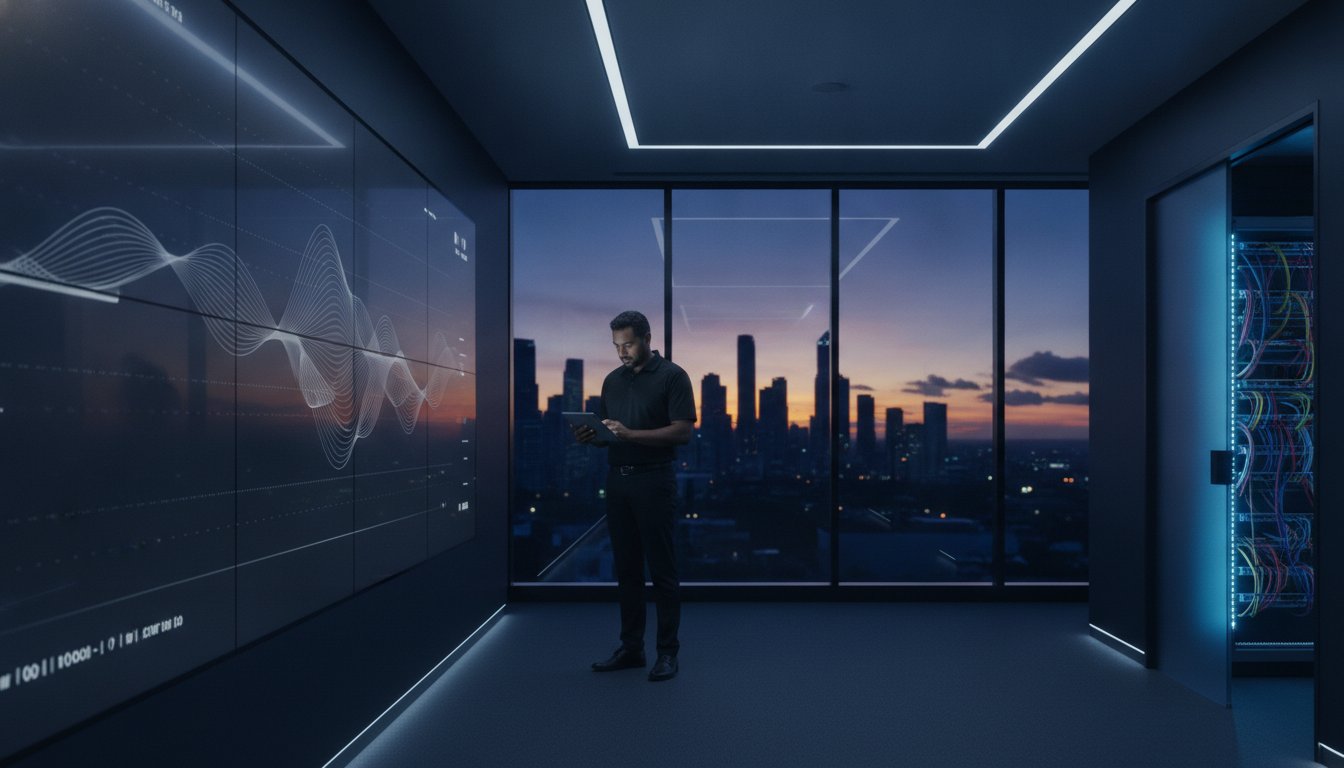
Why do so many premium home cinemas and boardroom setups fail to live up to the hype? It isn't usually the hardware at fault, but rather a lack of rigorous engineering beneath the surface. You've likely experienced the frustration of "smart" systems that refuse to communicate or messy bundles of cables that ruin a clean architectural aesthetic. In the intense Queensland heat, poor ventilation and subpar WiFi can quickly turn a sophisticated investment into a source of constant technical friction. Professional av installation is about more than just mounting a display; it is a disciplined process of integrating hardware, networking, and structured cabling to ensure long-term reliability.
You deserve a system that works every time you press a button, providing a seamless experience without a single visible wire. This guide explores how meticulous technical planning transforms spaces through high-performance audio and video integration. We will detail the essential infrastructure required for a future-proofed setup, covering everything from the latest AS/NZS 62368.1:2026 safety standards to the critical role of custom WiFi design in modern connectivity.
Key Takeaways
- Professional av installation is a systematic engineering process that moves beyond "plug-and-play" to ensure all hardware is perfectly calibrated and integrated.
- Differentiate between consumer-grade and commercial-grade systems to choose hardware that meets your specific usage requirements and durability needs.
- Discover how structured cabling using Cat6 or Fibre creates a robust technical backbone, eliminating signal lag and hiding unsightly wires for an "invisible" finish.
- Identify the specific licences and local Gold Coast expertise needed to guarantee a high-performance result that withstands the unique Queensland environment.
What is Professional AV Installation?
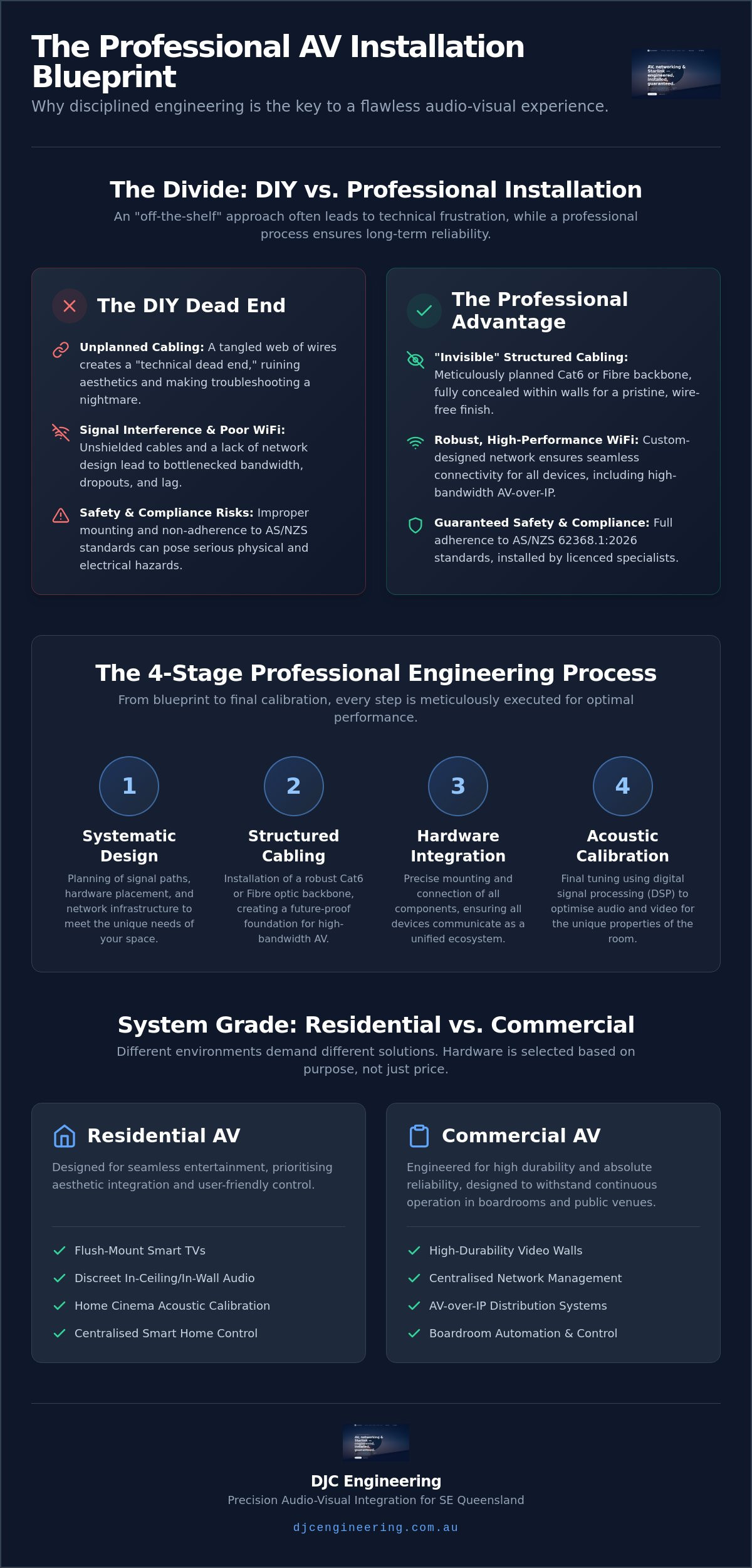
Professional av installation is far more than a simple hardware purchase. It is the systematic design, placement, and rigorous calibration of Audiovisual (AV) components to create a unified, high-performance ecosystem. While many retailers sell "plug-and-play" devices, these standalone units rarely function as a cohesive system without professional intervention. A specialist focuses on the technical infrastructure that remains hidden behind the walls. This includes meticulous signal path planning and robust structured cabling that ensures high-fidelity performance without the clutter of visible wires. We don't just hang screens; we engineer the environment.
The role of an AV specialist in 2026 has evolved. It's no longer just about mounting a display. It involves acting as a systems architect who ensures your media room, boardroom, or whole-home audio setup functions with absolute precision. We treat every project as a unique engineering challenge, prioritising the mechanical integrity of the build and the longevity of the hardware over quick, temporary fixes.
The Shift from Standalone Hardware to Integrated Systems
Modern entertainment and communication systems no longer rely on isolated components. Success in a smart property depends entirely on a high-performance WiFi Design & Installation foundation. As the industry moves toward AV-over-IP (AVoIP), traditional analogue cables are being replaced by high-speed digital networking. This shift allows for centralised control, where multiple zones and devices are managed through a single, intuitive interface. Without this integrated approach, you're left with a collection of gadgets that don't talk to each other.
Why DIY AV Installations Often Fail
The "do-it-yourself" approach often leads to a technical dead end. We frequently see systems plagued by bottlenecked bandwidth and signal interference because the cabling wasn't shielded or routed correctly. A common DIY nightmare involves troubleshooting a tangled web of unlabelled cables that were pulled through wall cavities without a logical plan. It's a mess that usually costs more to fix than it would have to install correctly the first time.
Beyond performance issues, there are significant safety and regulatory concerns. In Queensland, the installation and maintenance of visual recording or security-linked systems require a specific security equipment installer licence. Improper mounting of heavy displays or failing to comply with the hazard-based safety standards of AS/NZS 62368.1:2026 can lead to physical hazards or electrical interference. A professional av installation guarantees that your system is not only high-performing but also fully compliant and structurally sound.
Essential Audio-Visual Systems for Modern Properties
A premium av installation should be felt and heard, not necessarily seen. In 2026, the benchmark for a successful project is defined by how well the technology disappears into the architecture while providing a high-fidelity experience. By adhering to global AVIXA standards, we ensure that every system, whether it is a dedicated home cinema or a commercial video wall, delivers consistent and predictable results. This requires a shift away from thinking about hardware as isolated gadgets and instead viewing them as nodes within a larger, integrated technical ecosystem.
Modern properties demand a unified approach where audio, video, and networking operate as one. When these systems are designed with precision, they provide a level of reliability that "off-the-shelf" solutions simply cannot match. If you are planning a new build or a major refurbishment, early integration of audio visual installations into your property's design phase is essential for a clean, professional finish.
Residential AV: Entertainment Without the Clutter
In residential settings, the goal is often to maximise performance while minimising the visual footprint of the hardware. Homeowners are increasingly moving away from bulky floor-standing equipment in favour of sleek, integrated solutions that complement their interior design.
- Flush-Mount Smart TVs: We utilise specialised brackets and recessed wall boxes to ensure screens sit perfectly flush against the wall, with all cabling internalised to eliminate visible wires.
- Discreet Multi-Room Audio: High-quality in-ceiling and in-wall speakers provide immersive sound throughout the home without taking up valuable floor space.
- Acoustic Calibration: Every room has unique sound properties. We use digital signal processing to calibrate surround sound systems, ensuring optimal audio performance regardless of room dimensions or furniture placement.
- Hardened Outdoor Systems: Alfresco entertainment areas on the Gold Coast require hardware specifically rated for high humidity and salt air to prevent premature equipment failure.
Commercial AV: Productivity Through Connectivity
Commercial av installation focuses on robustness and ease of use. These systems must be reliable enough for 24/7 operation and intuitive enough for any staff member to use without technical assistance. High-performance connectivity is the backbone of the modern hybrid workplace.
- Integrated Boardrooms: We combine large-format 4K displays with beam-forming microphones and intelligent cameras to support seamless video conferencing for hybrid teams.
- Digital Signage: From retail shopfronts to hospitality menus, high-brightness commercial panels provide dynamic communication that is far more effective than traditional static displays.
- Background Music (BGM) & Paging: We design distributed audio systems for cafes, gyms, and medical centres that provide clear audio coverage without creating "hot spots" of excessive volume.
- Industrial PA Systems: For warehouses and manufacturing sites, we install high-output paging solutions that ensure clear communication across large, noisy environments.
Commercial vs. Residential AV: Key Differences
Choosing between commercial and residential systems isn't just about the price tag or the screen size. It's an engineering decision based on duty cycles and environmental stressors. A professional av installation in a retail space requires hardware capable of 24/7 operation, whereas a home media room prioritises peak performance during intermittent use. Understanding these distinctions prevents the premature failure of expensive equipment. While both environments benefit from the same high AVIXA industry standards, the practical application of the hardware differs significantly in scale and complexity.
Commercial setups often serve as a hub for broader business operations. This includes integrating audio and video feeds with existing security protocols or CCTV monitoring. Residential systems, however, are designed for ease of use and aesthetic harmony within a living space. The difference lies in the "heavy-lifting" capabilities of the hardware and the specific maintenance requirements needed to ensure long-term reliability.
Understanding Commercial Hardware Standards
In a business setting, using consumer-grade televisions is a common mistake that leads to rapid hardware degradation. "Cheap" TVs found in retail stores aren't designed for the heat generated by constant use; they lack the robust cooling fans and industrial-grade power supplies found in commercial panels. Commercial displays also offer higher brightness levels, often exceeding 700 nits, to remain visible under harsh office lighting or in shopfront windows. Because downtime equals lost revenue, these installations rely on high-grade structured cabling to guarantee 99.9% uptime. Furthermore, commercial warranties often cover on-site service and longer duty cycles, which are voided if a residential screen is used in a business capacity.
Residential Aesthetics and User Experience
For high-end Gold Coast homes, the priority shifts toward "invisible" technology. The goal of a residential av installation is to provide a premium cinematic experience without the hardware dominating the room. This involves recessed motorised screens, in-ceiling speakers, and specialised wall-mounts that allow displays to sit perfectly flush. The user interface must be simplified so that every family member, from children to guests, can operate the system without a manual. We focus on integrating the AV system with smart lighting and climate control, allowing a single command to dim the lights, close the blinds, and start the film. It's about creating a refined environment where the technical complexity is hidden behind a clean, intuitive finish.
The Technical Engineering Behind a Clean Install
A professional av installation is defined by the work you cannot see. While most focus on the quality of the display, we prioritise the mechanical and technical infrastructure that supports it. Our "No Shortcuts" philosophy means every cable run, every bracket, and every termination is executed with surgical precision. This meticulous approach ensures that the system remains stable for years, avoiding the frequent dropouts and hardware failures that plague generic setups. Longevity is never an accident; it is the result of rigorous engineering standards from the initial pull-through to the final verification.
The "invisible" elements of a system determine its true value. By utilising specialised racks and dedicated wall cavities, we conceal bulky components and power supplies, leaving only the sleek interface and high-performance screens visible. This creates a tidy, professional finish that enhances the architectural value of your property while protecting the sensitive hardware from dust and physical damage.
The Importance of Structured Cabling
Your AV system is only as good as the copper or glass running behind your walls. We utilise high-grade Cat6 or Fibre optic cabling to prevent signal lag and data bottlenecks. This isn't just about current performance; it's about future-proofing your property for 8K resolutions and beyond. By implementing a disciplined structured cabling plan, we eliminate the "cable spaghetti" often found in DIY or low-cost installs. Every line is meticulously labelled and routed to a central rack, making future upgrades or troubleshooting a straightforward process rather than a guessing game.
Precision Mounting and Hardware Placement
Achieving a clean finish requires more than just a level and a drill. We calculate precise viewing angles and speaker dispersion patterns to ensure maximum impact in every seat. Mounting heavy, large-format displays requires a deep understanding of structural integrity, particularly when dealing with different wall types found in SE Queensland homes and offices. Whether it's reinforced timber framing or masonry, we ensure the mount is secure and the finish is perfectly flush.
Thermal management is another critical, often overlooked factor. In the intense Queensland heat, hardware tucked away in enclosed cabinets can quickly overheat and fail. We design our installations with active or passive ventilation systems to protect your investment. The final stage is calibration, where we tune audio and video levels to suit the specific acoustics and lighting conditions of your room. This ensures the hardware performs exactly as the manufacturer intended. For a system engineered for performance and longevity, contact the specialists at DJC Engineering Pty Ltd to discuss your project.
Selecting an Accredited AV Specialist in SE Queensland
Choosing a provider for your av installation is a decision that impacts the long-term value and functionality of your property. It is not merely a matter of finding someone who can mount a screen; it is about partnering with a technician who understands the intricate relationship between hardware, structured cabling, and network stability. In South East Queensland, where building styles vary from modern high-rises to sprawling coastal estates, local expertise is non-negotiable. You need a specialist who prioritises technical precision over speed, ensuring every component is calibrated to perform in our specific environment.
A true professional provides more than just a working system on day one. They offer a comprehensive handover that includes "as-built" documentation and verified cable test results. This accountability ensures that if you ever need to expand or troubleshoot the system, the technical roadmap is already in place. Post-installation support is equally critical, as it keeps your firmware updated and your audio-visual levels perfectly tuned as the system settles into its environment.
Verifying Technical Credentials
The gap between a generic "handyman" and a licensed technical installer is significant. In Queensland, specific tasks, particularly those involving security-linked visual systems, require a security equipment installer licence. Always verify that your chosen specialist holds the necessary accreditation and comprehensive insurance to work on your property. Beyond basic legal requirements, look for a proven portfolio of complex technical work. A specialist who understands both AV and WiFi Design & Installation will be able to create a far more robust system than someone who only focuses on the hardware. This dual expertise prevents the common issue of high-end displays being bottlenecked by a weak home network.
Local SE QLD Considerations
The Queensland climate presents unique challenges for sensitive electronics. Coastal properties on the Gold Coast are subject to high humidity and salt air, which can lead to rapid corrosion of unshielded connectors and internal components. We select hardware and cabling specifically rated for these conditions to ensure longevity. Additionally, our team works strictly within local QLD building regulations and structured cabling standards, ensuring every av installation is structurally sound and electrically compliant. The final step in securing a high-performance system is requesting a professional technical assessment. This allows us to evaluate your specific site conditions and design a solution that meets your exact requirements without taking shortcuts.
Engineer a Seamless Digital Environment
A high-performance audio-visual system is only as reliable as the infrastructure supporting it. By prioritising structured cabling and precise calibration over quick hardware fixes, you ensure your technology remains a long-term asset rather than a source of technical frustration. Whether you're upgrading a commercial boardroom or designing a bespoke home cinema, the difference lies in a "no shortcuts" approach to engineering that respects the architectural integrity of your space.
Successful av installation in 2026 requires a deep understanding of local SE Queensland conditions and rigorous safety standards to deliver a truly robust finish. Our licensed and accredited technicians specialise in the unique demands of Gold Coast infrastructure, bridging the gap between sophisticated hardware and high-speed networking. To ensure your property is equipped with the technical foundation it deserves, Book a Technical AV Assessment with DJC Engineering Pty Ltd. You don't have to settle for visible wires and unreliable signals when a precision-engineered solution is within reach.
Frequently Asked Questions
How much does a professional AV installation cost in Australia?
The total investment for a professional av installation varies based on the scale of the project and the technical complexity of the integration. Basic setups for single rooms involve different requirements than bespoke, multi-zone systems that require structural modifications and extensive structured cabling. Factors such as the grade of hardware, the distance of cable runs, and the level of automation required will determine the final project scope. We focus on providing a long-term engineering solution rather than a quick fix, ensuring the infrastructure supports your property for years to come.
Can I use my existing WiFi for a multi-room audio system?
You can use your current network, but standard home routers often lack the necessary throughput to manage high-fidelity audio across multiple zones simultaneously. Integrated audio systems require a stable, high-bandwidth connection to prevent synchronisation issues or audible dropouts. If your property has dead zones or high interference, we typically recommend a dedicated WiFi design. This ensures your audio-visual traffic is prioritised and doesn't compete with other household devices for bandwidth.
What is the difference between Cat6 and Cat6a for AV cabling?
Cat6a is the preferred standard for modern av installation because it supports 10Gbps data speeds over the full 100-metre cable length. While standard Cat6 can reach these speeds over shorter distances, it's more susceptible to crosstalk and signal degradation. For 4K and 8K video distribution, the superior shielding of Cat6a provides a much more robust technical backbone. It's a critical component of future-proofing your property as digital content bitrates continue to climb.
Do I need a special licence to install AV systems in Queensland?
Yes, specific types of technical work in Queensland require a security equipment installer licence. This is mandatory for any professional who installs, maintains, or services visual recording systems or equipment linked to property security. Using a licensed technician isn't just about compliance; it's a guarantee that the person working on your infrastructure has met rigorous state competency and background standards. We always recommend verifying these credentials before any work begins on your property.
How do I hide the cables for my wall-mounted TV?
The most effective way to achieve a clean finish is through the use of recessed wall boxes and internalised conduits. We route all power and data cabling through the wall cavity to a centralised hub or rack, ensuring no wires are visible from the front or sides of the display. This meticulous approach allows the screen to sit perfectly flush against the wall. It also protects the cables from environmental stressors and makes future hardware upgrades significantly easier to manage.
Can you integrate my security cameras with my AV system?
Integrating CCTV feeds with your visual system is a standard feature of a well-engineered smart home or office. We can configure your network so that live camera footage is accessible on any integrated display, from your main media room screen to dedicated wall-mounted tablets. This creates a unified interface for your property, allowing you to monitor security without needing to switch between different apps or standalone monitors. It's a seamless way to combine safety with everyday convenience.
What happens if my AV hardware needs an update or fails?
Most modern hardware relies on periodic firmware updates to maintain security and peak performance. If a component fails, our "no shortcuts" approach to documentation means we can quickly identify the fault within the system's technical roadmap. Because we utilise meticulously labelled racks and structured cabling, troubleshooting is a disciplined process rather than a guessing game. We focus on getting your system back to its calibrated state with minimal downtime.
Is it worth installing a projector or should I get a large LED screen?
The choice depends on the ambient light in your room and the scale of the image you want to achieve. Projectors remain the best option for a true cinematic experience, easily producing images over 100 inches in dedicated, light-controlled media rooms. However, large-format LED screens are often superior for multi-purpose living areas or bright offices because they offer better contrast and brightness in high ambient light. We assess your specific environment to determine which technology will deliver the best visual performance.
Frequently Asked Questions
The total investment for a professional av installation varies based on the scale of the project and the technical complexity of the integration. Basic setups for single rooms involve different requirements than bespoke, multi-zone systems that require structural modifications and extensive structured cabling. Factors such as the grade of hardware, the distance of cable runs, and the level of automation required will determine the final project scope. We focus on providing a long-term engineering solution rather than a quick fix, ensuring the infrastructure supports your property for years to come.
You can use your current network, but standard home routers often lack the necessary throughput to manage high-fidelity audio across multiple zones simultaneously. Integrated audio systems require a stable, high-bandwidth connection to prevent synchronisation issues or audible dropouts. If your property has dead zones or high interference, we typically recommend a dedicated WiFi design. This ensures your audio-visual traffic is prioritised and doesn't compete with other household devices for bandwidth.
Cat6a is the preferred standard for modern av installation because it supports 10Gbps data speeds over the full 100-metre cable length. While standard Cat6 can reach these speeds over shorter distances, it's more susceptible to crosstalk and signal degradation. For 4K and 8K video distribution, the superior shielding of Cat6a provides a much more robust technical backbone. It's a critical component of future-proofing your property as digital content bitrates continue to climb.
Yes, specific types of technical work in Queensland require a security equipment installer licence. This is mandatory for any professional who installs, maintains, or services visual recording systems or equipment linked to property security. Using a licensed technician isn't just about compliance; it's a guarantee that the person working on your infrastructure has met rigorous state competency and background standards. We always recommend verifying these credentials before any work begins on your property.
The most effective way to achieve a clean finish is through the use of recessed wall boxes and internalised conduits. We route all power and data cabling through the wall cavity to a centralised hub or rack, ensuring no wires are visible from the front or sides of the display. This meticulous approach allows the screen to sit perfectly flush against the wall. It also protects the cables from environmental stressors and makes future hardware upgrades significantly easier to manage.
Integrating CCTV feeds with your visual system is a standard feature of a well-engineered smart home or office. We can configure your network so that live camera footage is accessible on any integrated display, from your main media room screen to dedicated wall-mounted tablets. This creates a unified interface for your property, allowing you to monitor security without needing to switch between different apps or standalone monitors. It's a seamless way to combine safety with everyday convenience.
Most modern hardware relies on periodic firmware updates to maintain security and peak performance. If a component fails, our "no shortcuts" approach to documentation means we can quickly identify the fault within the system's technical roadmap. Because we utilise meticulously labelled racks and structured cabling, troubleshooting is a disciplined process rather than a guessing game. We focus on getting your system back to its calibrated state with minimal downtime.
The choice depends on the ambient light in your room and the scale of the image you want to achieve. Projectors remain the best option for a true cinematic experience, easily producing images over 100 inches in dedicated, light-controlled media rooms. However, large-format LED screens are often superior for multi-purpose living areas or bright offices because they offer better contrast and brightness in high ambient light. We assess your specific environment to determine which technology will deliver the best visual performance.